
Introduction
In today’s competitive and fast-moving retail ecosystem, speed, accuracy, and traceability are non-negotiable. From supermarket shelves to global warehouses, barcodes silently power seamless transactions and real-time inventory tracking. Among the most widely adopted barcode formats worldwide is the EAN-13 barcode, a standardized system that ensures every product can be uniquely identified across borders. This blog explores how EAN-13 barcodes work, why they matter, and how businesses can leverage them to improve operational efficiency and global reach.
What Is EAN and Why It Matters
EAN stands for European Article Number, a product identification system governed by GS1, the global authority on barcode and supply-chain standards. Although originally developed for European markets, the EAN system has evolved into a globally accepted standard used by manufacturers, retailers, logistics providers, and ecommerce platforms worldwide.
The primary objective of EAN barcodes is simple yet powerful: to enable fast, accurate, and standardized product identification across the entire supply chain.
The Evolution of Product Identification
Before barcodes, inventory management and billing relied heavily on manual processes, increasing the likelihood of errors and inefficiencies. EAN-13 barcodes transformed this landscape by enabling instant data retrieval at the point of sale. When scanned, an EAN-13 barcode instantly links to product details such as pricing, stock levels, and descriptions—speeding up checkout, improving inventory accuracy, and enhancing customer experience. For businesses, this translates into better demand forecasting, reduced shrinkage, and real-time stock visibility.
📞 Contact our barcode experts at +91 729705118 or +91 8949793519
EAN-13 Barcode Structure Explained
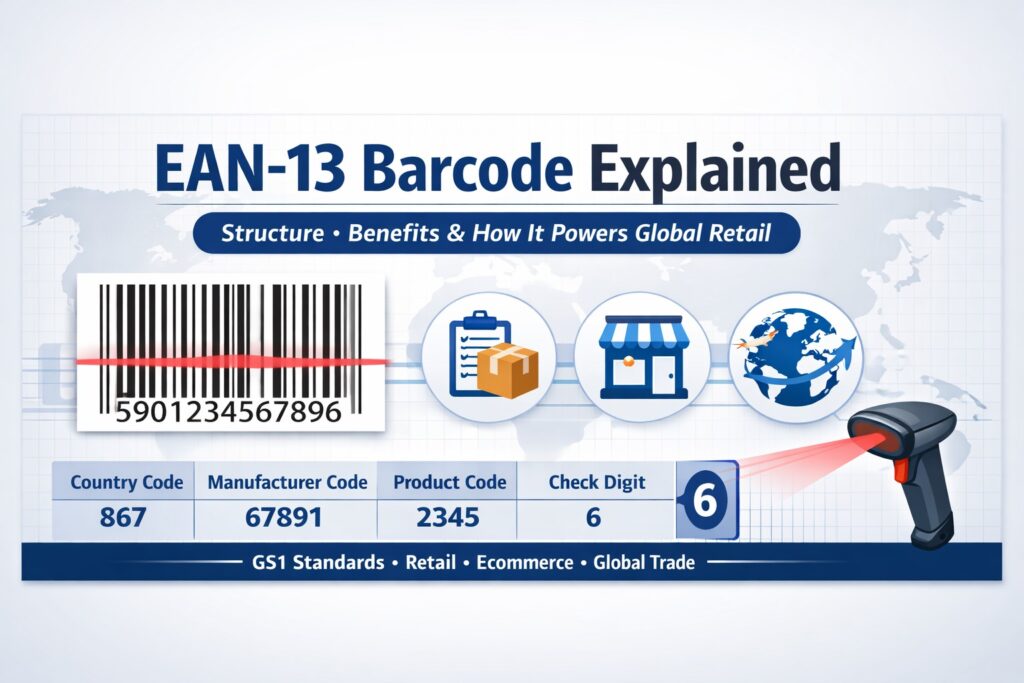
An EAN-13 barcode consists of 13 numerical digits, each serving a specific purpose. Together, they create a unique digital identity for a product.
| Component | Digits | Purpose |
| Country Prefix | 2–3 digits | Indicates the GS1 member organization where the company is registered |
| Manufacturer Code | 4–5 digits | Unique identifier assigned to the company by GS1 |
| Product Code | Variable | Identifies a specific product or SKU |
| Check Digit | 1 digit | Validates barcode accuracy |
Example
For the EAN code 8676789123456:
- 867 → GS1 prefix for India
- 67891 → Manufacturer identifier
- 2345 → Product identifier
- 6 → Check digit
This structured numbering ensures that every product can be uniquely identified anywhere in the world.
Why the Check Digit Is Critical
The final digit of an EAN-13 barcode is the check digit, a built-in error-detection mechanism that validates scanning accuracy.
How It Works (Simplified)
- Digits are weighted and summed using a predefined formula
- The total is rounded up to the nearest multiple of ten
- The difference becomes the check digit
This process allows scanners to instantly detect errors caused by printing defects or incorrect data entry, ensuring system reliability across retail environments.
Silent Zones: Small Detail, Big Impact
The blank spaces before and after an EAN-13 barcode, known as silent zones, are essential for accurate scanning. These zones signal scanners where the barcode begins and ends. GS1 standards require silent zones to be at least 2.31 mm wide, or ten times the width of the narrowest bar. Ignoring silent zone requirements can result in failed scans and operational delays, making compliance critical during label and packaging design.
📞 Contact our barcode experts at +91 729705118 or +91 8949793519
EAN-13 vs. UPC-A: Key Differences
| Feature | EAN-13 | UPC-A |
| Number of Digits | 13 | 12 |
| Market Coverage | Global | U.S. & Canada |
| Prefix System | Country-based | Manufacturer-based |
| Compatibility | Reads UPC-A | Limited EAN support |
EAN-13 is essentially a global extension of UPC-A, making it the preferred choice for businesses involved in international trade and cross-border ecommerce.
To know more about this, please check the below link.
How to Generate an EAN-13 Barcode
Creating a compliant EAN-13 barcode involves a few structured steps:
- Register with GS1: Obtain a unique company prefix that forms the foundation of your barcode.
- Assign Product Numbers: Allocate unique identifiers to each product or SKU.
- Calculate the Check Digit: Ensure barcode accuracy using the GS1-approved formula.
- Design and Print: Generate a scannable barcode, ensuring correct sizing, contrast, and silent zones.
📞 Contact our barcode experts at +91 729705118 or +91 8949793519
Conclusion: Why EAN-13 Barcodes Are Essential for Modern Business
EAN-13 barcodes are more than just lines on a package, they are the digital backbone of global commerce. By enabling accurate product identification, reducing errors, and supporting real-time inventory management, EAN-13 barcodes help businesses operate efficiently and scale confidently across markets. As ecommerce and globalization continue to grow, adopting GS1-compliant EAN-13 barcodes is no longer optional, it’s a strategic necessity. Businesses that understand and implement EAN-13 standards position themselves for smoother operations, higher customer trust, and long-term success in the global retail ecosystem.
📞 For expert guidance on barcode registration and implementation, contact us at +91 729705118 or +91 8949793519