
Introduction
Pharmaceutical products often travel across multiple countries and pass through numerous stakeholders before reaching the patient. While this globalized supply chain enables scale and accessibility, it also introduces significant risks. Even a single weak link can allow falsified or substandard medicines to enter circulation—posing serious threats to patient safety and eroding trust in pharmaceutical brands. For manufacturing-driven markets like India, which play a major role in global pharmaceutical exports, ensuring supply chain transparency is no longer optional. As regulatory scrutiny intensifies worldwide, pharmaceutical companies must adopt systems that provide complete visibility, accountability, and control across the product lifecycle. This is where track and trace solutions, built on GS1 standards, become indispensable.
Why Track and Trace Has Become Critical in Pharma
Counterfeit and falsified medicines remain a global public health challenge. The World Health Organization (WHO) defines counterfeit medicines as products that are deliberately mislabelled with respect to identity or source. These may contain incorrect dosages, harmful substances, or no active ingredients at all. The consequences are severe—ranging from treatment failure and drug resistance to serious injury and death. To address these risks, regulators across the globe have introduced stringent serialization and traceability requirements, compelling pharmaceutical companies to demonstrate full visibility of their supply chains.
An effective track and trace system helps companies to:
- Ensure Regulatory Compliance: Avoid penalties, shipment rejections, and market access restrictions
- Reduce Financial Losses: Minimize theft, diversion, recalls, and grey-market leakage
- Protect Brand Reputation: Reinforce trust among patients, healthcare providers, and regulators
Without robust traceability, pharmaceutical supply chains remain opaque and vulnerable, increasing both operational and compliance risks.
📞 Contact our barcode experts at +91 729705118 or +91 8949793519.
What Does Track and Trace Mean in the Pharmaceutical Industry?
In pharmaceutical supply chains, “track and trace” refers to the ability to monitor and verify a product’s movement throughout its lifecycle.
- Tracking involves capturing data at every critical point as a product moves from manufacturer to distributor, wholesaler, pharmacy, or hospital. This provides real-time visibility into where a product is and who handled it.
- Tracing allows stakeholders to look backward, identifying a product’s origin and movement history. This capability is vital during recalls, investigations, or regulatory audits.
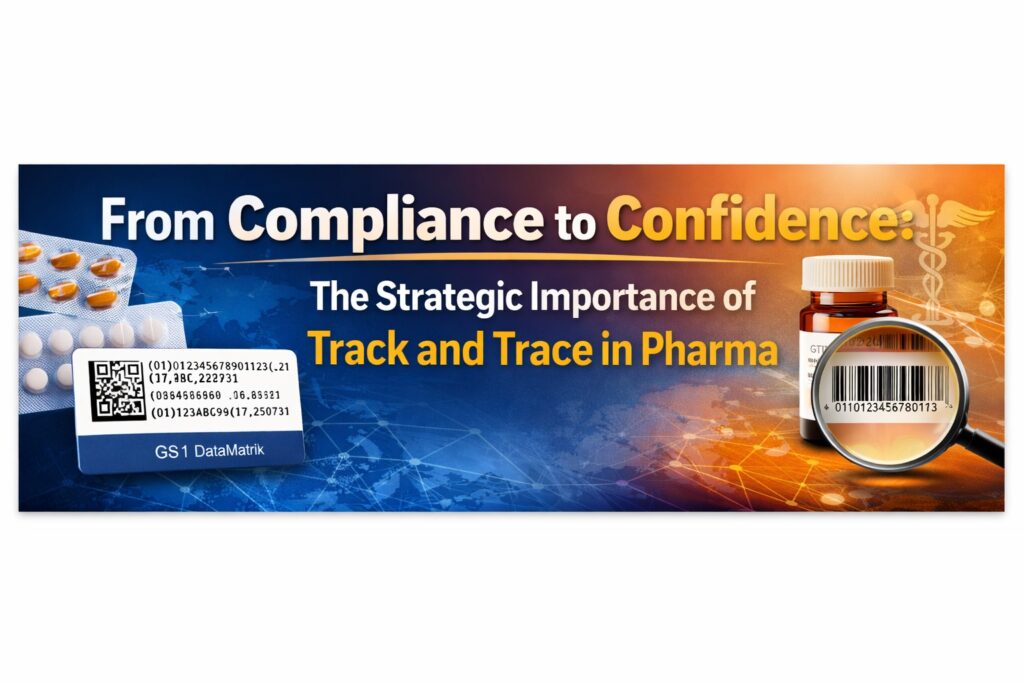
Both functions rely on unique and standardized identification, most commonly achieved through Global Trade Item Numbers (GTINs) encoded in 2D DataMatrix barcodes. Standardization ensures seamless data exchange between supply chain partners and supports compliance with global regulations.
📞 Contact our barcode experts at +91 729705118 or +91 8949793519.
How GS1 Standards Enable Pharmaceutical Traceability
GS1 standards form the foundation of global pharmaceutical traceability by providing a common language for product identification and data sharing. Key GS1 identifiers include:
- GTIN (Global Trade Item Number): Uniquely identifies pharmaceutical products
- SSCC (Serial Shipping Container Code): Identifies logistics units such as pallets and cases
- GLN (Global Location Number): Identifies physical locations and legal entities
Together, these identifiers ensure consistent and accurate identification from production to patient delivery. However, identification alone is not enough. GS1 standards also define how data is captured and shared across the supply chain.
To know more about this, please check the follow link.
How Track and Trace Works in Practice
1. Serialized Identification: Pharmaceutical products are serialized at various packaging levels—primary, secondary, and tertiary—using GTINs and SSCCs. Each saleable unit receives a unique serial number, enabling item-level traceability.
2. Data Capture Using GS1 DataMatrix: GS1 DataMatrix barcodes are widely used in healthcare due to their ability to store large amounts of information in a compact format. These barcodes typically encode:
- GTIN
- Serial number
- Batch or lot number
- Expiry date
This supports both regulatory compliance and operational efficiency.
3. EPCIS for Event Visibility: EPCIS (Electronic Product Code Information Services) captures and shares supply chain events, answering key questions such as:
- What happened?
- When did it happen?
- Where did it happen?
- Why did it happen?
By integrating EPCIS with serialized identifiers, organizations gain end-to-end visibility and actionable insights across the supply chain.
Benefits of GS1-Based Track and Trace Systems
Implementing GS1-enabled track and trace solutions delivers value well beyond compliance:
- Improved Patient Safety: Reduces the risk of counterfeit or expired medicines reaching patients
- Operational Efficiency: Streamlines processes, reduces manual errors, and lowers costs
- Faster Recalls: Enables precise, targeted recalls instead of broad market withdrawals
- Enhanced Trust: Demonstrates transparency and accountability to regulators and consumers
Conclusion
In the pharmaceutical industry, the margin for error is virtually nonexistent. As products move across complex global supply chains, ensuring their authenticity, quality, and safety is paramount. Track and trace systems powered by GS1 standards provide the visibility and control needed to meet regulatory demands, combat counterfeiting, and protect patients. Beyond compliance, these systems strengthen operational efficiency, reinforce brand credibility, and build long-term trust across the healthcare ecosystem. As regulations continue to evolve and supply chains become more interconnected, adopting robust track and trace solutions is no longer a choice—it is a necessity for sustainable pharmaceutical operations.
📞 Need help implementing GS1-based track and trace solutions?
Contact our barcode experts at +91 729705118 or +91 8949793519.