
Introduction
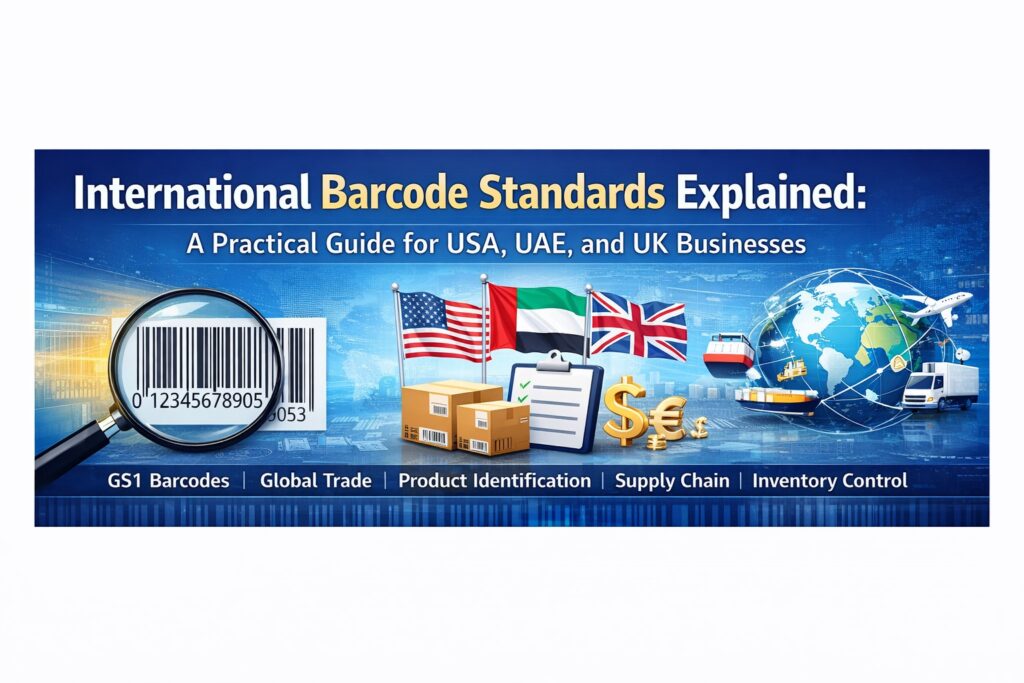
In today’s globalized economy, the ability to move products efficiently across borders is critical for business success. One of the most fundamental enablers of international trade is the use of standardized barcodes governed by Global Standards One (GS1). Retailers, logistics providers, and e-commerce platforms rely heavily on these standards to ensure accurate product identification and seamless data exchange. With the UPC-A system predominantly used in the USA and EAN-13 serving as the standard in the UK and UAE, understanding international barcode systems is vital for businesses aiming to operate across multiple markets. This guide examines how these barcode standards work, why they matter, and how businesses can implement them effectively.
Understanding International Barcode Standards
Barcodes consist of numerical identifiers encoded into machine-readable patterns that enable fast and accurate scanning across retail stores, warehouses, and logistics networks. They act as a universal language for products, allowing systems worldwide to recognize and process items instantly. In the United States, the 12-digit UPC-A barcode is most commonly used. In contrast, countries such as the UK and UAE rely primarily on the 13-digit EAN-13 barcode. Despite differences in length, both systems fall under the GS1 framework and are globally interoperable. Country prefixes embedded within these barcodes—such as 00–19 for the USA, 50 for the UK, and 629 for the UAE—help identify the GS1 member organization that issued the code. While these prefixes indicate registration origin, they do not necessarily represent manufacturing location.
📞 Contact our barcode experts: +91 729705118 | +91 8949793519
The Role of GS1 in Global Barcoding
GS1 is the international authority responsible for developing and managing barcode standards worldwide. By registering with a local GS1 organization—such as GS1 US, GS1 UK, or GS1 UAE—businesses receive a unique company prefix that forms the foundation of their product identification system. This global uniqueness ensures that each product can be accurately identified anywhere in the world, eliminating duplication and enabling universal acceptance across retail, logistics, and digital marketplaces.
How to Obtain International Barcodes
1. Register with Your Local GS1 Office: Businesses must apply for membership with the GS1 organization in their country of operation. Registration requirements may vary by region, but all GS1 offices follow the same global framework.
2. Receive Global Trade Item Numbers (GTINs): Once registered, GS1 assigns GTINs to your products. These numbers serve as the core identifiers used to generate UPC-A or EAN-13 barcodes.
3. Generate Barcode Symbols: Using approved software or online tools, businesses can convert GTINs into barcode images suitable for printing on product packaging, labels, or cartons. Proper sizing and contrast are essential for scanner readability.
Key Benefits of GS1 Barcodes for International Businesses
1. Seamless Global Operations: GS1 barcodes are universally recognized, allowing products to be scanned and processed across different countries without modification. This interoperability simplifies international trade and eliminates the need for region-specific codes.
2. Faster Market Entry and Marketplace Compliance: Major retailers and online platforms—such as Amazon, Walmart, and regional e-commerce marketplaces—require valid GTINs for product listings. GS1 compliance ensures quicker onboarding and smoother expansion into the USA, UAE, and UK markets.
3. Simplified Logistics and Export Processes: Standardized barcodes reduce friction in customs clearance, warehousing, and shipping, helping businesses avoid delays and improve supply chain efficiency.
To know more about this, please check the link below.
Operational Efficiency and Accuracy
Improved Inventory Control: Barcodes enable real-time inventory tracking across the supply chain, helping businesses maintain optimal stock levels and reduce carrying costs.
Reduced Errors Through Automation: Automated scanning minimizes errors associated with manual data entry, improving accuracy in pricing, stock records, and order fulfilment.
Increased Speed Across Operations: From point-of-sale checkouts to warehouse picking and dispatch, barcode scanning accelerates operations and lowers labor costs.
Building Brand Credibility and Consumer Trust
Unique Product Identification: Each product and variant is assigned a distinct GTIN, reducing the risk of duplication and counterfeiting while strengthening brand authenticity.
End-to-End Traceability: Barcodes support complete product traceability—from manufacturing to final sale—enabling efficient recalls, quality checks, and regulatory compliance.
Enhanced Consumer Experience: Consumers can scan barcodes using smartphones to access detailed product information, improving transparency and reinforcing brand confidence.
📞 Contact our barcode experts: +91 729705118 | +91 8949793519
Preparing for Barcode Registration
Core Business Documentation: Businesses are typically required to submit:
- Proof of business registration (Trade License, Certificate of Incorporation, etc.)
- Valid contact details and authorized signatory information
- Sales turnover or financial records to determine GS1 membership fees
Product Information Requirements: Detailed product data is essential, including:
- Product descriptions
- Categories and subcategories
- Variants such as size, color, or packaging
This information allows GS1 to accurately allocate GTINs across your product portfolio.
Conclusion
In a global marketplace driven by efficiency, accuracy, and transparency, international barcode standards are no longer optional—they are essential. GS1-managed barcode systems such as UPC-A and EAN-13 enable businesses to meet retail compliance requirements, streamline logistics, and build trust with consumers across borders. For companies operating in or expanding to the USA, UAE, and UK, adopting international barcode standards ensures operational consistency, faster market access, and long-term scalability. By investing in GS1-compliant barcodes, businesses position themselves for sustainable growth in today’s competitive global economy.
📞 Speak with our barcode experts: +91 729705118 | +91 8949793519