
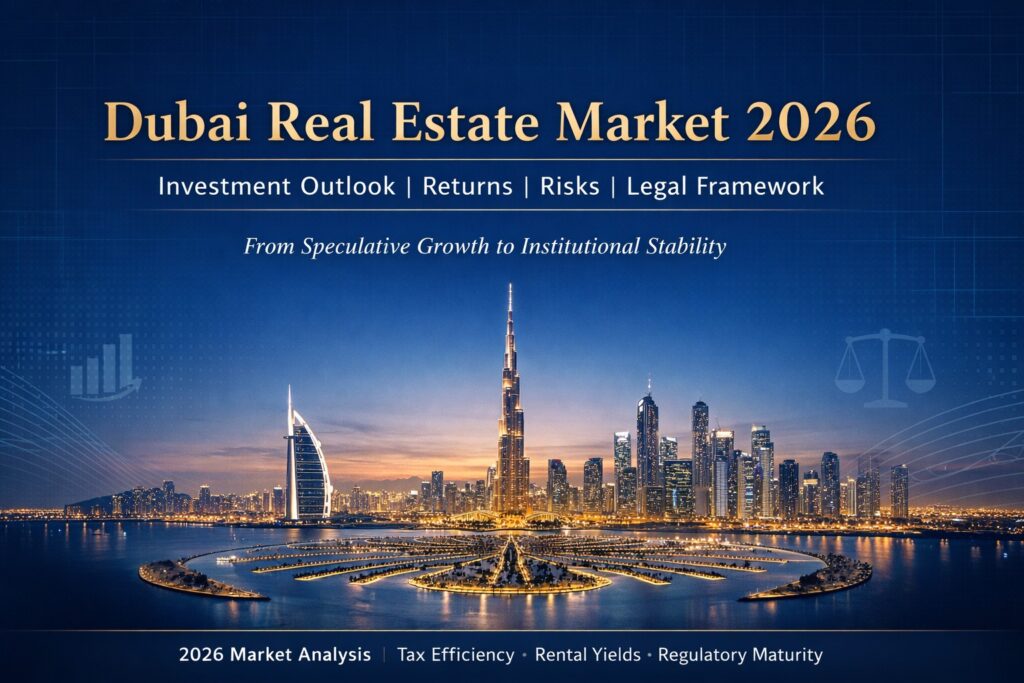
Introduction: Dubai’s Shift from Speculation to Stability
By 2026, Dubai’s real estate market has unmistakably entered a new chapter. Following a period of rapid post-pandemic expansion—often characterised by speculative inflows—the market is now recalibrating toward strategic maturity, regulatory depth, and long-term value creation. This evolution has altered global investor perception. Dubai is no longer viewed merely as a high-growth frontier market, but increasingly as a stable, income-generating destination within the global emerging real estate ecosystem. This transition is driven by a rare alignment of fundamentals: tax efficiency, consistently high rental yields, strengthened legal protections, residency-linked investment programs, and genuine population-led demand supported by infrastructure expansion and economic diversification. At the same time, 2026 brings structural challenges, including supply pressures, cost escalation, and global macroeconomic sensitivities.
This blog explores both sides of Dubai’s real estate equation in 2026—opportunity and risk.
1. Tax-Efficient Returns in a Yield-Driven Market
Zero-Tax Advantage
Dubai’s most compelling investment feature remains its tax framework. Property investors continue to benefit from:
- 0% property tax
- 0% capital gains tax
- 0% tax on rental income
For investors from high-tax jurisdictions, this creates a significant advantage on a net, post-tax basis, particularly for long-term holding and buy-to-let strategies.
Strong Rental Yields
In 2026, Dubai remains one of the highest-yielding major real estate markets globally. Gross rental yields typically range between 6% and 10%, with mid-market communities such as Jumeirah Village Circle (JVC) and International City offering yields of 8.5%–10%, driven by affordability and sustained tenant demand from a growing workforce.
Moderate, Sustainable Price Growth
Unlike the sharp appreciation witnessed during the post-pandemic surge, capital growth in 2026 is more measured. Prime districts such as Palm Jumeirah and Downtown Dubai are projected to deliver 5%–8% annual appreciation, reflecting a healthier, fundamentals-driven market rather than speculative excess.
2. Institutionalisation and Legal Certainty
Dubai Housing Law 2026
A landmark development shaping the 2026 market is the introduction of the Dubai Housing Law 2026, implemented under the direction of Sheikh Mohammed bin Rashid Al Maktoum. The law establishes an Alternative Dispute Resolution (ADR) mechanism for property disputes, enabling resolution within 20–30 days, significantly reducing legal uncertainty, cost, and delay.
Regulatory Oversight and Buyer Protection
The Dubai Land Department (DLD) and Real Estate Regulatory Agency (RERA) continue to strengthen investor confidence through:
- Mandatory escrow accounts for off-plan projects
- Milestone-based fund disbursement
- Strict project registration and compliance standards
These safeguards materially reduce counterparty and construction risk—particularly relevant for foreign investors.
Full Freehold Ownership
Foreign investors retain 100% freehold ownership in designated zones, supported by digitised title deeds that simplify resale, succession planning, and long-term asset structuring.
3. Residency-Linked Capital Inflows
Golden Visa Program
In 2026, property investments of AED 2 million or more qualify investors for a 10-year renewable Golden Visa. The program has become a major draw for high-net-worth individuals, entrepreneurs, and family offices seeking jurisdictional stability and lifestyle flexibility.
Mid-Market Residency Access
Properties valued at AED 750,000 qualify investors for a 2-year renewable investor visa, broadening residency access beyond luxury segments.
Lifestyle and Mobility Advantages
Visa holders can sponsor family members and reside outside the UAE for extended periods without jeopardising residency status—an attractive feature for globally mobile investors.
4. Demographic and Economic Fundamentals
Population-Driven Demand
Dubai’s population crossed 4 million in 2025, with projected annual growth of 4%–5% continuing into 2026. This demographic expansion underpins sustained demand across rental and owner-occupied housing segments.
Infrastructure-Led Growth
Key government-backed projects reshaping demand include:
- Dubai Metro Blue Line, adding 30 km and 14 stations, connecting emerging residential corridors
- Al Maktoum International Airport (DWC) expansion, a AED 128 billion investment anchoring Dubai South as a logistics and residential hub
Currency Stability
The UAE Dirham’s peg to the US Dollar provides currency stability and serves as a hedge against volatility for investors from emerging economies.
5. Mega-Projects as Confidence Signals
Palm Jebel Ali
Twice the size of Palm Jumeirah and adding 110 km of coastline, Palm Jebel Ali represents a long-term scarcity asset. With infrastructure completion targeted for late 2026, early-phase villa inventory has already sold out.
Burj Binghatti Jacob & Co Residences
Scheduled for completion in Q2 2026, this 112-storey tower in Business Bay will become the world’s tallest residential building, reinforcing Dubai’s appeal to ultra-high-net-worth investors seeking global trophy assets.
6. Strategic Business and Financial Ecosystems
Dubai’s real estate growth is reinforced by broader economic infrastructure:
- Etihad Rail, operational for freight and progressing toward passenger services
- DIFC, managing over USD 1.2 trillion in assets under a common-law framework
- DMCC Crypto & AI Centres, regulated under VARA
- Mohammed bin Rashid Al Maktoum Solar Park, targeting 5,000 MW by 2030, aligning with ESG priorities
To know more about this, please check the link below.
7. Risks Investors Must Factor In
Oversupply Pressures
An estimated 42,000–50,000 units are expected to be delivered in 2026. Rating agencies such as Fitch and Moody’s have flagged potential 10%–15% price corrections in oversupplied mid-market apartment segments.
High Ownership and Transaction Costs
Despite tax advantages, investors face:
- 7%–10% upfront transaction costs
- Service charges ranging from AED 10–30 per sq. ft., rising to AED 50–70+ in luxury projects
Liquidity Constraints
Resale units often compete with new launches offering flexible post-handover payment plans, impacting exit liquidity during market cooling phases.
Macroeconomic Sensitivity
US interest rates directly influence UAE mortgage costs due to the Dirham peg, while regional geopolitical risks remain low-probability but high-impact variables.
Conclusion: A Market for Strategic, Not Speculative, Capital
By 2026, Dubai’s real estate market is no longer defined by hype or short-term speculation. It has evolved into an institutionally regulated, infrastructure-backed, and demographically supported investment landscape. For disciplined investors prioritising yield, legal certainty, and long-term positioning, Dubai continues to offer one of the most attractive risk-adjusted real estate opportunities globally. However, success now depends on asset quality, location selection, cost management, and exit planning. The era of easy gains has passed—but for strategic capital, Dubai remains firmly open for business.