
Introduction: Why Funding Choice Matters
In the evolving world of entrepreneurship, securing capital is not merely about raising money—it is about choosing the right partners at the right stage. The decision between angel investors and venture capitalists (VCs) can fundamentally shape a startup’s control, pace of growth, strategic direction, and even its survival. Each funding source serves a distinct purpose within the startup lifecycle, and understanding these nuances allows founders to make informed, strategic decisions aligned with their company’s long-term vision.
Understanding the Funding Sources
Before comparing angel investors and venture capitalists, it is essential to understand their foundational differences.
Angel Investors
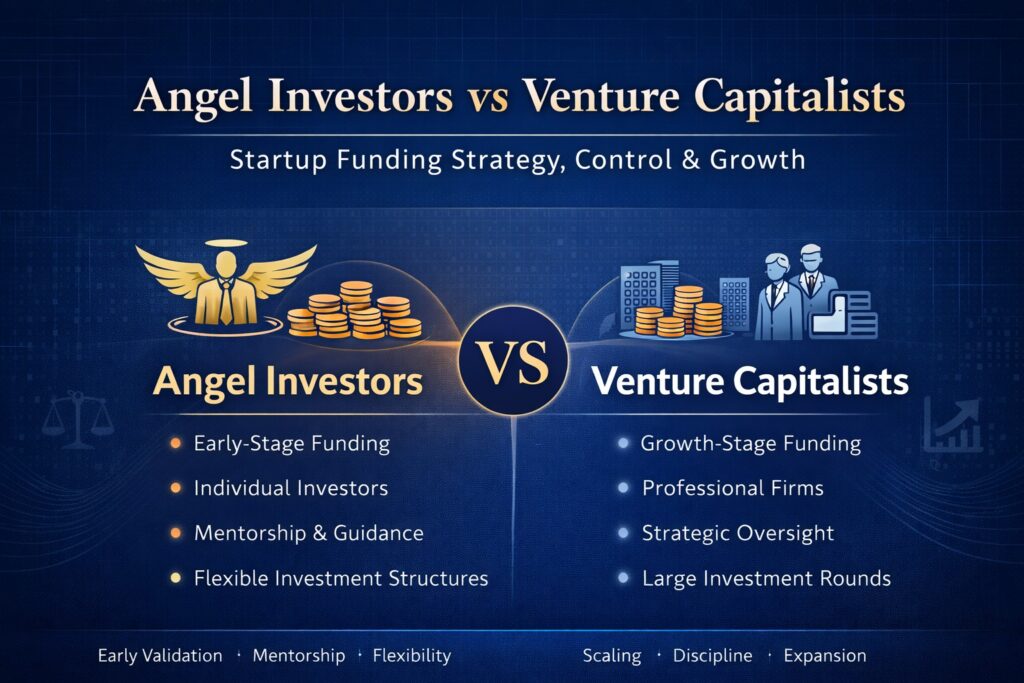
Angel investors are high-net-worth individuals who invest their personal capital into startups, typically in exchange for equity or convertible instruments. They usually participate at the earliest stages—when ideas are still being validated or prototypes are under development. Beyond capital, angel investors often bring mentorship, industry experience, and valuable personal networks, making them critical allies during a startup’s formative phase.
Venture Capitalists (VCs)
Venture capitalists are professional investment firms that deploy pooled funds from institutional sources such as pension funds, insurance companies, and family offices. VCs generally invest at later stages, once a startup has demonstrated product-market fit, revenue traction, and scalable growth potential. Their focus is on high-growth businesses capable of delivering significant returns.
When to Seek Angel Investors
Angel investors are particularly suited for startups in their earliest phases.
1. Early-Stage Validation
If your startup is still refining its business model, developing a minimum viable product (MVP), or validating market demand, angel investors are often the most appropriate funding source. They understand early-stage risk and are willing to invest before metrics are fully established.
2. Mentorship and Founder Support
Early-stage founders benefit immensely from guidance. Many angel investors are former entrepreneurs or industry leaders who can provide practical advice, strategic clarity, and emotional support during critical decision-making moments.
3. Faster Funding Cycles
Angel investments typically involve quicker decision-making and fewer formalities compared to institutional funding. This agility is especially valuable when startups require immediate capital to seize early opportunities.
4. Post Friends-and-Family Stage
After exhausting personal networks, angel investors often serve as the first layer of professional external funding, helping startups move beyond bootstrapping without excessive dilution or governance complexity.
When to Seek Venture Capitalists
Venture capital funding becomes relevant once a startup has established momentum.
1. Scaling and Market Expansion
If your business model is validated and you are ready to scale aggressively—enter new markets, expand teams, or increase production—venture capital can provide the financial muscle required for rapid growth.
2. Larger Capital Requirements
VCs typically invest larger ticket sizes than angel investors, making them suitable when funding needs exceed early-stage capital thresholds.
3. Strategic and Operational Expertise
Beyond funding, VCs bring structured governance, strategic oversight, and access to extensive professional networks. Their involvement often professionalises operations and prepares startups for later-stage exits or public markets.
4. Proven Traction and Revenue
Startups with consistent revenue, strong user growth, and clear unit economics are far better positioned to attract venture capital investment.
The Bridge Between Angels and VCs
Many successful startups follow a sequential funding path—beginning with angel investment and transitioning to venture capital as they scale. Angel funding is often used to build products, validate demand, and achieve early traction. Once these milestones are achieved, venture capital becomes a natural next step to accelerate growth. This progression creates a compelling investment narrative: angels enable proof of concept, while VCs fuel expansion. Together, they form a complementary funding ecosystem rather than competing alternatives.
The Strategic Importance of Angel Investors
Angel investors play a foundational role in the startup ecosystem.
1. Seed Capital for Survival
They often provide the first external capital, enabling startups to move from idea to execution—funding product development, early hiring, and market testing.
2. Mentorship and Industry Access
Their hands-on involvement can help founders avoid early mistakes, refine strategy, and access networks that would otherwise take years to build.
3. Flexible Investment Structures
Because angels invest personal capital, they often demonstrate greater patience, flexibility in terms, and tolerance for longer exit timelines.
4. Enablers of Innovation
By backing unproven ideas, angel investors fuel experimentation and innovation, supporting breakthroughs that institutional investors may initially avoid.
To know more about this, please check the link below.
The Strategic Role of Venture Capitalists
Venture capitalists are instrumental in transforming startups into market leaders.
1. Accelerating Scale
VC funding enables rapid operational expansion, whether through geographic growth, acquisitions, or increased production capacity.
2. Strategic Discipline and Networks
VCs bring governance frameworks, financial discipline, and access to global networks that support long-term scalability.
3. Economic and Employment Impact
VC-backed startups often grow faster, create more jobs, and invest heavily in research and development, contributing significantly to economic growth.
4. Market Validation and Credibility
Securing VC funding signals market confidence, enhancing a startup’s reputation with customers, employees, and future investors.
Conclusion: Aligning Capital with Vision
Choosing between angel investors and venture capitalists is not a binary decision—it is a strategic alignment exercise. Angel investors are best suited for early-stage validation, mentorship, and flexibility, while venture capitalists excel at scaling proven businesses through structured growth and institutional capital. Many successful founders leverage both, starting with angel funding to shape and validate their ideas, then transitioning to venture capital to unlock scale. Ultimately, the right funding choice depends on your startup’s stage, capital needs, control preferences, and long-term vision. Understanding these distinctions empowers entrepreneurs to build sustainable, high-growth companies with the right partners at every phase of their journey.