
Introduction
Turning an innovative idea into a scalable business often requires external capital. For startups, funding is not merely about raising money—it is about earning investor trust. Before committing capital, investors conduct a detailed due diligence exercise to validate a startup’s claims, identify risks, and assess long-term viability. For Indian startups, due diligence carries additional layers of complexity due to regulatory compliance, tax obligations, and foreign investment norms. A clear understanding of the due diligence process enables founders to anticipate investor concerns, organize documentation proactively, and approach fundraising with confidence.
What Is Due Diligence?
Due diligence is a structured verification process undertaken by investors to independently assess a startup’s business, financial position, legal standing, operations, and market prospects. It goes beyond pitch decks and projections, focusing on evidence, compliance, and risk exposure.
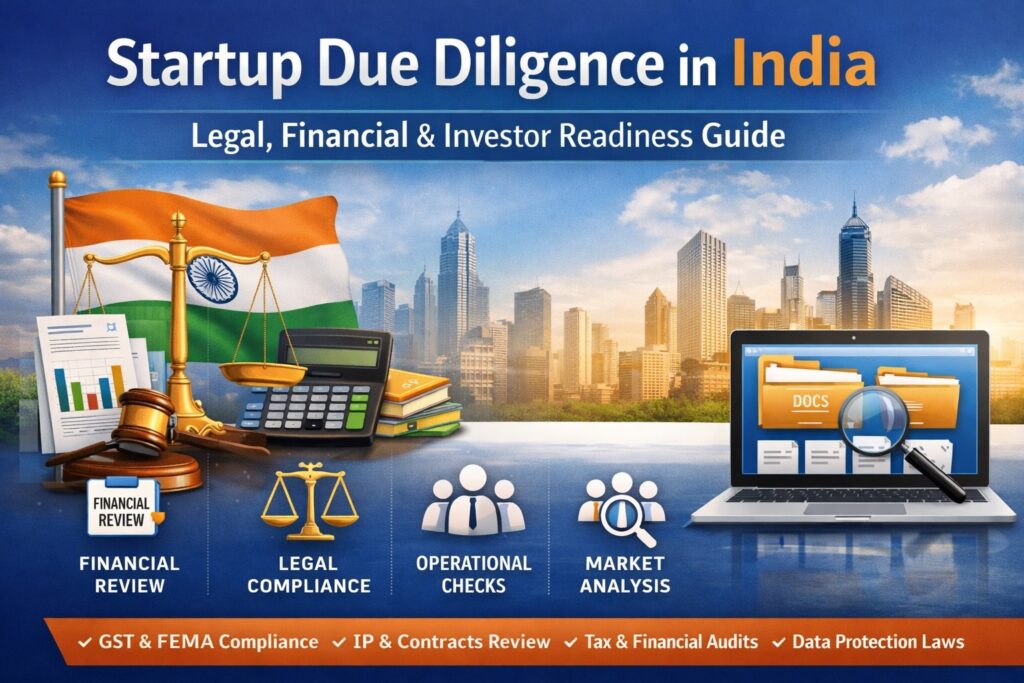
Typically, due diligence is divided into four core areas:
- Financial Due Diligence
- Legal & Compliance Due Diligence
- Operational & HR Due Diligence
- Market & Technology Due Diligence
Each component contributes to the investor’s final decision on valuation, deal structure, and investment terms.
Financial Due Diligence
Financial due diligence evaluates whether a startup’s numbers accurately reflect its business reality and growth potential. Investors usually focus on the following aspects:
Financial Statements
Audited profit and loss statements, balance sheets, and cash flow statements for the previous two to three financial years are reviewed to understand historical performance and financial discipline.
Key Performance Metrics
Investors analyze revenue models, burn rate, customer acquisition cost (CAC), lifetime value (LTV), gross margins, and unit economics to assess sustainability and scalability.
Liabilities and Obligations
All outstanding debts, loans, contingent liabilities, and guarantees must be transparently disclosed to avoid unpleasant surprises post-investment.
Tax Compliance
Up-to-date filings for income tax, GST, and TDS are critical. Any defaults, penalties, or notices can significantly impact investor confidence.
Financial Projections
Future projections are scrutinized for realism, consistency, and alignment with market conditions. Investors assess the assumptions underlying revenue growth, costs, and capital requirements.
Legal & Compliance Due Diligence
Legal due diligence determines whether the startup is lawfully structured, compliant, and free from material legal risks.
Corporate Records
Investors review the Certificate of Incorporation, Memorandum and Articles of Association, shareholder agreements, and capitalization tables to ensure clarity of ownership and governance.
Intellectual Property Rights
Ownership of patents, trademarks, copyrights, and domain names is verified. IP assignment agreements from founders, employees, and contractors are critical to avoid future disputes.
Material Contracts
Key agreements with customers, vendors, employees, consultants, and strategic partners are examined to identify restrictive clauses, termination risks, or revenue dependencies.
Litigation and Disputes
Any pending, past, or threatened litigation must be disclosed along with details of insurance coverage, if any.
Operational & HR Due Diligence
Operational due diligence evaluates how effectively the startup functions on a day-to-day basis and whether its team can execute growth plans.
Management and Organizational Structure
Investors assess the experience, roles, and decision-making structure of the founding and leadership teams.
Human Resource Policies
Employment contracts, ESOP plans, compensation structures, and internal HR policies are reviewed for compliance and retention effectiveness.
Team Stability and Culture
mployee turnover rates and retention strategies provide insight into organizational health and workplace culture.
Operational Processes
Key workflows, supply chain mechanisms, quality controls, and internal systems are analyzed to assess operational scalability.
Market & Technology Due Diligence
This stage focuses on whether the product solves a real problem and can compete sustainably in the market.
Market Assessment
Investors validate the Total Addressable Market (TAM), Serviceable Available Market (SAM), competitive positioning, and industry trends.
Product and Technology Review
The robustness, scalability, and security of the technology stack, software architecture, and product roadmap are examined.
Customer Validation
Metrics such as customer retention, churn rate, Net Promoter Score (NPS), and testimonials help establish product-market fit.
Data Security and Privacy
Compliance with data protection standards and cybersecurity protocols is increasingly important, especially for tech-driven startups.
To know more about this, please check the link below.
Preparing for Due Diligence in India
Indian startups must navigate additional regulatory and compliance considerations that investors closely scrutinize.
Regulatory and Tax Compliance
- GST Compliance: Accurate registration, timely returns, and reconciliation are essential.
- TDS Compliance: Delays or defaults in TDS remittance raise serious concerns.
- MCA Filings: Annual returns, financial statements, and event-based filings must be up to date with the Ministry of Corporate Affairs.
- FEMA Compliance: Foreign investments, share issuances, and cross-border payments must strictly comply with FEMA regulations.
Legal and IP Ownership
- IP Assignment: All intellectual property created by founders, employees, and contractors must be formally assigned to the company.
- Stamp Duty: Proper stamp duty payment is essential, as unstamped or inadequately stamped documents may be unenforceable.
- Data Protection: Compliance with the Digital Personal Data Protection Act, 2023 is increasingly critical for investor trust.
Human Resources and Statutory Records
- Labour Law Compliance: Adherence to wage laws, provident fund regulations, gratuity provisions, and workplace safety norms is mandatory.
- Statutory Registers and Minutes: Accurate maintenance of statutory registers and board/shareholder meeting minutes under the Companies Act is essential.
Conclusion
Due diligence is not merely an investor formality—it is a credibility test for startups. A well-prepared due diligence process reflects strong governance, transparency, and execution capability. For Indian startups, proactive compliance with financial, legal, and regulatory requirements can significantly accelerate fundraising timelines and strengthen negotiation positions. By organizing documentation in a secure virtual data room and addressing potential red flags in advance, founders can build investor confidence and pave the way for successful funding rounds and sustainable growth.