
Introduction
For years, Dubai has been marketed as a tax-free paradise. Entrepreneurs relocated, multinational companies established regional headquarters, and expatriates built careers drawn by the promise of zero income tax. But in 2026, the reality is more nuanced. Dubai is still highly tax-efficient—but it is no longer entirely tax-free. The introduction of corporate tax, global minimum tax rules, and stricter compliance standards has reshaped the landscape.
Let’s separate myths from facts.
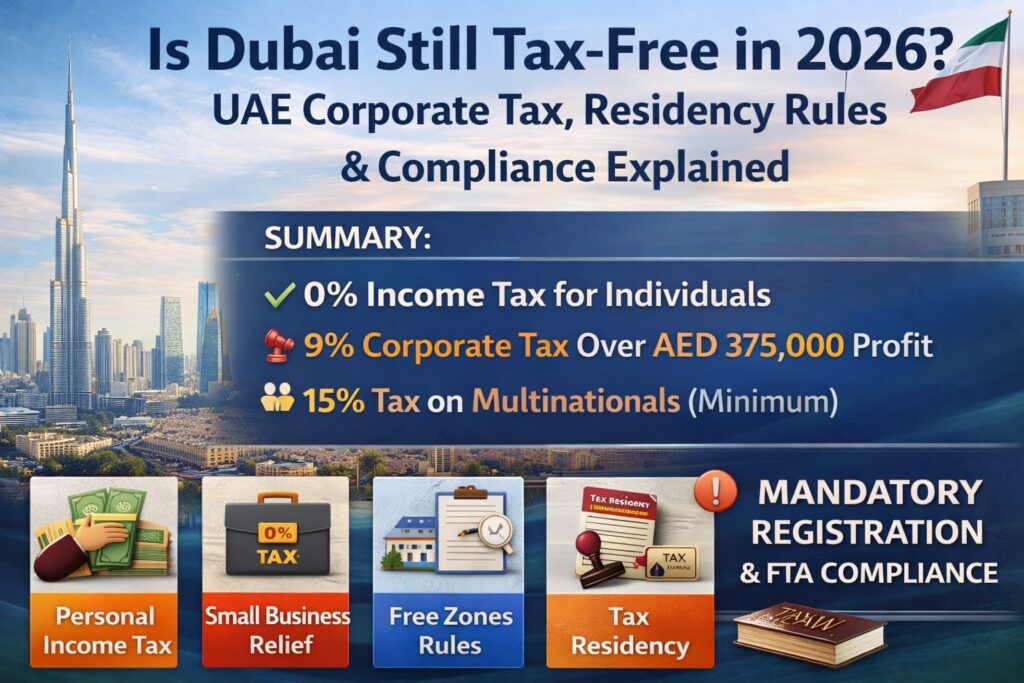
1. Personal Income Tax: Still 0%
The biggest attraction remains intact:
- 0% personal income tax
- No tax on salaries or wages
- No tax on dividends or personal investment income
This applies to both UAE nationals and expatriates. For professionals, remote workers, and high-income earners, Dubai remains one of the most tax-friendly destinations globally. So yes—individual income remains tax-free.
2. Corporate Tax: The Game Changer
The major shift came with the introduction of UAE corporate tax in 2023.
Under current law:
- 0% tax on taxable profits up to AED 375,000
- 9% corporate tax on profits exceeding AED 375,000
This applies to most mainland businesses and certain Free Zone entities. Corporate taxation is administered by the Federal Tax Authority, and registration is mandatory—even if your business qualifies for 0%. Dubai is no longer a zero-tax jurisdiction for profitable companies.
3. Small Business Relief (SBR): Temporary Opportunity
To support startups and SMEs, the UAE introduced Small Business Relief. Businesses with annual revenue below AED 3 million can apply for:
- 0% corporate tax
However, this relief is currently scheduled to expire on 31 December 2026. For entrepreneurs, this is a strategic window to optimize tax planning before full taxation potentially applies.
4. Free Zones: Still Attractive, But Conditional
Free Zones were once perceived as automatic tax havens. That perception has changed. To maintain a 0% tax rate, companies must qualify as a:
“Qualifying Free Zone Person” (QFZP)
This requires:
- Earning “Qualifying Income”
- Demonstrating “Adequate Economic Substance”
- Maintaining proper accounting records
- Filing annual corporate tax returns
Operating in a Free Zone no longer guarantees automatic tax exemption.
5. Global Minimum Tax: Impact on Multinationals
From 2025/2026 onward, the UAE implemented a 15% Domestic Minimum Top-Up Tax (DMTT) aligned with OECD global minimum tax rules.
This applies to:
- Multinational enterprises (MNEs)
- Global revenue exceeding EUR 750 million
The objective is to ensure large corporations pay a minimum effective tax rate globally, while preserving the UAE’s competitiveness. Small and mid-sized companies are generally unaffected by this rule.
6. Corporate Compliance: Registration Is Mandatory
Even businesses qualifying for 0% tax must:
- Register with the Federal Tax Authority
- Obtain a Tax Registration Number (TRN)
- File corporate tax returns
- Maintain audited financial records (if required)
Failure to register can lead to penalties starting at AED 10,000. The era of “no paperwork” is officially over.
7. Tax Residency for Individuals
To benefit from UAE tax residency status, individuals must meet specific criteria.
The 183-Day Rule
Stay in the UAE for 183 days or more within 12 months.
The 90-Day Rule
Stay at least 90 days with:
- Valid UAE residency visa
- Permanent residence (owned or rented property)
Centre of Life Test
Authorities evaluate where your primary residence, family, and economic interests are located.
Proof may include:
- Entry/Exit reports
- Salary certificate
- Local bank statements
- Rental contract or title deed
8. Business Tax Residency
A company is considered UAE tax resident if:
- It is incorporated in the UAE (Mainland or Free Zone), and
- It is effectively managed and controlled within the UAE
Board meetings, strategic decisions, and operational management must occur locally. Businesses may also apply for a Tax Residency Certificate (TRC) to benefit from Double Taxation Avoidance Agreements (DTAAs). Generally, companies must operate for 12 months before applying.
To know more about this, please check the link below.
9. Costs & Processing Timelines
Tax Residency Certificate (TRC):
- Individuals: AED 1,000–2,000
- Businesses: Approx. AED 10,000
Processing Time:
- Individuals: 5–7 working days
- Businesses: 7–12 working days
Truth vs Rumor: Quick Summary
| Claim | Reality in 2026 |
| Dubai is completely tax-free | ❌ Not for businesses |
| No income tax for individuals | ✅ True |
| Free Zones pay zero tax automatically | ❌ Conditional |
| Corporate tax applies to everyone | ❌ Only above threshold |
| Multinationals face new tax rules | ✅ Yes (15% minimum tax) |
Conclusion: Is Dubai Still Worth It?
Dubai in 2026 is not tax-free—but it remains highly tax-efficient.
- Individuals still pay 0% personal income tax
- SMEs benefit from temporary relief
- Free Zones offer structured advantages
- Corporate tax remains globally competitive at 9%
The key difference today is compliance. Businesses and individuals must actively manage registration, documentation, and residency status. With proper planning and professional guidance, Dubai continues to offer significant financial advantages—but informed decision-making is now more important than ever. If you operate in Dubai, staying updated and compliant is no longer optional—it’s strategic.