
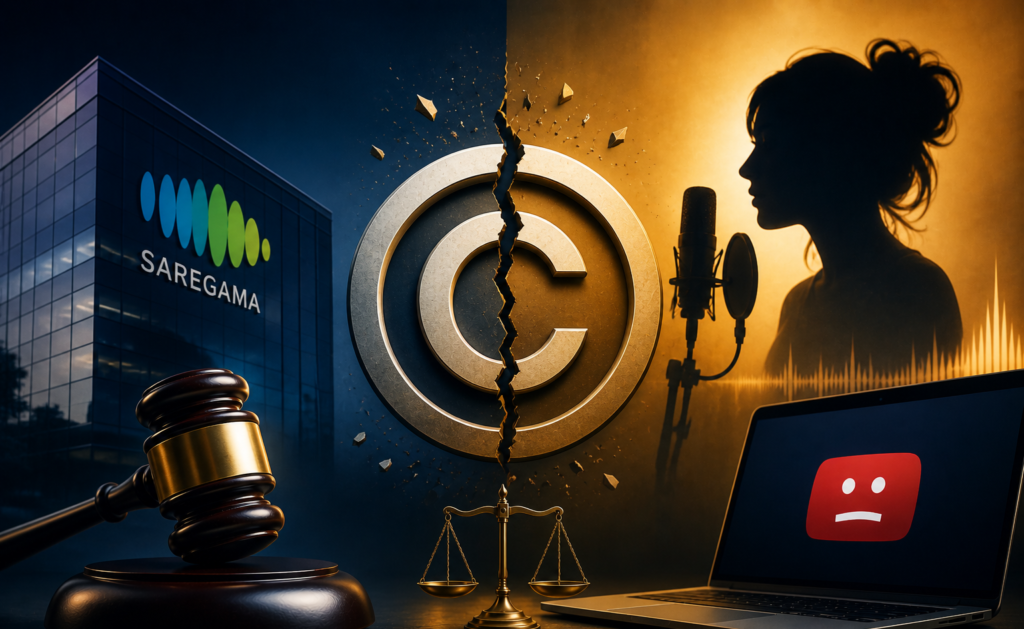
In today’s digital content economy, intellectual property (IP) is one of the most valuable business assets. From music and videos to branding and digital media, companies rely heavily on copyright enforcement to protect their content and maintain competitive advantage. However, while enforcement mechanisms are designed to safeguard rights, their misuse can create serious legal, financial, and reputational risks.
A recent dispute involving Saregama India Ltd. and independent artist Anamika Sood highlights how aggressive or unverified copyright claims can backfire. The case serves as an important lesson for businesses operating in content-driven industries.
The Incident: A Digital Takedown with Real Consequences
The issue began when Anamika Sood released her song “Ferrareee” on YouTube, a platform widely used by creators and businesses alike. Shortly after its release, a copyright strike was issued by Saregama, alleging that the song infringed upon an older musical work.
As a result, the song was taken down from the platform. While such actions are often automated and immediate, the business impact can be significant:
- Loss of audience reach and visibility
- Interruption of revenue streams
- Damage to brand reputation
- Reduced consumer trust
For independent creators and even small businesses, such disruptions can directly affect growth and sustainability.
Court’s Perspective: Accountability in IP Enforcement
Upon reviewing the dispute, the court identified critical issues with the enforcement action. It found that the original work cited by Saregama had already entered the public domain, meaning exclusive rights were no longer applicable. Additionally, the court observed that there was no substantial similarity between the two works in terms of composition, lyrics, or structure.
The enforcement action was deemed arbitrary and lacking proper due diligence. As a result, the court ruled in favor of Anamika Sood and directed Saregama to pay ₹5 lakh as compensation for the wrongful takedown.
This decision reinforces a key principle for businesses: intellectual property rights must be exercised responsibly, not aggressively.
TO KNOW MORE ABOUT THIS, CLICK THE LINK BELOW-
Why This Matters for Businesses
Although this case arises from the music industry, its implications extend across all sectors that rely on digital content, including e-commerce, advertising, media, and technology.
Businesses today operate in an environment where:
- Content is distributed instantly across platforms
- Enforcement actions are executed through automated systems
- Brand perception is shaped in real time
In such a landscape, a single wrongful action can create ripple effects that impact both legal standing and market reputation.
Key Business Takeaways
1. Verify Before You Enforce
Before initiating any copyright claim, businesses must ensure:
- Ownership of the content is valid and documented
- The work is still protected under copyright law
- There is a clear case of infringement
Acting without proper verification can expose companies to legal liability and compensation claims.
2. Understand the Limits of IP Rights
Copyright protection is not indefinite. Many older works eventually enter the public domain, making them freely usable.
Businesses must stay informed about:
- Copyright duration
- Public domain principles
- Scope of protection
Failing to understand these limits can weaken enforcement actions and damage credibility.
3. Reputation is a Critical Asset
In the digital marketplace, reputation directly influences customer trust and business growth. Wrongful copyright claims can:
- Trigger negative publicity
- Harm relationships with creators and partners
- Reduce brand reliability
For established companies, reputational damage can be far more costly than legal penalties.
4. Digital Platforms Amplify Impact
Platforms like YouTube rely on automated enforcement systems. While efficient, these systems often act without detailed human verification.
This means:
- Content can be removed instantly
- Businesses may face backlash before facts are verified
- Recovery from wrongful takedowns can be slow and costly
Responsible use of these systems is essential to avoid unintended consequences.
5. Legal Accountability is Increasing
Courts are increasingly adopting a balanced approach toward intellectual property enforcement. While protecting rights holders, they are also ensuring that:
- Enforcement actions are fair and justified
- Misuse of rights is penalized
- Smaller players and independent creators are protected
The compensation awarded in this case highlights that misuse of IP rights is no longer overlooked.
Strategic Approach for Businesses
To minimize risks, businesses should adopt a structured IP management strategy:
- Conduct IP audits: Regularly review ownership and validity of content
- Implement internal checks: Verify claims before initiating enforcement
- Seek legal guidance: Evaluate the strength of potential claims
- Assess risk vs reward: Consider reputational and financial impact before action
- Train teams: Ensure employees understand IP laws and compliance requirements
A proactive approach can help businesses avoid disputes while strengthening their overall IP position.
Bottom Line
The dispute between Saregama India Ltd. and Anamika Sood highlights a critical shift in the digital business environment: enforcement alone is not enough—responsibility matters.
Copyright is meant to protect innovation, not suppress it. Businesses that adopt a balanced, well-verified, and strategic approach to intellectual property will not only reduce legal risks but also build stronger trust in the marketplace.
In a world where digital presence drives value, responsible IP management is no longer optional—it is a core business necessity.