
The case shows that trademark rights depends upon the prior registration and distinctiveness, not just a cultural inspiration. It also highlights that businesses should be clear and register brand names early
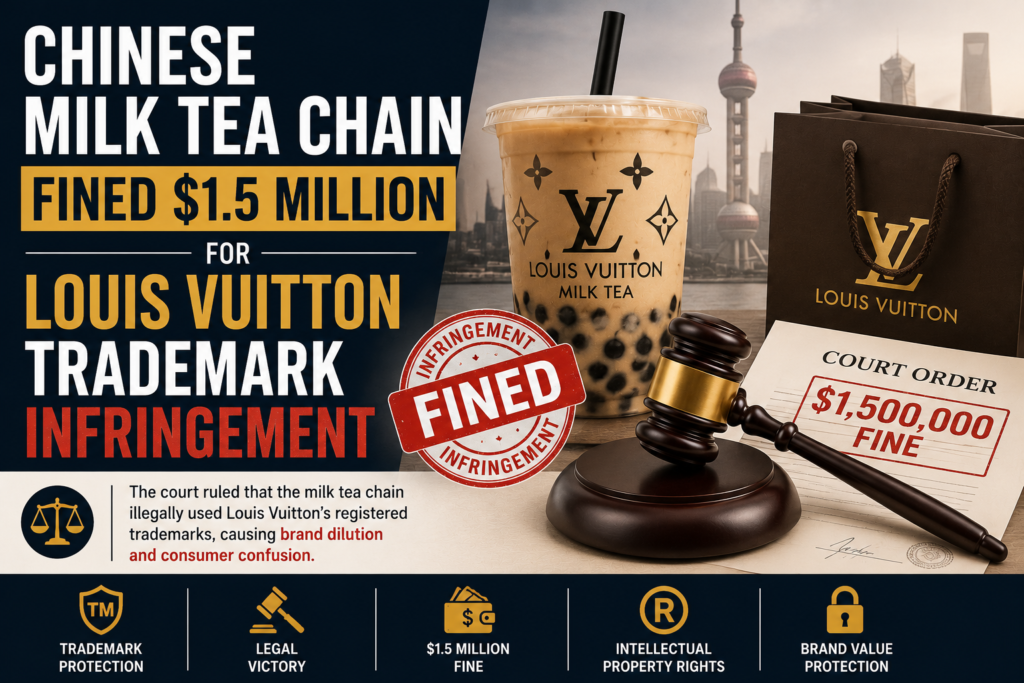
In the recent news of China, a well known Chinese milk tea chain has been found guilty by the court and has been asked by the court to pay 10.3 million yuan as compensation to the French luxury brand Louis Vuitton Malletier for the cause of trademark infringement. Trademark infringement is the unauthorize use of a trademark or a deceptive similar on a competing goods and services. The news sparkled global discourse on IP protection.
The Suzhou court ruled that Molly tea (from Shenzhen), a milk tea company, and one of its franchise stores has copied the several Louis Vuitton’s registered four petal flower graphic trademarks. On June 29, the ruling was made, the court orderd 10 million yuan for the economic damages and in addition to those 300,000 yuan to cover the legal expenses of the Louis Vuitton. The tea brand later confirmed in the media that they will reach for an appeal to the higher court.
The dispute rose because of the similarity between the Molly tea brand and the four petal flower design and the Louis Vuitton’s renowned monogram motifs. On May 2025, the French brand filed a lawsuit with the Suzhou Court. The Molly Tea brand applied to register several flower logo trademarks in China for restaurant and food services. However most of them were rejected and only one that included the Chinese character was registered i.e., MOLLY TEA.
It was found that the Molly tea expertise in fresh milk tea with the floral notes and it has rapidly all over China and overseas. The ruling triggered the public attention on the Social media platforms in China. Some of them argue that the pattern closely take after the Louis Vuitton design, and some of them argue that it is not the same and they operate different products. And in context to hat some of them again questioned on the reality of the Louis Vuitton motif,saying it has been drawn inspiration from the China’s cultural elements.
Kang Lixia, a partner at the Beijing standzer Intellectual property firm, observed that the defendant is entitle to pursue appellate remedies and may submit more evidences in support of the case. She explained that the motifs are connected to the traditional culture and belongs to the society at large and are not proprietary per se. The operations in china trademark is governed by first to file rule. Consequently the registration depends on the priority and exclusivity of the registrant.
Liu Bin, of Beijing Zhongwen law firm, said traditional cultural elements should be kept available for every one of the public, but the businesses must avoid commercial use of signs that are similar to others.
Lastly, the case shows that the trademark rights also depends upon the early registration and distinctiveness. It also highlights that all the businesses should be clear and register their brand names early, because copying an existing protected mark can amount to infringement even if the design uses traditional motiffs.