
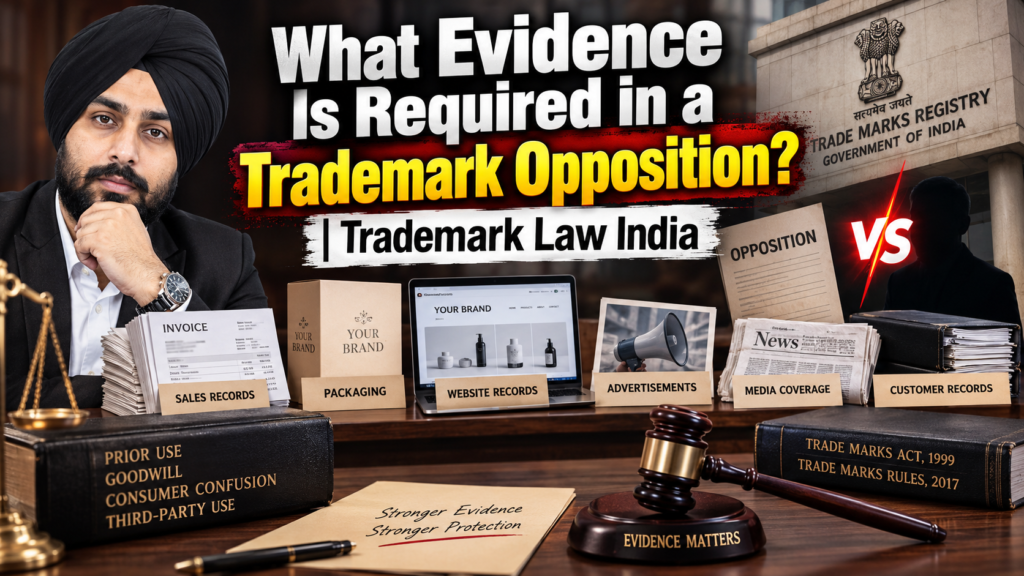
What Evidence Wins a Trademark Opposition in India?
A trademark opposition in India is not decided merely on the basis of which party presents a stronger argument. Once the pleadings are complete, documentary and affidavit evidence can become extremely important in establishing the facts relied upon by either party.
An opponent may claim that it has been using a trademark for several years, built substantial goodwill, invested heavily in advertising, or that consumers are likely to confuse its mark with the applicant’s mark. However, such claims need to be supported by credible evidence.
The Trade Marks Act, 1999 and Trade Marks Rules, 2017 provide the legal framework governing trademark opposition proceedings, including the stages at which parties can submit evidence.
So, what evidence should you file in a trademark opposition?
The answer depends on the grounds of opposition and the facts of the particular case. However, certain categories of evidence are commonly important.
1. Why Is Evidence Important in a Trademark Opposition?
A trademark opposition generally begins with pleadings. The opponent sets out the grounds on which it objects to registration of the applicant’s mark, while the applicant responds through a counterstatement.
But allegations in pleadings are not the same as proof.
For example, an opponent may state:
“We have been using this trademark since 2012 and have acquired substantial goodwill.”
The important question then becomes:
What documents prove use since 2012 and the claimed goodwill?
This is where evidence becomes critical.
The evidence should connect the legal grounds pleaded with actual facts and commercial activity.
2. Trademark Opposition Evidence Under Rule 45
Under Rule 45 of the Trade Marks Rules, 2017, the opponent can submit evidence by way of affidavit in support of the opposition after the applicant files its counterstatement.
This stage provides the opponent with an opportunity to substantiate the factual assertions made in the notice of opposition.
The objective should not simply be to file a large number of documents.
Instead, the evidence should establish a clear and credible chain of facts.
For example:
Adoption of trademark → First use → Continuous use → Sales → Advertising → Market presence → Goodwill → Consumer recognition
The exact evidence required will depend upon the grounds of opposition and circumstances of the dispute.
3. Prior Use Evidence: One of the Most Important Categories
Where an opposition relies upon prior use of a trademark, evidence establishing the history of use can be particularly important.
Section 34 of the Trade Marks Act, 1999 recognizes certain rights of a prior continuous user of a trademark.
The Supreme Court has also discussed the significance of prior-user rights in cases such as S. Syed Mohideen v. P. Sulochana Bai, (2016) 2 SCC 683.
Therefore, simply claiming:
“We have been using the trademark since 2012.”
may not be enough.
The opponent should consider producing documents capable of demonstrating:
- When the trademark was adopted
- When commercial use began
- Whether use has been continuous
- The nature of goods or services sold
- Geographic extent of use
- Volume of sales
- Advertising and promotional activity
- How the trademark has been presented to consumers
Examples of prior-use evidence
Depending upon the facts, this may include:
- Invoices
- Tax invoices
- GST records
- Purchase orders
- Sales records
- Product packaging
- Labels
- Catalogues
- Brochures
- Advertisements
- Newspaper advertisements
- Website records
- E-commerce listings
- Domain-name records
- Social-media records
- Distributor agreements
- Licensing documents
- Trade-show materials
The important factor is not simply the quantity of documents but their ability to establish the claimed timeline of use.
4. Invoices as Evidence of Trademark Use
Invoices can be important evidence in trademark proceedings, particularly where they clearly establish commercial transactions involving the relevant goods or services and the trademark.
However, an invoice should be examined in context.
For example, if a party claims use of a trademark since 2010, but produces invoices only from 2023, those invoices may demonstrate use in 2023 but do not, by themselves, establish continuous use since 2010.
A stronger evidentiary record may contain documents from different periods demonstrating the development and continuity of the business.
A useful evidence timeline could look like:
| Period | Possible Evidence |
|---|---|
| 2010 | First invoice / adoption documents |
| 2011–2014 | Sales invoices and packaging |
| 2015–2018 | Advertising and business records |
| 2019–2022 | Website, e-commerce and sales records |
| 2023–Present | Recent invoices and promotional material |
The objective is to create a coherent evidentiary chain.
5. Evidence of Goodwill and Reputation
Another common ground in trademark disputes involves goodwill and reputation.
A party may claim:
- “Our trademark is well known in the market.”
- “Consumers associate this trademark with our company.”
- “We have substantial goodwill.”
- “We have invested heavily in advertising.”
These claims should ideally be supported with relevant commercial evidence.
Evidence may include:
- Annual turnover
- Sales figures
- Advertising expenditure
- Marketing campaigns
- Newspaper coverage
- Magazine publications
- Industry publications
- Website analytics
- E-commerce presence
- Geographic distribution
- Distributor network
- Customer records
- Promotional campaigns
- Social-media activity
- Awards and recognitions
- Market surveys, where appropriate
The evidence should demonstrate the commercial and consumer recognition of the trademark, rather than merely showing that the business exists.
6. Is Social-Media Following Enough to Prove Trademark Reputation?
Not necessarily.
A large number of social-media followers may demonstrate online reach, but it does not automatically establish the legal extent of trademark goodwill or reputation.
The relevance of social-media evidence depends on factors such as:
- Nature of the business
- Target consumers
- Geographic market
- Engagement
- Duration of use
- Sales generated
- Advertising activity
- Consumer recognition
Therefore, social-media screenshots are generally more useful when they form part of a broader evidentiary record.
7. Evidence of Actual Consumer Confusion
Actual confusion is not always necessary in a trademark dispute because legal analysis may focus on the likelihood of confusion.
However, where genuine instances of actual confusion exist, they may be relevant evidence.
Examples could include:
- Customer emails sent to the wrong company
- Misdirected enquiries
- Mistaken purchase orders
- Incorrect invoices
- Customer complaints
- Social-media messages
- WhatsApp communications
- Emails intended for another business
- Enquiries relating to the wrong product or company
Such evidence should be genuine, identifiable and properly documented.
Manufactured or unreliable evidence can seriously undermine a party’s credibility.
8. Third-Party Trademark Use: Registration vs Actual Commercial Use
Third-party use can become important where one party argues that a particular word or expression is common to the trade.
For example, an applicant may argue that numerous businesses use similar marks and therefore the common element should receive limited protection.
In response, the opponent may attempt to demonstrate that the alleged third-party marks are not actually being used commercially to any significant extent.
This leads to an important distinction:
Trademark registration ≠ actual marketplace use
A search showing numerous trademark applications or registrations does not automatically prove that all those marks are actively used in commerce.
A party should therefore consider the nature and quality of the third-party evidence.
Depending on the case, relevant evidence may include:
- Actual product listings
- Websites
- E-commerce pages
- Packaging
- Invoices
- Advertisements
- Physical market presence
- Business records
The evidentiary value of third-party registrations and third-party commercial use may be different.
9. Applicant’s Evidence Under Rule 46
The applicant also has an important role in the evidence stage.
Under Rule 46 of the Trade Marks Rules, 2017, the applicant may file evidence in support of its application after receiving the opponent’s evidence.
The applicant may use evidence to establish or support matters such as:
- Independent adoption
- Actual use of the trademark
- Honest concurrent use, where applicable
- Distinctiveness
- Commercial presence
- Extent of use
- Different trade channels
- Different consumer base
- Response to the opponent’s allegations
- Challenge to the opponent’s claimed prior use
The applicant may also challenge whether the opponent has actually established the claimed date of first use, goodwill or reputation.
10. Evidence Must Match the Legal Ground of Opposition
One of the most important principles in trademark opposition proceedings is that evidence should be connected to the legal grounds pleaded.
For example:
Section 11 Opposition
Where the opposition is based on an earlier trademark, relevant evidence may relate to:
- Earlier trademark rights
- Similarity between marks
- Similarity of goods/services
- Relevant market circumstances
- Evidence supporting the alleged likelihood of confusion
Prior Use
Where prior use is relied upon, evidence should focus on:
- Date of adoption
- Date of first use
- Continuity of use
- Commercial transactions
- Market presence
Goodwill and Reputation
Evidence may focus on:
- Sales
- Advertising
- Market reach
- Consumer recognition
- Media coverage
- Geographic presence
Bad Faith
Where bad faith is alleged, evidence may relate to the circumstances surrounding adoption, knowledge of the earlier mark and other facts relevant to the allegation.
The evidence should therefore be strategically aligned with the legal case.
11. More Documents Does Not Always Mean a Stronger Case
A common mistake in trademark opposition proceedings is filing hundreds of pages without explaining their relevance.
Volume of evidence is not the same as strength of evidence.
Suppose an opponent files:
- 500 invoices
- 100 screenshots
- 50 advertisements
- 20 product photographs
But the documents do not clearly establish the claimed date of first use or continuity of use.
The sheer quantity may not solve the evidentiary gap.
Instead, the evidence should be:
Relevant + Authentic + Chronological + Legally Connected
A well-organized collection of relevant documents can be easier to understand and evaluate than a large collection of disconnected material.
12. Build a Chronological Evidence Record
A chronological approach can make trademark evidence significantly easier to understand.
Suppose a business claims:
“We have used the trademark since 2010.”
The evidence could be organized around:
2010 → Adoption and first use
2011–2013 → Early sales
2014–2016 → Advertising and market expansion
2017–2020 → Increased sales and distribution
2021–2024 → Online and offline market presence
2025–Present → Continuing commercial use
This approach helps demonstrate how the trademark developed over time.
13. Keep Trademark Evidence Before the Dispute Begins
One of the biggest lessons from trademark opposition proceedings is that businesses should preserve their trademark records from the beginning.
Important documents should not be created or collected only after receiving an opposition notice.
Businesses should maintain records such as:
- Old invoices
- Product packaging
- Advertising materials
- Brochures
- Website records
- Domain registrations
- Social-media records
- E-commerce listings
- Licensing agreements
- Distributor agreements
- Sales records
- Promotional campaigns
- Trademark applications and registrations
These documents may become important years later when proving the history and extent of trademark use.
14. Common Evidence Mistakes in Trademark Opposition
Businesses should be particularly careful about the following:
❌ Claiming an early use date without early documents
If you claim use since 2010, evidence from only 2023 may leave an evidentiary gap.
❌ Filing irrelevant documents
Not every business document is necessarily relevant to the trademark dispute.
❌ Relying only on trademark registrations
Registration of a mark does not automatically establish the extent of actual commercial use.
❌ Treating social-media followers as automatic proof of goodwill
Online popularity and legal reputation are not necessarily identical concepts.
❌ Filing third-party applications as proof of market use
A trademark application may exist without meaningful commercial use.
❌ Ignoring contradictions
Differences in dates, invoices, names, addresses or descriptions across documents can create credibility issues.
15. What Makes Trademark Opposition Evidence Strong?
There is no single document that automatically “wins” a trademark opposition.
Generally, useful evidence should help establish the specific factual proposition on which the party relies.
A strong evidence record will typically be:
1. Relevant
It directly relates to the legal ground or factual allegation.
2. Authentic
The source and nature of the document can be properly established.
3. Chronological
It helps establish the history and continuity of relevant events.
4. Consistent
Different documents support rather than contradict one another.
5. Commercially meaningful
It demonstrates genuine business activity where commercial use or reputation is relevant.
6. Properly explained
The evidence is connected to the pleadings and the legal issues in dispute.
16. Key Supreme Court Decisions on Trademark Evidence and Prior Use
Several important Indian trademark decisions provide useful guidance on issues including prior use, goodwill, reputation, deceptive similarity and the evidentiary significance of market circumstances.
These include:
- S. Syed Mohideen v. P. Sulochana Bai, (2016) 2 SCC 683
- Hardie Trading Ltd. v. Addisons Paint & Chemicals Ltd., (2003) 11 SCC 92
- Neon Laboratories Ltd. v. Medical Technologies Ltd., (2016) 2 SCC 672
- Corn Products Refining Co. v. Shangrila Food Products Ltd., AIR 1960 SC 142
- N.R. Dongre v. Whirlpool Corporation, (1996) 5 SCC 714
These cases should be studied in the context of the particular legal issue involved rather than treated as a substitute for examining the facts and applicable statutory provisions.
Conclusion: Trademark Opposition Is a Battle of Law and Evidence
A trademark opposition is ultimately not just about making allegations.
The Trade Marks Act, 1999 provides the legal framework, while evidence helps establish whether the factual foundation for those legal grounds has actually been demonstrated.
Whether the issue involves prior use, goodwill, reputation, likelihood of confusion, third-party use or the circumstances of adoption, the evidence should be carefully selected and connected to the specific case.
For businesses, the most important lesson is simple:
Do not wait for a trademark dispute to start collecting evidence.
Invoices, packaging, advertisements, website records, sales documents and other commercial records created during the ordinary course of business can become valuable evidence years later.
A trademark dispute may begin with a notice of opposition, but the strength of the case can depend on documents that were created long before the dispute ever existed.