
Inroduction
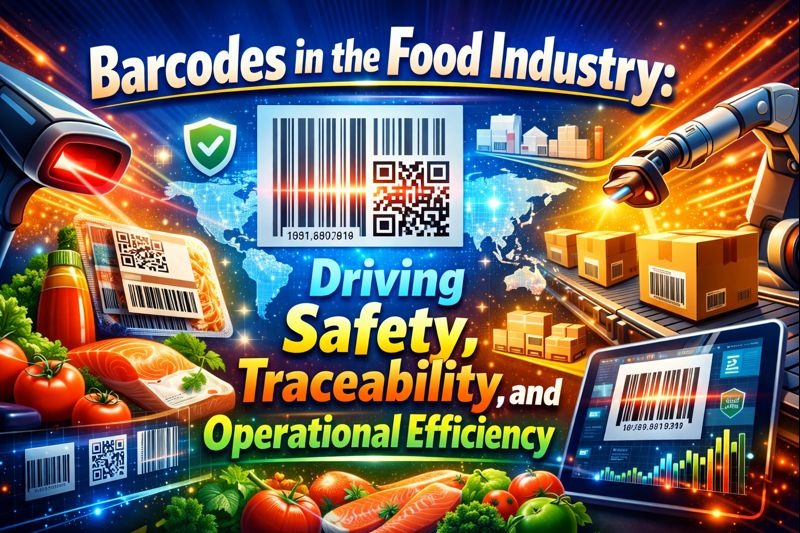
From farm fields to grocery store shelves, barcodes have become a silent yet powerful force in the food industry. They simplify complex processes, improve operational efficiency, and play a crucial role in ensuring food safety and regulatory compliance. More than just a set of lines on packaging, barcodes act as digital gateways that allow food businesses to track, manage, and verify products at every stage of the supply chain. In this blog, we explore how barcode technology supports food and retail operations, the types of barcodes commonly used, their key benefits, and best practices for successful implementation.
Understanding Barcodes in Food Products
Barcodes have transformed how food products are identified and managed by creating a direct link between physical items and digital data. A barcode is a unique, machine readable code made up of black bars and white spaces that can be scanned to retrieve product information instantly. In the food industry, barcodes store essential details such as product type, origin, pricing, batch information, and expiration dates, allowing for fast and accurate processing.
Two barcode formats are especially common in food applications: the Universal Product Code (UPC) and the GS1 Data Bar. UPCs are widely used in retail environments for packaged goods, while GS1 Data Bars are ideal for fresh and perishable items due to their compact size and ability to encode additional information. These barcode types help accommodate varying packaging sizes and information needs across the food sector.
📞 Contact our barcode experts at +91 729705118 or +91 8949793519
Key Benefits of Barcodes in the Food Industry
The impact of barcodes on food industry operations is substantial. One of the most significant advantages is improved inventory management. Barcodes enable real time tracking of stock levels, helping businesses avoid overstocking, reduce waste, and prevent stockouts. This is particularly important for perishable goods, where freshness and shelf life are critical.
Barcodes also reduce human error by automating data entry processes, ensuring higher accuracy and faster operations. In environments where even small mistakes can lead to safety risks or financial losses, this reliability is invaluable. Additionally, barcodes play a vital role in recall management by allowing businesses to quickly trace affected products back to their source, protecting consumers and preserving brand trust.
📞 Contact our barcode experts at +91 729705118 or +91 8949793519
Types of Barcodes Commonly Used in Food Products
Universal Product Code (UPC)
The Universal Product Code is one of the most widely recognized barcode systems in the food industry. Each UPC consists of a 12-digit number that uniquely identifies a product. This code includes a manufacturer identifier, a product number, and a check digit that ensures scanning accuracy. UPC barcodes support fast checkout processes, efficient inventory tracking, and standardized product identification across retail systems worldwide.
GS1 Data Bar
The GS1 Data Bar is designed for situations where space is limited, making it ideal for fresh foods such as fruits, vegetables, and meat products. Unlike traditional barcodes, GS1 Data Bars can store additional data such as expiration dates, batch numbers, and weight information. This enhanced data capacity strengthens traceability and improves communication across the supply chain, from producers to retailers and consumers.
How to Create Barcodes for Food Products
Creating barcodes for food products involves a structured yet simple process. The first step is selecting the appropriate barcode type based on your product and packaging requirements. Next, you must obtain a globally unique product identifier from GS1, which ensures accurate product recognition across markets. Once the identifier is secured, barcode generation software is used to convert the data into a scanable barcode image. These tools range from basic online generators to advanced software that supports customization and bulk creation. Finally, the barcode must be integrated clearly into the product packaging design to ensure reliable scanning throughout the supply chain.
📞 Contact our barcode experts at +91 729705118 or +91 8949793519
To know more about this, please follow the below link.
Best Practices for Implementing Barcodes in Food Products
Effective barcode implementation requires careful planning, quality materials, and consistent monitoring. High quality printing and labelling are essential to prevent scanning issues caused by fading, smudging, or environmental exposure. Barcodes should be printed with strong contrast, typically black on white and placed on flat, easily accessible areas of packaging to ensure consistent readability. Routine quality checks help maintain barcode integrity throughout transportation, storage, and retail handling.
Barcodes also play a critical role in traceability and regulatory compliance. They enable businesses to track food products back to their origin, verify safety standards, and respond quickly to recalls if necessary. Accurate barcode data simplifies audits and inspections, making compliance with food safety regulations more efficient and reliable.
Conclusion
Barcodes are far more than a convenience in the food industry—they are a foundational tool that supports efficiency, safety, and transparency across the entire supply chain. By enabling accurate tracking, reducing errors, and strengthening compliance, barcode technology helps ensure that food products reach consumers safely and efficiently. Businesses that adopt and implement barcode systems effectively gain not only operational advantages but also increased consumer trust. As food systems continue to evolve, barcodes will remain central to building smarter, safer, and more connected food supply chains.
📞 Contact our barcode experts at +91 729705118 or +91 8949793519