
Introduction
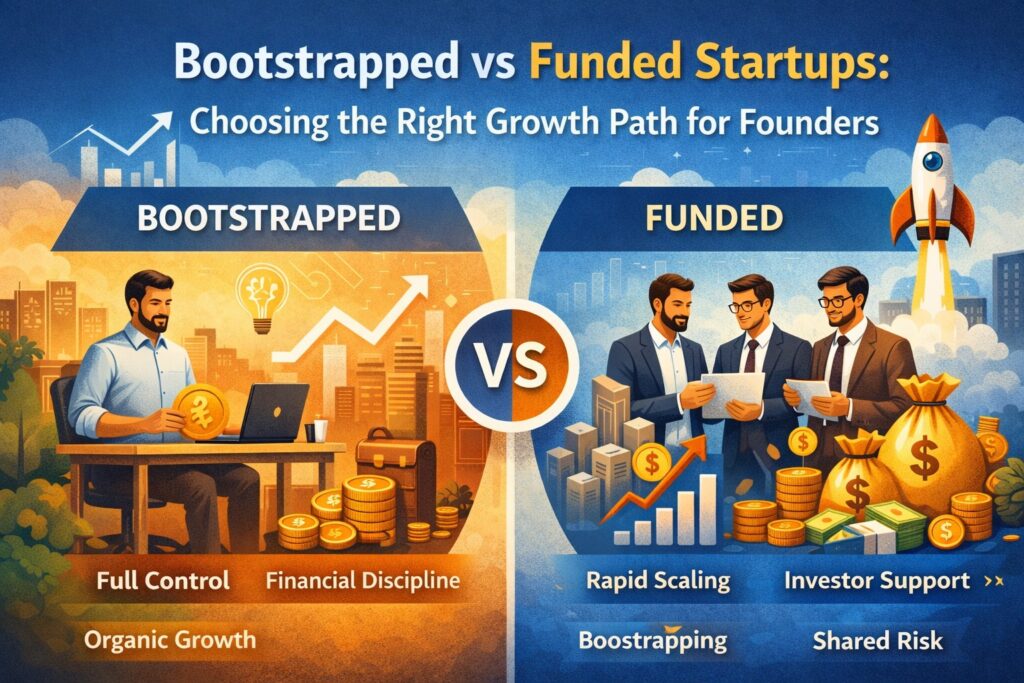
Launching a startup is an exciting yet demanding journey—and one of the earliest strategic decisions founders face is whether to bootstrap the business or raise external funding. This choice has long-term implications on ownership, growth speed, decision-making power, and personal risk. While bootstrapped startups emphasize control and sustainability, funded startups focus on rapid scaling and market dominance. Neither approach is inherently superior; the right choice depends on your vision, industry, and appetite for risk. This article breaks down both models to help you decide what aligns best with your entrepreneurial goals.
Understanding Bootstrapped Startups
What Does Bootstrapping Mean?
Bootstrapping refers to building and scaling a startup using personal savings and internally generated revenue, without relying on external investors. Founders grow the business gradually, reinvesting profits back into operations.
Who Is Bootstrapping Best Suited For?
Bootstrapping works well for founders who value independence and operate in businesses with low capital requirements, such as:
- Service-based ventures
- Niche SaaS products
- Consulting and digital platforms
Advantages of Bootstrapping
1. Complete Ownership and Control: Founders retain 100% equity and decision-making power, allowing them to pivot freely without investor approvals.
2. Strong Financial Discipline: Limited resources enforce efficiency, profitability, and customer-centric thinking from the outset.
3. Sustainable, Organic Growth: Growth is driven by real market demand rather than aggressive valuation targets, resulting in resilient businesses.
Challenges of Bootstrapping
1. Slower Growth Trajectory: Scaling may take time, especially in competitive markets dominated by well-funded players.
2. High Personal Financial Exposure: Founders often invest personal savings, increasing financial pressure and stress.
3. Limited Access to Networks and Mentorship: Without investors, founders may miss strategic guidance and industry connections.
Notable Bootstrapped Startups in India
- Zerodha – Built into India’s largest stock brokerage without external funding
- Zoho Corporation – A global SaaS giant focused on long-term sustainability
- Wingify (VWO) – Proved that profitable SaaS companies can thrive without VC backing
Understanding Funded Startups
What Is a Funded Startup?
Funded startups raise capital from angel investors, venture capitalists, or institutional funds in exchange for equity. This approach enables rapid growth and aggressive market expansion.
Who Should Consider Funding?
External funding is ideal for startups operating in capital-intensive or high-growth sectors, including:
- E-commerce
- Fintech and AI
- Deep tech and platform-based businesses
Advantages of Funded Startups
1. Faster Scaling and Market Expansion: Access to capital allows rapid hiring, marketing, infrastructure development, and product innovation.
2. Strategic Expertise and Networks: Investors bring mentorship, credibility, partnerships, and access to global markets.
3. Reduced Personal Financial Risk: Financial responsibility is shared, easing pressure on founders during uncertain phases.
Challenges of Funded Startups
1. Equity Dilution: Founders sacrifice ownership and may lose majority control over time.
2. High Performance Pressure: VCs expect exponential growth and exits within defined timelines.
3. Reduced Flexibility: Major strategic decisions often require investor consent, limiting agility.
Successful Funded Startups in India
- Ola – Expanded aggressively with strong VC backing
- Zomato – Used funding to scale globally and diversify offerings
- Paytm – Leveraged large investments to dominate India’s fintech ecosystem
To know more about this, please check the link below.
How to Choose Between Bootstrapping and Funding
The right funding model depends on aligning your business goals with personal priorities.
Key Factors to Consider
- Business Model: Capital-light or capital-intensive?
- Growth Ambition: Steady growth vs rapid scaling?
- Risk Appetite: Personal financial exposure vs shared risk?
- Control Preference: Independence or collaborative decision-making?
The Hybrid Model: Best of Both Worlds
Many founders today adopt a hybrid approach—bootstrapping initially to achieve product-market fit, then raising funds for scaling. This strategy:
- Strengthens valuation
- Preserves early control
- Attracts quality investors
Conclusion
There is no universal answer to the bootstrapped vs funded debate. Both models have produced iconic success stories. The key lies in understanding your startup’s needs, your personal vision, and the trade-offs each path brings. Whether you choose disciplined organic growth or aggressive expansion backed by investors, informed decision-making will define your entrepreneurial journey. Choose the path that supports not just your startup—but the founder you want to be.