
Introduction
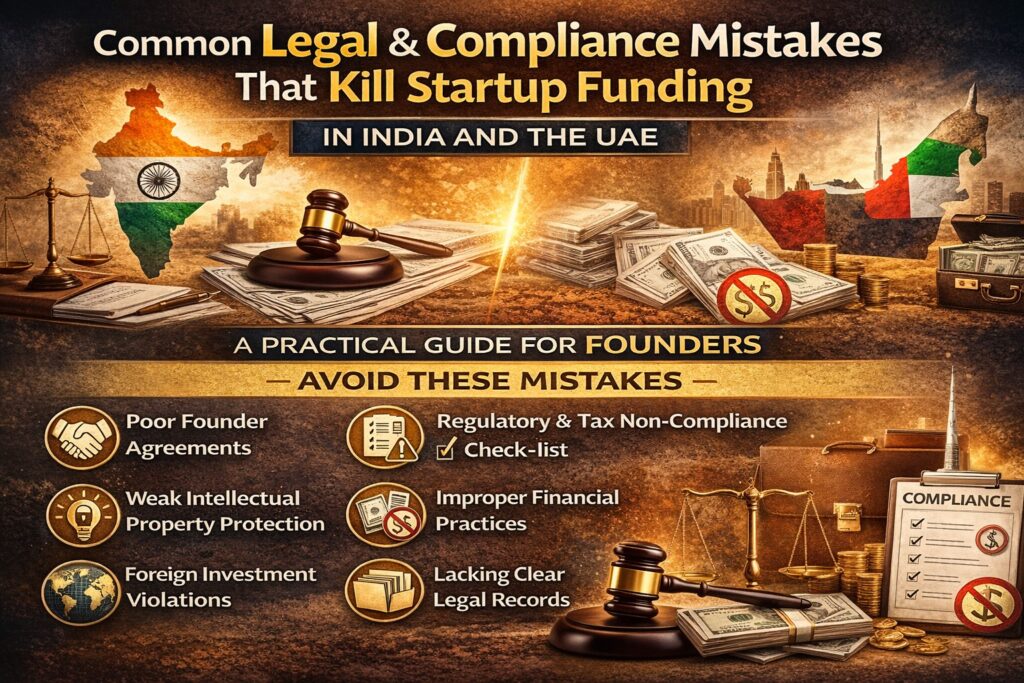
Building a startup is inherently risky, but losing funding opportunities due to preventable legal mistakes is one of the most avoidable setbacks founders face. Across India and the UAE, investors increasingly prioritise governance, transparency, and compliance alongside business potential. While founders often focus on product development and growth metrics, legal readiness frequently becomes the deciding factor during investor due diligence. Missing documentation, regulatory violations, or unclear ownership structures can immediately reduce investor confidence. This blog explores the most common legal and compliance pitfalls that undermine funding prospects and outlines actionable measures startups can adopt to strengthen their investment readiness.
Understanding the Regulatory Landscape
Both India and the UAE offer thriving startup ecosystems, yet each jurisdiction imposes distinct compliance expectations.
India
Startups must comply with statutory frameworks such as:
- The Companies Act, 2013
- FEMA regulations governing foreign investments
- Tax and regulatory filings with the Registrar of Companies (ROC) and GST authorities
Non-compliance in these areas often leads to penalties and investor hesitation.
UAE
The UAE operates through mainland and multiple free-zone jurisdictions, each with unique compliance requirements. Investors expect:
- Proper licensing structures
- Accurate financial reporting
- Adherence to corporate governance and data protection standards
Failure to understand jurisdiction-specific obligations can significantly hinder fundraising.
Common Legal Mistakes That Affect Funding in India
1. Absence of Proper Founder Agreements
Many early-stage startups operate informally without structured founder agreements. Investors view this as a major risk.
Essential provisions should include:
- Equity ownership and vesting schedules
- Roles and responsibilities
- Exit mechanisms
- Dispute resolution clauses
Unclear founder arrangements often signal future conflict.
2. Weak Intellectual Property Protection
A startup’s value frequently lies in its intellectual property. Failure to:
- register trademarks or patents, or
- secure IP assignment from founders and employees
creates ownership uncertainty, which investors strongly avoid.
3. Regulatory and Tax Non-Compliance
Delayed or missing filings such as:
- ROC compliances
- GST returns
- TDS obligations
indicate operational indiscipline and may expose investors to inherited liabilities.
4. FEMA Violations in Foreign Funding
Foreign investment compliance is heavily regulated in India. Common errors include:
- delayed FC-GPR filings
- incorrect share valuation procedures
- accepting restricted foreign investments without approval
Such violations can attract significant penalties and delay funding rounds.
5. Poor Employment Documentation
Missing employment contracts or unclear IP ownership clauses may result in retrospective liabilities. Investors carefully examine workforce compliance during due diligence.
Common Compliance Mistakes in the UAE
1. Choosing the Wrong Business Structure
Selecting an unsuitable jurisdiction or entity structure may:
- restrict scalability
- complicate foreign ownership
- discourage institutional investors
Strategic structuring at incorporation is critical.
2. Mixing Personal and Business Finances
Combining founder and company finances undermines transparency and raises accounting concerns during audits. Dedicated corporate banking and clear bookkeeping are essential.
3. Incorrect Treatment of Investment Funds
Misclassifying investments as revenue distorts financial statements and creates regulatory complications. Funding must be accurately reflected as equity or debt.
4. Lack of Formal Contracts and Data Policies
Informal arrangements with vendors or customers increase legal risk. UAE data protection standards also require:
- privacy policies
- terms of service
- proper consent mechanisms.
5. Incomplete Corporate Records
Missing documentation such as:
- shareholder registers
- board resolutions
- updated trade licenses
can immediately delay or terminate investor negotiations.
To know more about this, please check the link below.
Best Practices to Stay Investor-Ready
1. Strengthen Corporate Governance
- Execute detailed founder agreements with vesting structures.
- Establish advisory boards or independent oversight.
- Maintain a Virtual Data Room (VDR) for investor access.
2. Close Compliance Gaps
- Conduct periodic legal audits.
- Maintain a compliance calendar covering statutory filings.
- Rectify historical defaults proactively.
3. Secure Intellectual Property Early
- Execute IP assignment agreements.
- Register trademarks and patents at early stages.
- Treat IP as a core investment asset.
4. Improve Financial and Data Discipline
- Separate personal and corporate finances.
- Use professional accounting software.
- Implement data protection compliance frameworks.
Conclusion
In today’s investment ecosystem, legal preparedness is no longer optional, it is a prerequisite for funding. Investors evaluate startups not only on innovation but also on governance maturity, regulatory discipline, and risk exposure. Startups in India and the UAE that prioritise compliance, corporate structure, and intellectual property protection significantly enhance their credibility and valuation potential. By addressing legal gaps early and adopting structured governance practices, founders can transform compliance from a burden into a strategic advantage. Ultimately, investor confidence is built on clarity, compliance, and consistency, and startups that recognise this early are far more likely to secure sustainable funding and long-term success.