
Introduction
Dubai is globally recognized for its luxury lifestyle, architectural landmarks, and strong economic growth. The city’s real estate sector—regulated by the Dubai Land Department—offers transparency and investor-friendly frameworks that continue to attract global buyers. While many assume that entering Dubai’s property market requires substantial capital, developer payment plans have significantly lowered the entry barrier. Today, buyers can secure property with manageable monthly payments instead of large lump-sum investments. Let’s break down how these payment structures work and how you can leverage them.
Understanding Developer Payment Plans
Traditional mortgages in the UAE often require:
- 20–25% down payment (for expatriates)
- Bank approval and income verification
- Interest payments over long tenures
Developer payment plans, by contrast, typically require:
- 5–10% initial booking amount
- Structured installment payments
- No bank involvement
- Usually interest-free terms
This makes them particularly attractive for salaried professionals, overseas investors, and first-time buyers.
Most Popular Low-Capital Payment Plans
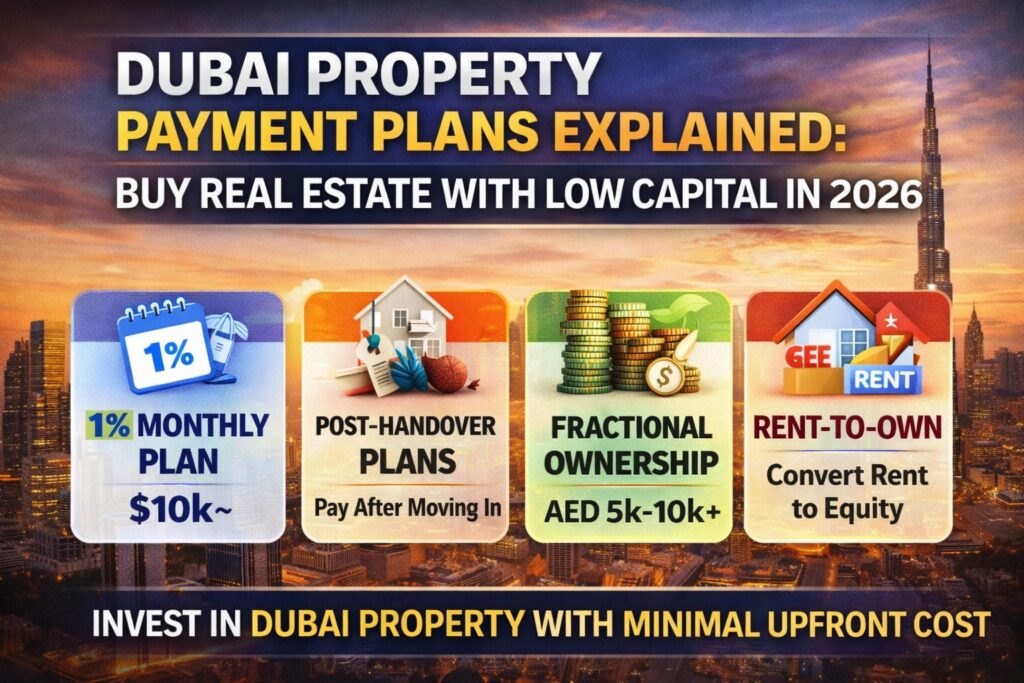
1. 1% Monthly Payment Plan
Popularized by developers like Danube Properties, this structure allows buyers to:
- Pay 10–20% upfront
- Pay 1% of the property value monthly
For example, on a AED 1,000,000 property, monthly payments may be AED 10,000—similar to rent—making ownership far more accessible.
2. Post-Handover Payment Plans (PHPP)
Under PHPP models, buyers pay 40–60% during construction and the remaining 40–60% after handover over 2–5 years.
This enables:
- Moving in before full payment
- Renting out the property
- Using rental income to cover installments
It’s a “pay-as-you-earn” structure ideal for investors.
3. 10/90 or 20/80 Plans
These plans allow buyers to:
- Pay 10–20% upfront
- Pay the remaining 80–90% either during construction or at handover
This structure helps lock in current prices while spreading financial exposure.
4. Construction-Linked Plans
Payments are tied to construction milestones, such as:
- 10% on booking
- 10% at foundation completion
- 10% at structure completion
This reduces buyer risk by linking payments to visible progress.
Smart Strategies to Buy with Low Capital
1. Target Emerging Areas
Affordable communities such as:
- Dubai South
- Jumeirah Village Circle
- International City
offer studio apartments starting from AED 400,000–600,000. These locations often provide higher appreciation potential due to ongoing infrastructure development.
2. Fractional Ownership
Platforms like SmartCrowd allow investors to purchase shares of properties starting from AED 5,000–10,000.
This approach offers:
- Lower risk exposure
- Diversification
- Passive rental income
3. Rent-to-Own (RTO)
Rent-to-Own schemes allow tenants to convert a portion of their rent into equity. This is ideal for residents who want to test living in a property before committing to full ownership.
4. REIT Investments
For indirect exposure, investors can consider UAE-listed REITs such as Emirates REIT. With entry points as low as AED 1,000, REITs allow participation in Dubai’s property market without direct property management responsibilities.
To know more about this, please check the link below.
Essential Costs Beyond the Down Payment
Even with low upfront capital, buyers must budget for additional mandatory fees:
- DLD Fee: 4% of property value (paid to the Dubai Land Department)
- Oqood Fee: Approx. AED 1,000 for off-plan registration
- Agency Commission: Typically 2% (often waived in direct developer sales)
- Service Charges: Annual building maintenance fees
Planning for these ensures smoother transactions.
Why Developer Plans Lower Entry Barriers
Eliminating the Mortgage Barrier
Developer financing reduces reliance on banks, minimizing approval complexities and large upfront commitments.
Interest-Free Advantage
Unlike mortgages, most developer plans are interest-free. Every payment contributes directly toward ownership.
Capital Appreciation on Small Deposits
If property value rises during construction, appreciation applies to the full property value—not just the deposit.
Example:
A 10% deposit on AED 1,000,000 means AED 100,000 invested.
If the property appreciates by 10%, the value increases by AED 100,000—effectively doubling your invested capital.
Self-Financing Through Rental Income
With post-handover plans, investors can:
- Lease the property after handover
- Use rental income to cover remaining installments
- Achieve partial or full self-sustainability
This makes Dubai particularly attractive for yield-focused investors.
Conclusion
Buying property in Dubai with low capital is no longer a distant possibility—it is a practical, structured opportunity. Through developer-backed payment plans, fractional ownership, rent-to-own schemes, and REIT investments, buyers can enter the market without heavy mortgage burdens.
With proper due diligence and smart area selection, Dubai real estate can offer:
- Accessible entry
- Strong rental yields
- Long-term capital appreciation
- Globally competitive returns
The key lies in choosing the right payment structure aligned with your financial goals. With strategic planning, property ownership in Dubai can transition from aspiration to reality—even with limited upfront capital