
Introduction
In today’s globalized economy, accurate product identification is essential for seamless operations, effective inventory management, and enhanced customer satisfaction. At the heart of this ecosystem lies the European Article Number (EAN), also referred to as the International Article Number (IAN). Widely used across retail and distribution networks, EAN barcodes enable consistent identification of products worldwide. As a result, performing an accurate EAN number check has become a fundamental requirement for businesses operating across modern supply chains.
What Is an EAN Number?
An EAN is a standardized barcode represented by either a 13-digit (EAN-13) or 8-digit (EAN-8) numeric code assigned to products globally. Its primary purpose is to uniquely identify products, allowing retailers and supply chain partners to manage inventory efficiently and process transactions accurately.
An EAN number is composed of the following key components:
- Country Prefix: Identifies the GS1 member organization where the barcode is registered. While often associated with a country or region, it indicates the registration authority rather than the manufacturing location.
- Manufacturer Code: A unique identifier assigned to the brand owner or manufacturer, enabling traceability back to the source.
- Product Code: Allocated by the manufacturer to distinguish individual products within their portfolio.
- Check Digit: The final digit, calculated using a mathematical algorithm, serves as an error-detection mechanism to validate the accuracy of the EAN.
Understanding these components helps businesses verify product data accurately and maintain transparency across the supply chain. Correct EAN usage supports inventory tracking, order fulfillment, pricing accuracy, and point-of-sale efficiency.
📞 Contact our barcode experts at +91 729705118 or +91 8949793519
Why EAN Number Verification Matters
EAN number verification is crucial for both businesses and consumers. For businesses, accurate EANs reduce operational inefficiencies, prevent inventory mismatches, and minimize pricing or billing errors. Proper verification ensures smooth logistics, reliable data exchange, and compliance with global retail standards. For consumers, verified EAN numbers increase confidence in product authenticity. A valid barcode reassures buyers that the product meets recognized standards and corresponds to accurate product information.
Methods of EAN Number Verification
Depending on business size and operational needs, several EAN verification methods are available:
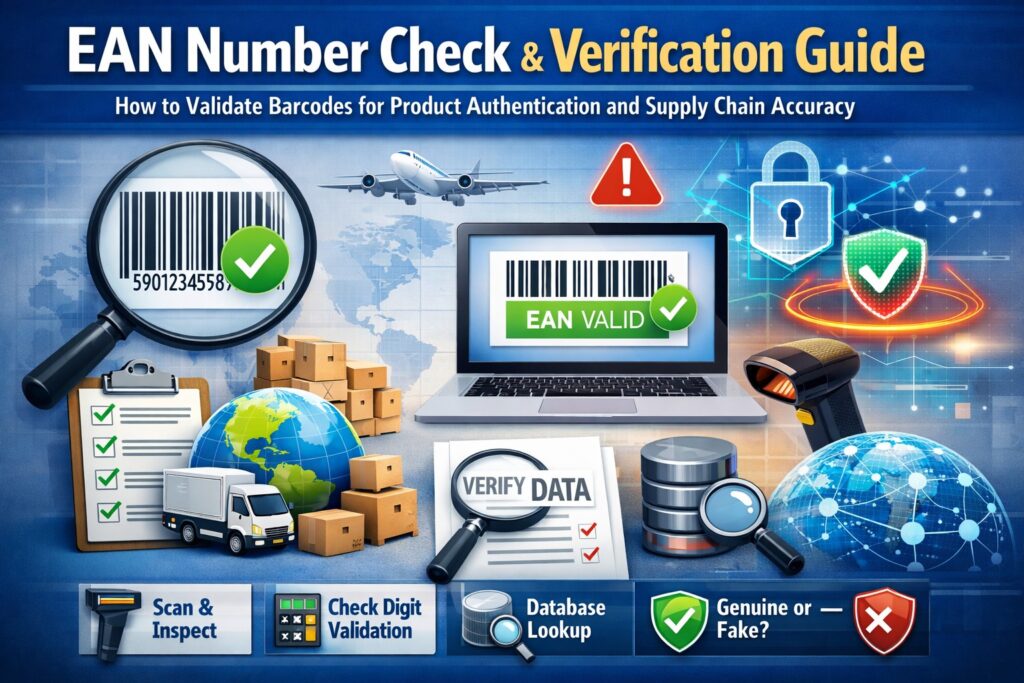
1. Manual EAN Number Verification: Manual verification involves cross-checking an EAN against a trusted database or manually validating the check digit using the standard calculation method. While simple, this approach can be time-consuming and prone to human error. This method is typically suitable for small-scale operations with limited product volumes. In India, DataKart powered by GS1 India acts as a national product data repository, enabling verification of registered retail products and supporting authenticity checks.
2. Smart Consumer Applications: Mobile and web-based applications such as Smart Consumer allow end users to verify EAN numbers instantly. By entering or scanning the barcode, consumers can access verified product information sourced from centralized databases. This transparency strengthens consumer trust and promotes informed purchasing decisions.
3. Automated EAN Number Verification: For businesses managing large product catalogs, automated verification systems offer the most efficient solution. Using barcode scanners, integrated software, and validation APIs, these systems can instantly verify EAN numbers with high accuracy. GS1 India’s GTIN Validation service enables bulk EAN verification, making it ideal for enterprises, e-commerce platforms, and large retailers. Automated verification reduces human error, accelerates operations, and supports real-time supply chain decision-making.
📞 Contact our barcode experts at +91 729705118 or +91 8949793519
To know more about this, please follow the below link.
Best Practices for Reliable EAN Number Verification
To ensure consistent and accurate EAN verification, businesses should adopt the following best practices:
1. Use Industry-Standard Verification Tools: Rely on GS1-approved tools and services to validate EANs against global standards. Regular verification prevents costly errors and enhances credibility among supply chain partners and consumers.
2. Train Teams on Accurate Data Handling: Employee awareness and training are critical. Teams should understand the importance of correct data entry, barcode allocation, and verification procedures. Ongoing training reduces errors and safeguards operational efficiency.
3. Leverage Automation for Scale: For high-volume operations, automated verification is essential. These systems provide faster validation, real-time insights, and improved inventory visibility, enabling data-driven decisions and streamlined workflows.
📞 Contact our barcode experts at +91 729705118 or +91 8949793519
Conclusion
The EAN number check is a cornerstone of accurate product identification and effective inventory management. Robust verification processes help businesses maintain efficient supply chains, deliver authentic products to consumers, and comply with international standards. As global trade and e-commerce continue to expand, mastering EAN verification is no longer optional, it is a strategic necessity. By adopting best practices and leveraging modern verification tools, organizations can reduce errors, build consumer trust, and achieve long-term operational success.