
Introduction
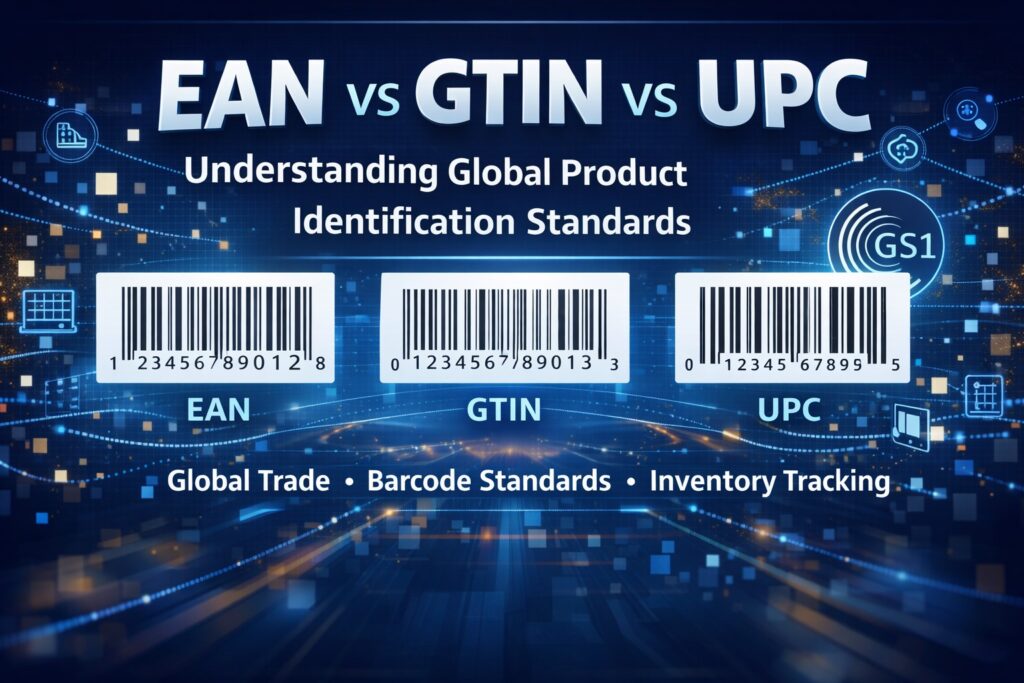
In today’s interconnected global economy, accurate and standardized product identification is essential for smooth trade, efficient inventory management, and fast retail transactions. From manufacturing units and warehouses to retail checkout counters, businesses rely on universal coding systems to ensure that products are recognized correctly across borders and platforms. Among the most widely used identification systems are EAN (European Article Number), GTIN (Global Trade Item Number), and UPC (Universal Product Code). While these codes share the same objective—uniquely identifying products—their structure, scope, and geographic usage differ. Understanding these distinctions is critical for businesses operating in domestic as well as international markets. This article breaks down EAN, GTIN, and UPC in a simple, practical manner to clarify how each code functions within the global supply chain.
GTIN: The Global Identification Framework
The Global Trade Item Number (GTIN) is the core identification system used worldwide to uniquely identify products and trade items. Governed by GS1, GTIN provides a standardized approach to product identification across industries and borders. GTIN is not a single barcode format but a family of identifiers that varies in length depending on product type and packaging level. It can be:
- GTIN-8 for very small items
- GTIN-12 (commonly represented by UPC)
- GTIN-13 (commonly represented by EAN)
- GTIN-14 for cartons, cases, and pallets
By accommodating multiple packaging levels, GTIN supports accurate inventory tracking, pricing, logistics, and sales reporting across the supply chain.
Contact our barcode experts at +91 729705118 and +91 8949793519.
EAN: The International Retail Standard
The European Article Number (EAN) is a barcode format most commonly represented as EAN-13, though a shorter EAN-8 variant exists for products with limited packaging space. EAN codes are widely used across Europe, Asia, India, Australia, and many other international markets. They enable retailers to manage large product assortments efficiently while maintaining compatibility with global trade systems.
An EAN typically includes:
- A GS1 prefix (often associated with the country or region)
- A company identifier
- A product reference
- A check digit for validation
EAN codes are especially valuable for businesses engaged in cross-border trade, as they align seamlessly with international retail and distribution systems.
UPC: The North American Retail Identifier
The Universal Product Code (UPC) is a 12-digit barcode predominantly used in the United States and Canada. It has been a retail standard in North America for decades and is deeply integrated into point-of-sale systems.
UPC codes consist of:
- A GS1-assigned company prefix
- An item reference number
- A check digit for accuracy
While UPC and EAN differ in length, they both fall under the GTIN system. A UPC is essentially a GTIN-12, making it fully compatible with global identification standards despite its regional focus.
Contact our barcode experts at +91 729705118 and +91 8949793519.
Structural Differences at a Glance
Although EAN, GTIN, and UPC are closely related, their structural differences influence how and where they are used:
- GTIN
Acts as the umbrella system and can be 8, 12, 13, or 14 digits long, depending on product and packaging level. - EAN
Typically 13 digits (EAN-13), designed for international retail environments; EAN-8 is used for small items. - UPC
Fixed at 12 digits, optimized for retail operations in North America.
All three include a check digit to ensure scanning accuracy and data integrity.
Geographic Usage and Market Relevance
The choice between EAN and UPC often depends on where products are sold:
- GTIN
Used globally as the master identification framework. - EAN
Dominant in Europe, India, and most international markets. - UPC
Primarily used in the United States and Canada.
For businesses operating internationally, GTIN compatibility ensures that products are recognized across different retail and logistics systems without duplication or confusion.
Contact our barcode experts at +91 729705118 and +91 8949793519.
To know more about this, please check the link below.
Role in Supply Chain Operations
These identification codes play a vital role in streamlining supply chain processes:
- GTIN improves end-to-end visibility, enabling accurate tracking across multiple packaging levels.
- EAN simplifies cross-border trade and inventory management for international retailers.
- UPC supports fast and reliable checkout experiences in North American retail environments.
Together, they enable automation, real-time inventory updates, and consistent data exchange among supply chain partners.
Key Benefits of Using Standardized Product Codes
Implementing EAN, GTIN, and UPC offers several operational advantages:
- Operational Efficiency – Faster scanning and automated data capture
- Reduced Errors – Minimized manual entry and mismatches
- Improved Customer Experience – Quicker checkouts and accurate pricing
- Global Trade Compatibility – Seamless integration across international markets
- Better Inventory Control – Accurate stock monitoring and replenishment
Conclusion
EAN, GTIN, and UPC are not competing systems but interconnected components of a unified global product identification framework. GTIN serves as the foundation, while EAN and UPC function as region-specific formats within that system. By understanding how these standards differ and where they apply, businesses can make informed decisions that enhance supply chain efficiency, ensure global compatibility, and support long-term growth. As global commerce continues to expand, adopting the right identification standard is not just a technical requirement—it is a strategic necessity.
Contact our barcode experts at +91 729705118 and +91 8949793519.