
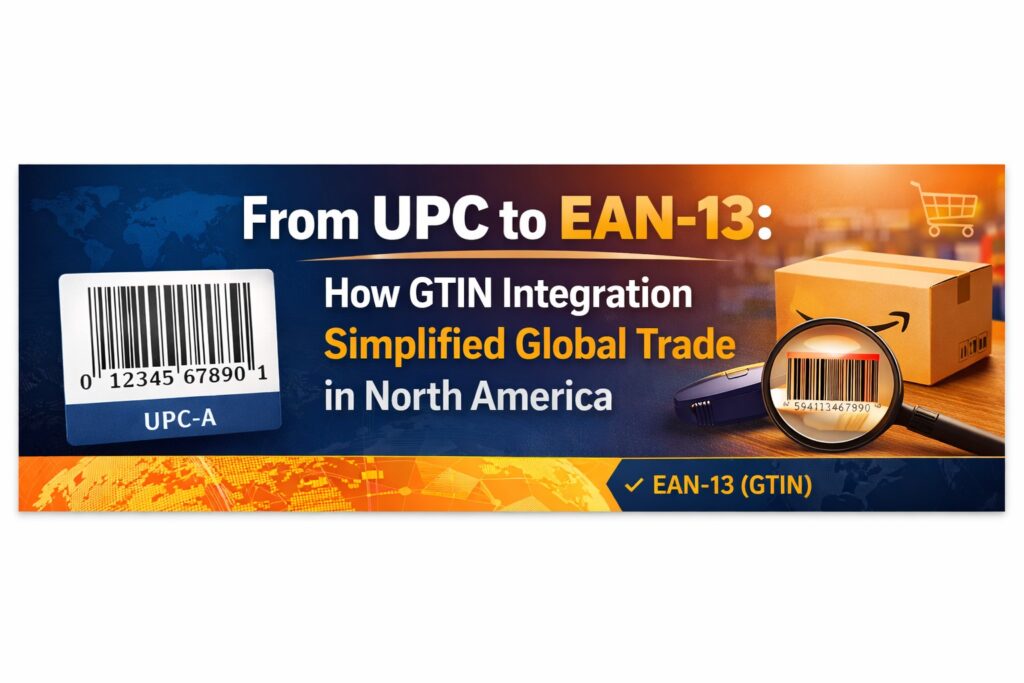
Introduction
In an increasingly interconnected global economy, standardized product identification is essential for seamless trade and efficient retail operations. Barcodes serve as the foundation of this standardization, enabling accurate product tracking, inventory management, and automated data exchange across borders. The adoption of EAN-13—now widely recognized as GTIN-13—represents a major step toward harmonizing global trade systems. In North America, particularly the United States and Canada, the integration of EAN-13 alongside the long-established UPC-A system has helped bridge regional and international markets, reducing friction in global commerce.
Historical Evolution: From UPC-A to EAN-13
The Universal Product Code (UPC) was introduced in the United States during the 1970s to modernize retail operations, particularly in supermarkets. Designed to streamline checkout processes and inventory control, UPC-A quickly became the dominant barcode standard in North America.
UPC-A consists of 12 digits:
- The first segment identifies the manufacturer
- The next segment identifies the product
- The final digit serves as a check digit
While highly effective for domestic retail, UPC-A was limited in its ability to support international trade. Around the same time, Europe introduced the EAN-13 system to accommodate a broader, more diverse market. EAN-13 expanded the barcode structure to 13 digits, enabling global uniqueness and wider scalability. Over time, EAN-13 evolved into a globally accepted standard, forming the basis of today’s GTIN system.
📞 Contact our barcode experts at +91 729705118 or +91 8949793519.
The Shift Toward EAN-13 in North America
A major turning point occurred in 2005, when North American retailers and scanning systems began accepting 13-digit barcodes. This decision significantly reduced the need for dual barcoding—where manufacturers previously printed both UPC-A and EAN-13 on product packaging. By recognizing GTIN-13, retailers simplified supply chains, reduced packaging complexity, and enabled smoother cross-border trade. European exporters, in particular, benefited from this shift, as their existing EAN-13 barcodes became fully compatible with North American retail systems. While UPC-A remains in use, the coexistence of both formats reflects a transitional phase rather than a limitation. Modern POS systems seamlessly scan both UPC-A and EAN-13, ensuring interoperability across markets.
📞 Contact our barcode experts at +91 729705118 or +91 8949793519.
EAN-13 vs. UPC-A: Key Differences
Understanding the distinctions between EAN-13 and UPC-A is essential for businesses engaged in international trade.
1. Length and Structure
- EAN-13 (GTIN-13): 13 digits, including a GS1 prefix, company prefix, item reference, and check digit
- UPC-A: 12 digits, consisting of a company prefix, product number, and check digit
2. Geographic Scope
- EAN-13: Globally accepted and used across Europe, Asia, Africa, and increasingly in North America
- UPC-A: Primarily used in the United States and Canada
3. Global Scalability
- EAN-13: Designed for international markets, offering greater flexibility and global uniqueness
- UPC-A: Optimized for regional use, with limited scalability beyond North America
How EAN-13 Enhances Retail Operations
The adoption of EAN-13 streamlines retail operations by enabling fast and accurate product scanning at checkout points. Instead of manual data entry, barcodes link products to centralized databases containing pricing, inventory, and product details.
This approach:
- Speeds up checkout processes
- Reduces human error
- Improves inventory accuracy
- Enables dynamic pricing without relabeling products
EAN-13 also supports advanced analytics, allowing retailers to track sales trends and optimize stock levels with greater precision.
To know more about this, please check the below link.
Understanding GS1 Prefixes and Country Codes
EAN-13 barcodes include GS1 prefixes that identify the issuing GS1 member organization. These prefixes do not indicate where a product is manufactured but rather where the barcode was registered.
For example:
- Germany: 40–43
- United States & Canada: 00–13
This system ensures global uniqueness and consistent product identification across supply chains.
📞 Contact our barcode experts at +91 729705118 or +91 8949793519.
The Global Impact of EAN-13 (GTIN)
EAN-13 has become a cornerstone of modern supply chains, extending far beyond retail into manufacturing, logistics, healthcare, and distribution. Its ability to support automation, data accuracy, and cross-border compatibility makes it indispensable in today’s global economy. By enabling a single, globally recognized product identifier, EAN-13 reduces complexity and enhances efficiency across international trade networks.
📞 Contact our barcode experts at +91 729705118 or +91 8949793519.
Conclusion
The integration of EAN-13 (GTIN-13) into North American retail systems represents a significant milestone in global trade standardization. While UPC-A remains relevant, the widespread acceptance of EAN-13 reflects a broader shift toward harmonized, international supply chains. As global commerce continues to expand, standardized identification systems like EAN-13 will play an increasingly vital role in enabling efficiency, accuracy, and scalability. For businesses operating across borders, adopting globally recognized barcode standards is no longer optional—it is essential for long-term growth and competitiveness.