
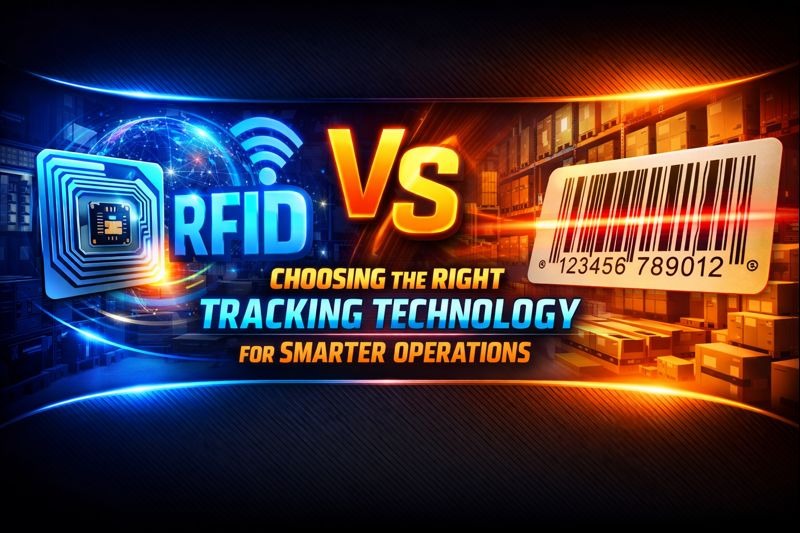
Introduction
The pace of change in logistics and inventory management has accelerated rapidly with the adoption of smarter tracking technologies. One notable advancement is the growing use of Radio-Frequency Identification (RFID) systems, such as the introduction of RFID baggage tags at Delhi’s Indira Gandhi International Airport. As organizations adopt these innovations, it becomes increasingly important to understand how RFID compares with traditional barcode systems, where each technology excels, and what limitations they may present in practical use.
What Is RFID Technology?
RFID, or Radio-Frequency Identification, is a wireless technology that uses radio waves to automatically identify and track objects. An RFID system is made up of three core components: an RFID tag (also called a transponder), an RFID reader, and a backend system that processes the data. The reader emits radio signals, and when a tag enters this signal range, it responds by transmitting its stored information, enabling instant identification without physical contact or direct visibility. RFID is widely used across industries, from retail inventory tracking and warehouse asset management to airport operations. In aviation, RFID-enabled baggage tags significantly improve check-in efficiency and tracking accuracy, reducing lost luggage and enhancing passenger satisfaction.
📞Contact our barcode experts at +91 729705118 and +91 8949793519.
Types of RFID Tags
RFID tags are categorized based on how they are powered and how they communicate with readers.
Passive RFID Tags: Passive tags do not contain an internal power source. They draw energy from the radio waves emitted by the reader, making them affordable, lightweight, and ideal for applications such as inventory management, retail tagging, and access control.
Semi-Passive RFID Tags: Semi-passive tags include a small internal battery that powers the chip but still rely on the reader’s signal to communicate. This allows for improved performance and longer read ranges compared to passive tags, while remaining more cost-effective than active tags.
Active RFID Tags: Active tags have their own battery and can transmit signals independently. They offer the longest read ranges and highest performance, making them suitable for tracking high-value assets, vehicles, or equipment, albeit at a higher cost.
RFID systems operate across different frequency bands Low Frequency (LF), High Frequency (HF), and Ultra-High Frequency (UHF) each designed for specific ranges, data capacities, and environmental conditions.
Understanding Barcodes
Barcodes have been a reliable identification method since the 1970s. A barcode consists of a series of printed lines or patterns that represent data in a machine-readable format. Barcode scanners interpret these patterns using visible light to retrieve information such as product numbers or batch details. Because barcode scanning requires a direct line of sight, items must be scanned individually. Beyond traditional one-dimensional barcodes, two-dimensional formats like QR codes can store significantly more data and are widely used in retail, logistics, and marketing. Barcode readers are available as handheld devices, mobile scanners, or integrated point-of-sale systems.
📞Contact our barcode experts at +91 729705118 and +91 8949793519.
RFID vs Barcodes: Key Differences Explained
Although both technologies are used for identification and tracking, their capabilities differ considerably.
Communication Method: RFID uses radio waves and does not require line-of-sight scanning, allowing multiple items to be read simultaneously. Barcodes rely on optical scanning and must be read one at a time.
Durability: Barcode labels are typically printed on paper or adhesive materials and can degrade due to wear, moisture, or dirt. RFID tags are more robust and can be embedded or encased, making them suitable for harsh environments.
Speed and Accuracy: RFID systems can capture data from dozens of tags instantly, reducing manual effort and human error. Barcode systems are slower, as each item must be aligned and scanned individually.
Security: Barcodes are easy to duplicate, which can increase the risk of counterfeiting. RFID tags are more complex and can include encryption, offering higher levels of data security.
Cost Considerations: Barcodes are inexpensive and easy to deploy, while RFID involves higher initial costs. However, RFID often delivers better long-term value through automation and efficiency gains.
Read Range: RFID tags can be read from several meters away, whereas barcodes typically require close-range scanning.
📞Contact our barcode experts at +91 729705118 and +91 8949793519.
To know more about this, please check the link below.
Real-World Applications of RFID
RFID technology has expanded well beyond airport baggage handling and continues to transform multiple industries.
Retail and Inventory Control: Retailers use RFID to gain real-time visibility across the supply chain, improving inventory accuracy and reducing losses.
Asset Tracking: Warehouses, factories, and construction sites rely on RFID to track equipment and tools, ensuring better utilization and reduced theft.
Healthcare: Hospitals use RFID for patient identification, medication tracking, and equipment monitoring, enhancing safety and operational efficiency.
Event Management: RFID wristbands enable quick access control, cashless payments, and valuable insights into attendee behaviour.
Supply Chain Visibility: RFID provides real-time tracking of goods in transit, helping organizations respond faster to disruptions and improve overall efficiency.
The Future of RFID Technology
As digital transformation accelerates, RFID is set to play an even larger role across industries. The adoption of RFID baggage tags at major airports signals a broader shift toward automation, transparency, and improved customer experience. However, organizations must also consider challenges such as system integration, cost of implementation, data privacy concerns, and performance issues in environments with metal or liquids.
Choosing between RFID and barcodes depends on specific operational needs, scale, and budget. While RFID offers advanced capabilities and automation, barcodes remain practical and cost-effective for many applications.
Conclusion
RFID represents a powerful evolution in tracking technology, delivering speed, accuracy, and visibility that traditional barcodes cannot always match. That said, both technologies have distinct strengths and continue to coexist in modern operations. By carefully evaluating business requirements and long-term goals, organizations can select the right solution to optimize efficiency, reduce errors, and stay competitive in an increasingly data-driven world.
📞Contact our barcode experts at +91 729705118 and +91 8949793519.