
Introduction
In an innovation-driven economy, intellectual property is often a startup’s most valuable asset. Whether it is proprietary technology, a distinctive brand, original content, or confidential business know-how, IP forms the foundation of long-term value creation. As India moves into 2026, the IP landscape has become markedly more startup-friendly. Streamlined filing procedures, expedited examinations, and generous government-backed incentives have reduced both the time and cost of securing IP rights. For founders, this creates a critical opportunity—not just to protect ideas, but to build defensible businesses that attract capital, partnerships, and global expansion.
Understanding Intellectual Property in the Startup Context
Intellectual property refers to legally protected rights over creations of the mind, including inventions, software, brand identifiers, artistic works, and confidential business information. For startups, IP protection serves three essential purposes:
- Value Creation: IP strengthens valuation during funding and exit events.
- Risk Mitigation: It reduces exposure to infringement claims and internal ownership disputes.
- Market Advantage: It creates entry barriers and brand exclusivity.
An effective IP strategy integrates legal protection with business goals from the earliest stages.
1. Initial IP Assessment and Strategic Planning
The foundation of IP protection lies in understanding what needs protection and why.
Identify Core IP Assets
Startups should systematically map all intellectual assets—technology, algorithms, product designs, brand names, logos, software code, databases, and proprietary processes.
Conduct Clearance and Prior Art Searches
Early trademark and patent searches help ensure that proposed brands or technologies do not infringe existing rights, preventing costly rebranding or litigation later.
Perform an IP Audit
Periodic IP audits help identify protection gaps, assess commercial value, and ensure that ownership and filings align with business growth and regulatory requirements.
2. Asset-Specific IP Protection
Different IP assets require different legal tools.
Trademarks
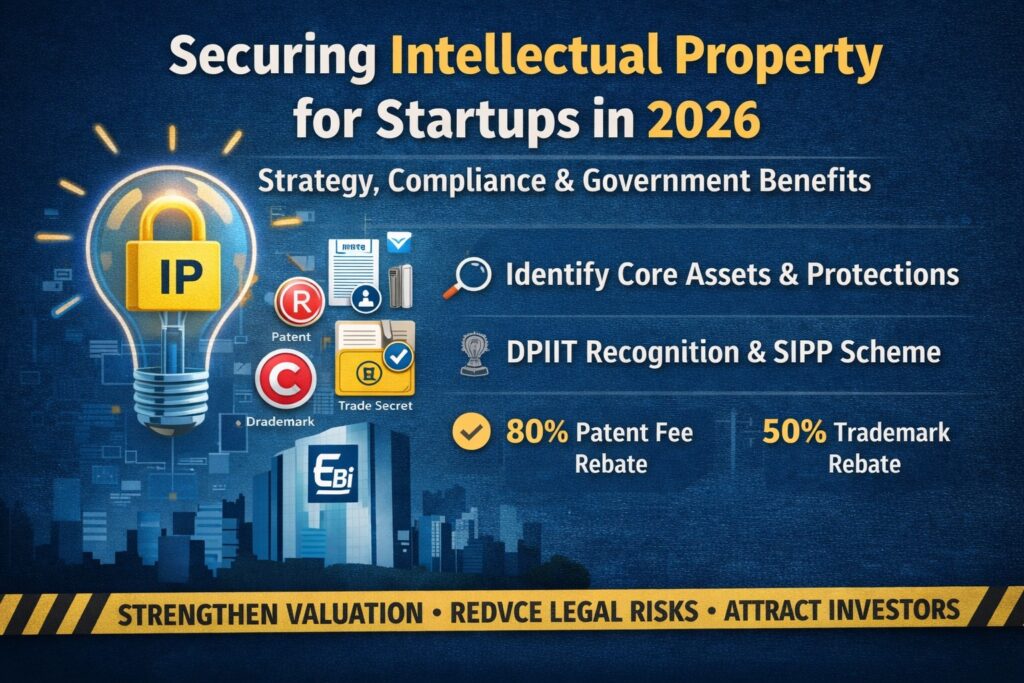
Registering trademarks for company names, logos, and product identifiers secures exclusive rights and brand recognition. In India, DPIIT-recognised startups receive a 50% rebate on trademark filing fees, making early registration highly cost-effective.
Patents
For startups developing novel technologies or processes, patents are critical. Recognised startups benefit from an 80% reduction in patent filing fees and access to expedited examination, often reducing grant timelines from years to months.
Copyrights
Software code, digital content, documentation, and marketing materials are protected through copyright. While protection exists automatically, registration strengthens enforceability and evidentiary value.
Trade Secrets
Confidential information such as algorithms, customer data, and pricing models should be protected through internal controls, restricted access, and contractual safeguards rather than public filings.
3. Ownership and Assignment Framework
Many startups fail not because of weak innovation, but because of unclear IP ownership.
Founder IP Assignment
All intellectual property created by founders must be formally assigned to the company. Without this, investors may view the startup as legally unstable.
Employee and Contractor Agreements
Every employment and consultancy contract should include “work-for-hire” and IP assignment clauses to ensure that all creations legally vest in the company.
Non-Disclosure Agreements (NDAs)
NDAs should be executed before sharing sensitive information with employees, vendors, partners, or potential investors to preserve confidentiality and trade secret protection.
4. Operational Compliance and IP Enforcement
IP protection is an ongoing process, not a one-time filing.
Internal IP Policies
Clear internal policies on IP creation, usage, disclosure, and ownership help prevent accidental leakage or misuse.
Monitoring and Enforcement
Startups should actively monitor markets and digital platforms for potential infringement and adopt structured enforcement strategies, including cease-and-desist notices and alternative dispute resolution.
Data Protection Compliance
With the Digital Personal Data Protection (DPDP) Act now fully operational, startups must ensure lawful handling of personal and proprietary data, as non-compliance can severely impact IP and brand credibility.
Leveraging Government Incentives in 2026
India’s policy ecosystem strongly supports startup IP protection.
DPIIT Recognition
DPIIT recognition is the gateway to most IP-related benefits and is essential for cost and time efficiency.
Cost Rebates
- 80% rebate on patent filing fees
- 50% rebate on trademark filing fees
SIPP Scheme (IP Facilitation)
Under the Scheme for Facilitating Startups Intellectual Property Protection, the government bears the professional fees of empanelled IP facilitators, significantly reducing legal costs.
Expedited Examinations
Fast-track patent examination allows startups to secure enforceable rights quickly—an advantage during fundraising or technology licensing negotiations.
To know more about this, please check the link below.
Legal and Regulatory Compliance Considerations
A robust IP strategy must align with broader legal compliance.
- DPDP Act Compliance: Mandatory for startups handling personal data
- Formal IP Assignment Agreements: For founders and employees
- Employment Law Compliance: Including POSH Act obligations
- Arbitration Clauses: Essential for faster dispute resolution amid judicial backlogs
Key Statutory Platforms for Startups
- IP India Portal: Patents, trademarks, designs
- Startup India Portal: DPIIT recognition and SIPP access
- Ministry of Corporate Affairs (MCA): Corporate filings and compliance
Conclusion
As startups enter 2026, intellectual property protection has evolved into a core business and governance function. Startups that proactively assess their IP, secure asset-specific protections, clarify ownership, and leverage government incentives are far better positioned to scale, attract investment, and defend innovation. In a competitive and compliance-driven ecosystem, IP is not merely a legal safeguard—it is a strategic asset. Startups that treat it as such will define the next generation of sustainable, high-value enterprises in India.