
Introduction
Securing Series A funding is one of the most pivotal milestones in a startup’s lifecycle. It signifies a shift from validating an idea to proving scalability. At this stage, founders are expected to demonstrate not only innovation but also structured growth, predictable revenue, and operational discipline. Unlike seed funding — which often backs vision and early traction — Series A investors prioritize data, repeatability, and growth efficiency. This guide outlines the essential steps startups must take to position themselves as attractive, investment-ready ventures.
Understanding Series A Funding
Series A typically follows seed or pre-Series A rounds and represents the first significant institutional venture capital investment. Funding at this stage generally ranges between $5 million and $15 million, with startups often diluting 15% to 30% equity. Investors participating in Series A are not merely funding experimentation — they are backing growth engines. They seek startups that have validated demand and are ready to scale aggressively.
The Strategic Shift: From Validation to Scalability
At the seed stage, the focus is on testing assumptions and building a minimum viable product (MVP).
At Series A, the focus shifts to:
- Demonstrating consistent revenue growth
- Optimizing customer acquisition channels
- Improving unit economics
- Strengthening leadership and governance
- Preparing for institutional due diligence
Startups must prove that growth is not accidental but systematic and repeatable.
Key Areas of Preparation for Series A
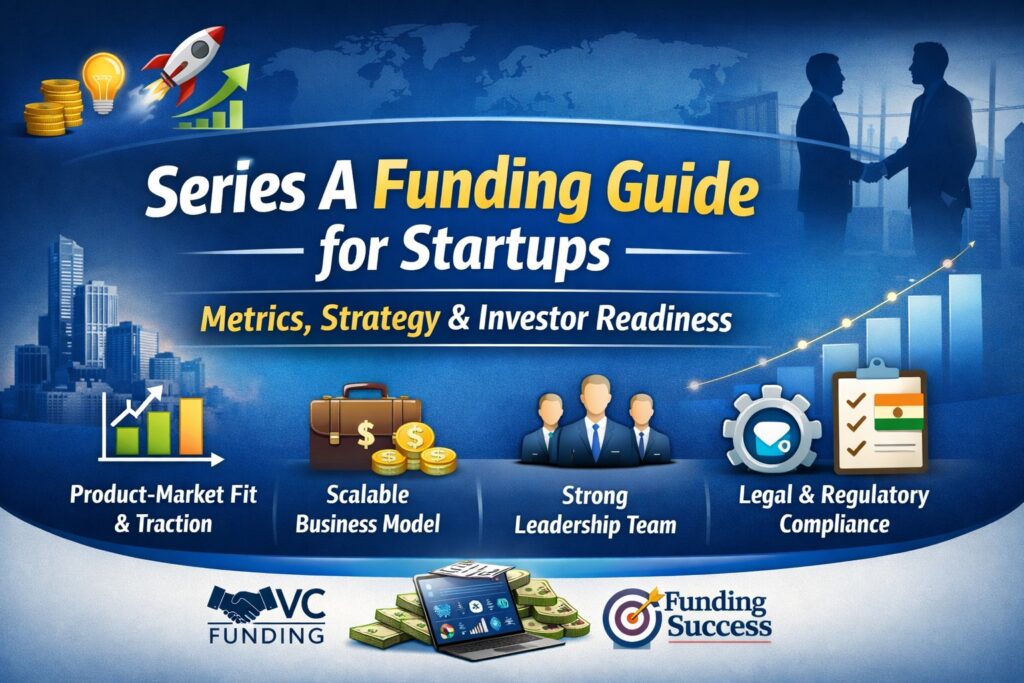
1. Demonstrating Product-Market Fit and Traction
Clear evidence of product-market fit is non-negotiable. Investors want to see that customers value the product enough to pay consistently and remain engaged.
Key metrics investors evaluate include:
- Monthly Recurring Revenue (MRR): Typically $100,000–$500,000
- Annual Recurring Revenue (ARR): For Indian SaaS startups, ~$1 million ARR is often a benchmark
- Growth Rate: 15–20% month-over-month growth sustained over 6+ months
- Retention & Churn: Low churn and strong cohort retention
- LTV:CAC Ratio: Ideally 3:1 or higher
- Customer Acquisition Cost (CAC) Payback Period: Preferably under 12–18 months
The goal is to prove that growth is scalable, predictable, and capital-efficient.
2. Building a Scalable Business Model
Series A investors fund scale, not survival. Your business model must demonstrate operational leverage and the ability to expand without disproportionate cost increases.
Focus areas include:
- Clear Go-to-Market (GTM) Strategy: Defined customer segments and acquisition channels
- Optimized Unit Economics: Sustainable margins and cost control
- Expansion Strategy: Geographic, product-line, or vertical expansion plans
- Path to Profitability: A realistic roadmap, even if profitability is not immediate
Scalability must be embedded in the model — not dependent on constant reinvention.
3. Strengthening the Leadership Team
Investors back teams as much as businesses. A credible, execution-focused leadership team significantly increases funding probability.
Important considerations:
- Complementary founding team skillsets
- Strong technical and commercial leadership
- Experienced advisors or board members
- Defined roles and decision-making clarity
Institutional investors look for teams capable of managing rapid growth and complex governance structures.
4. Crafting a Compelling Investor Narrative
Numbers open the door, but storytelling closes the deal. Your pitch deck must clearly articulate:
- The Problem: What inefficiency or gap exists?
- The Solution: Why is your product uniquely positioned?
- Market Opportunity: A Total Addressable Market (TAM) ideally exceeding $1 billion
- Traction: Real data demonstrating demand
- Competitive Advantage: Defensibility, IP, network effects, or switching costs
- Financial Projections: 3–5 year projections aligned with growth assumptions
- Use of Funds: Clear deployment strategy for capital
Your narrative should reflect clarity, ambition, and execution capability.
5. Organizing Legal and Financial Documentation
Institutional due diligence at Series A is rigorous. An investor-ready virtual data room should include:
Corporate Documents
- Certificate of Incorporation
- Memorandum of Association (MoA)
- Articles of Association (AoA)
- Board resolutions
Agreements
- Founder agreements
- Shareholders’ agreements
- IP assignment agreements
- Employment and ESOP documentation
Financial Documents
- Audited financial statements
- Revenue breakdowns
- Forecast models
- Clean capitalization table
A structured and transparent documentation process builds investor confidence.
To know more about this, please check the link below.
6. Ensuring Regulatory Compliance (Indian Context)
Startups in India must pay close attention to regulatory compliance, particularly when raising funds from foreign investors.
Key regulatory areas include:
- Companies Act, 2013: Corporate governance and reporting compliance
- FEMA Regulations: Filing Form FC-GPR within 30 days of share issuance to foreign investors
- Angel Tax (Section 56(2)(viib)): Ensuring fair market valuation compliance
- Startup India Recognition (if applicable)
Regulatory preparedness minimizes delays and prevents valuation complications during due diligence.
7. Building Investor Relationships Early
Fundraising is not a transactional activity — it is relationship-driven. Founders should begin engaging with potential Series A investors 6–12 months before actively raising capital.
Effective strategies include:
- Regular investor updates
- Warm introductions via seed investors or advisors
- Participation in startup events and VC networking forums
- Strategic industry visibility
When fundraising begins, familiarity increases trust and accelerates decision-making.
8. Strategizing the Fundraising Timeline
The Series A fundraising cycle typically spans 3–6 months. Founders should initiate fundraising with at least 6 months of runway remaining.
Raising capital under financial pressure weakens negotiation power. A structured timeline ensures:
- Competitive term sheets
- Stronger valuation discussions
- Better investor alignment
Preparation is leverage.
Conclusion
Preparing for Series A funding requires far more than a compelling idea. It demands measurable traction, scalable operations, disciplined governance, and strategic storytelling. Startups that successfully raise Series A demonstrate:
- Clear product-market fit
- Strong growth metrics
- Sustainable unit economics
- Leadership maturity
- Legal and regulatory readiness
- A long-term vision backed by data
Series A is not merely about raising capital — it is about proving that your startup is ready to evolve into a category-defining company. Thorough preparation transforms fundraising from uncertainty into opportunity — positioning your startup for accelerated growth and long-term success.