
Introduction
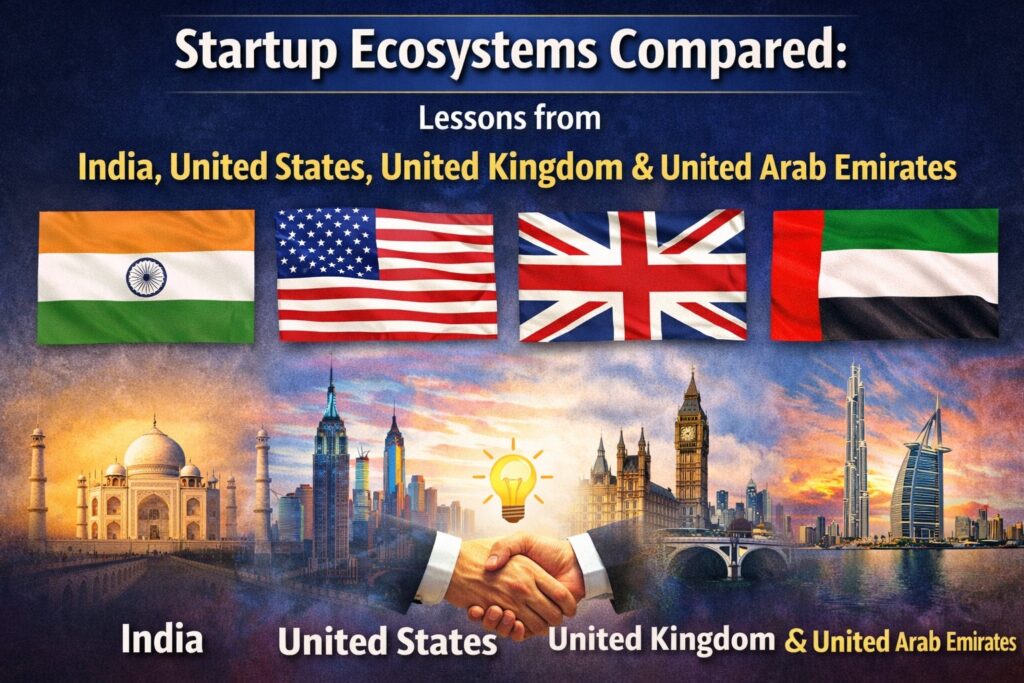
The modern startup economy is no longer confined by geography. Founders today think globally from day one—raising capital across borders, hiring distributed teams, and launching products in multiple jurisdictions. Yet, every startup ecosystem operates within a distinct cultural, legal, and financial framework. Four ecosystems in particular—India, the United States, the United Kingdom, and the United Arab Emirates—offer powerful but contrasting models of entrepreneurial growth. Understanding their structures, incentives, and regulatory environments is essential for founders aiming to scale sustainably. This blog reframes the startup conversation through a comparative lens, identifying strategic insights founders can apply regardless of location.
The United States: Scale, Speed, and Capital Depth
The United States remains the benchmark for startup ambition. With innovation hubs such as Silicon Valley, New York, and Austin, it offers unmatched access to venture capital and institutional support.
What Defines the US Ecosystem?
- Deep Venture Capital Networks
The US hosts one of the world’s most mature VC ecosystems, enabling rapid scaling for high-growth startups.
- Strong University–Startup Pipeline
Institutions like Stanford, MIT, and Harvard continuously fuel entrepreneurship with research, talent, and commercialization frameworks.
- Risk-Tolerant Culture
Failure is often viewed as experience rather than stigma, encouraging bold experimentation.
Key Challenge
The pressure to scale aggressively can lead to overvaluation, operational strain, and founder burnout. High operating costs also demand faster traction.
Lesson: Build for scalability—but ensure governance and financial discipline grow alongside valuation.
India: Cost-Efficient Innovation at Massive Scale
India has evolved into one of the fastest-growing startup ecosystems globally, producing unicorns across fintech, SaaS, edtech, and consumer tech.
What Drives India’s Growth?
- Vast Talent Pool
India produces millions of engineering and management graduates annually, creating a robust technical workforce.
- Cost Advantage
Lower operational costs allow startups to experiment longer with limited capital.
- Policy Push
Government initiatives like “Startup India” have streamlined incorporation, funding access, and regulatory support.
Key Challenge
Founders often navigate bureaucratic complexities, infrastructure constraints, and regulatory delays.
Lesson: Legal structuring and compliance planning from day one reduce friction as scale increases.
The United Kingdom: Legal Sophistication Meets Financial Strength
The UK stands as Europe’s leading startup hub, with London as a global fintech capital.
What Makes the UK Attractive?
- Investor Confidence & Structured Funding
Angel networks and VCs operate within a well-regulated, transparent financial environment.
- Strong IP Protection Framework
The legal infrastructure offers clarity in intellectual property rights and dispute resolution.
- Gateway to Europe & Global Markets
Despite Brexit, London remains internationally connected.
Key Challenge
Regulatory shifts and cross-border trade complexities post-Brexit require adaptive planning.
Lesson: Strong documentation and IP protection strategies are competitive advantages in mature ecosystems.
The United Arab Emirates: Strategic Location & Policy Agility
The UAE has rapidly positioned itself as a gateway between East and West, particularly through hubs like Dubai and Abu Dhabi.
What Sets the UAE Apart?
- Tax Efficiency
Zero personal income tax and favorable corporate regimes attract global founders.
2. Government-Led Innovation
Free zones and startup hubs encourage foreign ownership and streamlined setup.
3. Multinational Market Access
The UAE’s demographic diversity enables product testing across cultures.
Key Challenge
Regulatory frameworks vary by emirate and free zone, requiring careful legal navigation.
Lesson: Jurisdictional structuring decisions significantly impact scalability and tax efficiency.
Cross-Border Themes: What Every Founder Must Understand
Despite structural differences, several universal patterns emerge across all four ecosystems:
- Founder Agreements Are Non-Negotiable
Most startup failures arise from internal disputes rather than market competition. A well-drafted founders’ agreement prevents governance crises.
2. Regulatory Literacy Is a Strategic Asset
Understanding local compliance requirements avoids costly litigation and investor hesitation.
3. Talent Competition Is Global
Top talent evaluates culture, equity participation, and growth potential—not just salary.
4. Market Localization Matters
What succeeds in the US may require pricing, compliance, or distribution adjustments in India or the UAE.
5. Sustainability & ESG Expectations Are Rising
Investors increasingly evaluate environmental and governance standards alongside profitability.
To know more about this, please check the link below.
Strategic Takeaways for Global Founders
- Structure before scale: Incorporation choices, IP ownership, and shareholder rights determine long-term resilience.
- Think jurisdictionally: Where you incorporate affects taxation, fundraising, and exit opportunities.
- Balance ambition with governance: Growth without compliance invites regulatory exposure.
- Leverage ecosystem strengths: Build R&D in India, raise capital in the US, protect IP in the UK, and expand regionally via the UAE—global strategy is modular.
Conclusion: Building Beyond Borders
The startup ecosystems of India, the United States, the United Kingdom, and the United Arab Emirates represent four distinct but interconnected models of entrepreneurship. Each offers unique structural advantages shaped by policy, capital depth, cultural attitudes toward risk, and regulatory clarity. For founders, the future lies not in choosing one ecosystem—but in understanding how to bridge them. In an increasingly borderless economy, adaptability, legal preparedness, and cross-jurisdictional awareness are no longer optional. They are the foundation of sustainable global entrepreneurship.