
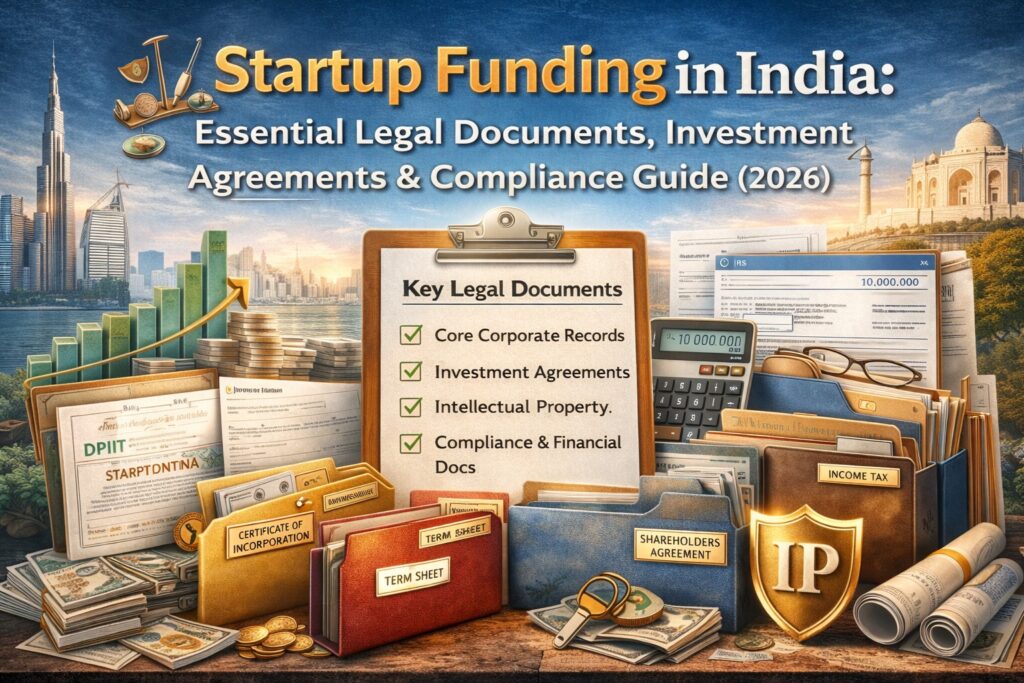
Introduction
Launching a startup is exciting — but raising capital introduces a layer of legal complexity that many founders underestimate. While investors assess business models and growth potential, they also carefully examine a startup’s legal preparedness. Strong documentation is not merely procedural — it reflects governance discipline, risk management, and operational maturity. Without the right legal framework, even promising funding conversations can collapse.
This guide breaks down the essential legal documents every founder must prepare before and during a funding round.
1. Core Corporate Documents: The Legal Foundation
Before seeking investment, your company must be structurally sound. These documents establish legal identity and governance clarity.
- Certificate of Incorporation
This document confirms that your company has been legally formed under applicable law. It serves as proof of existence and is required for opening bank accounts, entering contracts, and issuing shares.
b. Memorandum of Association (MoA)
The MoA defines the company’s objectives and scope of operations. It outlines what your startup is legally permitted to undertake and forms the outer boundary of corporate activity.
c. Articles of Association (AoA)
The AoA functions as the company’s internal governance charter. It regulates shareholder rights, director powers, share issuance procedures, and internal decision-making. During funding rounds, the AoA is often amended to incorporate investor rights such as:
- Preference shares
- Liquidation preference
- Anti-dilution protection
- Reserved matters
d. Founder’s Agreement
This agreement clarifies equity allocation, vesting schedules (commonly a 1-year cliff with 4-year vesting), roles, responsibilities, and dispute resolution mechanisms among co-founders. Investors closely review founder arrangements to assess long-term commitment and internal stability.
e. Board Resolutions
Formal resolutions authorizing fundraising, share issuance, and investor entry demonstrate structured governance and legal compliance.
2. Investment-Specific Documents: Structuring the Deal
Once funding discussions begin, specific agreements formalize the investor-founder relationship.
a. Term Sheet
A non-binding document outlining key commercial terms:
- Investment amount
- Valuation
- Type of securities
- Investor rights
Although not legally binding (except confidentiality and exclusivity clauses), it sets the negotiation framework.
b. Shareholders’ Agreement (SHA)
A binding agreement governing shareholder rights and obligations. It typically includes:
- Board composition
- Voting rights
- Reserved matters
- Anti-dilution provisions
- Exit mechanisms (Tag-Along & Drag-Along rights)
- Information rights
A robust SHA prevents future disputes and protects minority and majority stakeholders alike.
c. Share Subscription Agreement (SSA)
This agreement formalizes the investor’s commitment to subscribe to shares at a specified price. It includes representations, warranties, and closing conditions.
d. Convertible Instruments (Convertible Notes / SAFE / iSAFE)
Early-stage startups often raise capital through convertible instruments that convert into equity at a future funding round — typically at a discount or subject to a valuation cap.
These instruments:
- Delay valuation discussions
- Reduce immediate dilution
- Offer flexibility for early-stage fundraising
e. Valuation Report
In India, issuance of shares must comply with fair market value requirements under applicable regulations. A registered valuer’s report ensures compliance and pricing transparency.
3. Intellectual Property & HR Documentation: Protecting Core Assets
For many startups, intellectual property is the primary asset.
a. IP Assignment Agreements
Ensure that all intellectual property created by founders, employees, or contractors is legally owned by the company. Without proper assignment, ownership disputes can derail funding or acquisitions.
b. Non-Disclosure Agreements (NDAs)
NDAs protect confidential information when sharing business models, technology, or financial projections with investors, advisors, or employees.
c. Employment Agreements & ESOP Documentation
Employment contracts should include:
- Confidentiality clauses
- IP ownership provisions
- Non-compete clauses (where enforceable)
Employee Stock Option Plans (ESOPs) help attract and retain talent while aligning employee incentives with company growth.
4. Compliance & Financial Documentation: Building Investor Confidence
Investors perform legal and financial due diligence before closing deals.
a. Financial Statements & Tax Filings
Accurate, updated, and preferably audited financials reflect operational transparency and financial discipline.
b. Statutory Registers & Secretarial Records
Maintaining proper corporate records signals governance maturity.
c. Regulatory Registrations
Depending on the nature of business, startups may require:
- GST Registration
- Sector-specific licenses
- DPIIT recognition under Startup India
- FEMA compliance for foreign investment
Non-compliance can delay or invalidate funding transactions.
To know more about this, please check the link below.
5. Understanding the Indian Legal Framework
Startup funding in India operates within a defined regulatory environment governed by:
- The Companies Act, 2013
- Foreign Exchange Management Act (FEMA)
- Reserve Bank of India (RBI) regulations
- SEBI regulations (where applicable)
Foreign investments, pricing guidelines, reporting obligations, and sectoral caps must be carefully evaluated before structuring transactions. Legal structuring is not optional — it is foundational.
Conclusion
Startup funding is not merely a financial milestone — it is a legal transformation of your company’s structure, governance, and ownership. Well-prepared documentation:
- Protects founders
- Builds investor trust
- Minimizes disputes
- Ensures regulatory compliance
- Accelerates deal execution
By proactively preparing essential legal documents, founders position themselves as serious, investment-ready entrepreneurs. Funding success is not just about vision — it is about preparation.