
Introduction
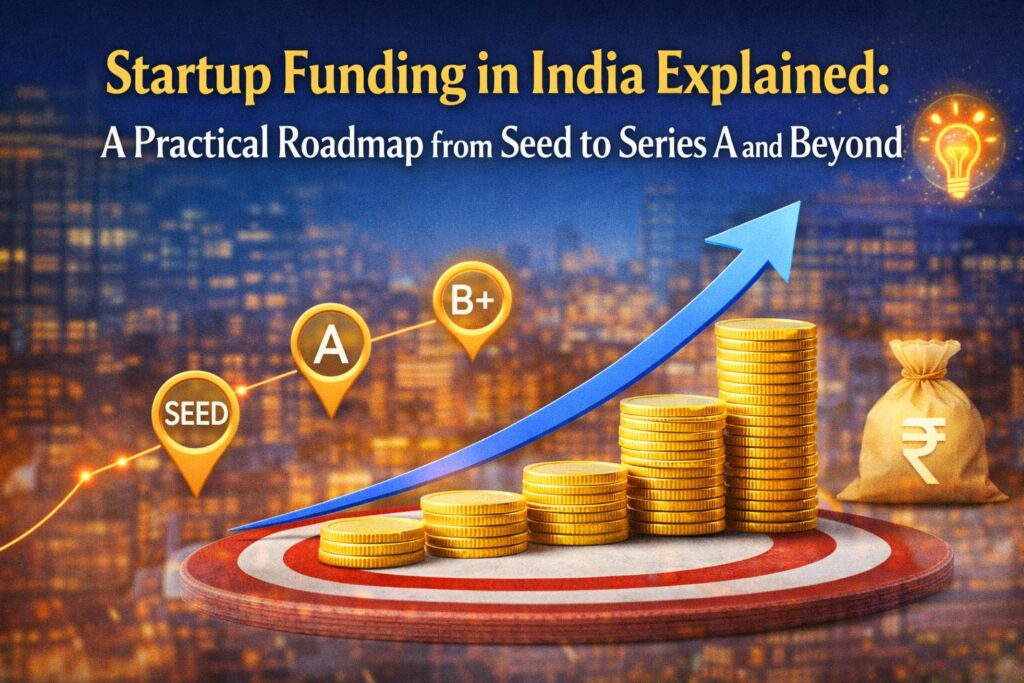
India’s startup ecosystem has matured into one of the most dynamic in the world, attracting domestic and global investors alike. Yet for founders, raising capital remains one of the most complex and time-sensitive challenges in the entrepreneurial journey. Understanding funding stages, realistic timelines, investor expectations, and compliance requirements is essential for success. Fundraising is not merely about pitching—it is about preparation, positioning, and persistence. This blog provides a practical roadmap to help entrepreneurs navigate India’s startup funding landscape strategically and efficiently.
Understanding the Startup Funding Timeline in India
Securing startup funding in India typically takes 4 to 6 months, though timelines may extend depending on market conditions, investor appetite, and internal preparedness.
Several factors influence this duration:
- Stage of funding
- Investor alignment
- Market conditions
- Due diligence requirements
- Traction and financial clarity
Fundraising is a structured process—not an overnight event.
Funding Stages and Typical Timelines
1. Seed Funding: Building the Foundation
Seed funding supports early-stage development such as:
- Prototype creation
- Market validation
- Initial team building
The seed round may take 5 to 9 months to close. While schemes like the Startup India Seed Fund Scheme (SISFS) aim to process applications within 45 days, overall capital deployment can take longer due to evaluation and documentation.
At this stage, investors focus heavily on:
- Founder capability
- Problem-solution fit
- Market potential
- Early traction
2. Series A Funding: Scaling a Validated Model
Series A represents the first major institutional funding round.
Recent ecosystem data indicates that startups may take several years from incorporation to reach Series A readiness. However, the active fundraising process generally spans 3 to 6 months.
Investors at this stage examine:
- Revenue growth
- Unit economics
- Customer acquisition strategy
- Scalability potential
- Strong governance practices
Due diligence becomes more rigorous, and valuation negotiations become more complex.
3. Later Stages (Series B, C & Beyond): Accelerated Expansion
Later funding rounds focus on:
- Market expansion
- Product diversification
- International scaling
- Strategic acquisitions
Intervals between rounds typically range from 12 to 18 months, depending on performance milestones. Investors expect demonstrated profitability pathways and sustainable growth metrics.
Key Factors That Influence Funding Timelines
1. Preparation and Documentation
A well-prepared startup significantly shortens fundraising cycles. Essential elements include:
- A structured business plan
- Detailed financial projections
- Clean cap table
- Compliance readiness
Clarity reduces investor hesitation.
2. Investor Targeting
Aligning with investors who:
- Specialize in your sector
- Invest at your stage
- Share your growth vision
can dramatically reduce negotiation cycles.
3. Market Conditions
Economic uncertainty often leads to cautious investment behavior. During volatile periods, investors demand stronger metrics and risk mitigation clarity.
4. Due Diligence
Due diligence generally lasts 3 to 6 weeks and includes:
- Financial audits
- Legal review
- Compliance checks
- Founders’ background verification
Organized documentation can significantly accelerate this process.
5. Traction and Team Credibility
Startups with:
- Clear revenue growth
- Strong customer retention
- Experienced leadership
tend to close funding faster and at stronger valuations.
Strategic Roadmap to Streamline Fundraising
1. Develop a Data-Driven Pitch Deck
Your pitch deck should clearly communicate:
- The problem
- Your solution
- Market size (TAM/SAM/SOM)
- Business model
- Growth metrics
- Competitive advantage
- Financial projections
Investors respond to clarity and evidence—not generic storytelling.
2. Build a Robust Financial Model
A credible 3–5 year projection with clear assumptions builds confidence. Include:
- Revenue forecasts
- Burn rate
- Break-even timeline
- Return potential
Transparency enhances credibility.
3. Target Investors Strategically
Research:
- Angel networks
- Venture capital firms
- Corporate venture arms
- Government-backed schemes
Focused outreach is far more effective than mass pitching.
4. Leverage Ecosystem Networks
Warm introductions increase response rates. Consider:
- Incubators
- Accelerators
- Industry events
- LinkedIn networking
- Founder communities
Relationship-building often precedes capital access.
5. Maintain Due Diligence Hygiene
Prepare a secure digital data room containing:
- Financial statements
- Tax filings
- Contracts
- Intellectual property documents
- Corporate governance records
Proactive organization signals professionalism.
6. Demonstrate Financial Discipline
Investors reward:
- Controlled burn rates
- Capital efficiency
- Revenue visibility
- Operational maturity
Sound financial management improves valuation outcomes.
7. Consider Professional Advisors
Engaging:
- Legal advisors
- Company secretaries
- Fundraising consultants
can strengthen documentation, negotiation strategy, and regulatory compliance.
Government and Institutional Support for Startups
India’s policy ecosystem offers structured support mechanisms:
• Startup India Seed Fund Scheme (SISFS)
Provides grants and early-stage debt support.
• Startup India Investor Connect
Facilitates algorithm-based investor matchmaking.
• Credit Guarantee Scheme for Startups (CGSS)
Enables collateral-free loans.
• Fund of Funds for Startups (FFS)
Channelizes capital via SIDBI-backed Alternative Investment Funds.
Leveraging these initiatives can reduce reliance on purely private capital channels.
To know more about this, please check the link below.
Conclusion
Startup fundraising in India is both challenging and opportunity-rich. Success requires more than an innovative idea—it demands preparation, patience, financial clarity, and strategic networking.
Founders who:
- Understand funding timelines
- Align with the right investors
- Maintain compliance discipline
- Demonstrate measurable traction
position themselves for sustainable growth.
Capital does not flow to ideas alone—it flows to structured, scalable, and strategically prepared businesses. With the right roadmap, India’s funding ecosystem can become a powerful growth catalyst rather than a barrier.