
Introduction
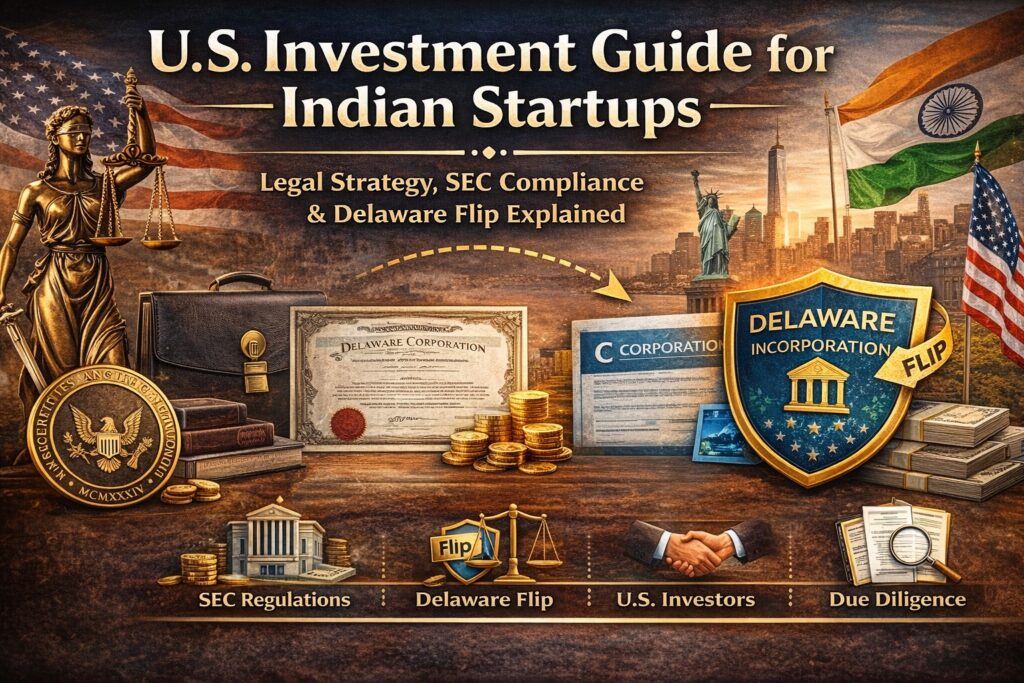
As Indian startups mature and scale, many founders are increasingly looking toward the United States for capital, strategic partnerships, and global expansion opportunities. The U.S. venture ecosystem offers deep capital pools, experienced mentors, and access to international markets. However, cross-border fundraising is not merely about pitching to overseas investors—it involves navigating complex securities laws, restructuring entities, ensuring regulatory compliance, and adapting to different investor expectations. This guide provides Indian founders with a structured roadmap to successfully attract U.S. investment while minimizing legal and operational risks.
1. Understanding U.S. Securities Laws
Any company raising funds from U.S. investors must comply with regulations enforced by the U.S. Securities and Exchange Commission (SEC). Under U.S. law, securities offerings must either be registered or qualify for an exemption.
Regulation D (Reg D)
Reg D is the most commonly used exemption for private fundraising in the U.S.
- Rule 506(b): Allows startups to raise unlimited capital from accredited investors and up to 35 non-accredited investors. Public solicitation is not permitted.
- Rule 506(c): Permits general solicitation and advertising but restricts participation to accredited investors only. Founders must undertake strict verification of accredited investor status.
Companies relying on Reg D must file Form D within 15 days of the first securities sale. Failure to comply can expose the company to regulatory penalties and investor disputes.
Regulation S (Reg S)
Reg S provides a safe harbor for offerings made outside the United States to non-U.S. persons. Indian startups often combine Reg D and Reg S to structure global fundraising rounds efficiently. Understanding which exemption applies—and structuring the round accordingly—is critical to avoiding securities law violations.
2. The “Flip” Structure: Establishing a U.S. Entity
Most U.S. venture capital firms prefer investing in a Delaware C Corporation. As a result, Indian startups frequently undertake a corporate restructuring commonly known as a “flip.”
Under this structure:
- A new Delaware C Corp becomes the parent entity.
- The Indian company becomes a wholly owned subsidiary.
- Existing shareholders exchange their Indian shares for shares in the U.S. entity.
Why Investors Prefer Delaware
- Well-developed corporate law framework
- Familiar governance structures
- Predictable investor protections
- Ease of issuing preferred stock
Although restructuring involves tax, regulatory, and compliance considerations (including Indian FEMA and RBI rules), it significantly increases investability in the U.S. market.
3. Operational Readiness & Investor Expectations
U.S. investors evaluate startups through a data-driven lens. Founders must demonstrate:
- Product-market fit
- Revenue traction or strong user growth
- Clear go-to-market strategy
- Scalable business model
- Large Total Addressable Market (TAM)
Most venture capitalists look for “venture-scale” opportunities—typically businesses capable of generating billion-dollar outcomes.
Building a Strong Pitch
Your pitch deck should clearly articulate:
- The problem and solution
- Market size and expansion strategy
- Competitive differentiation
- Business model economics
- Exit potential
Clarity, metrics, and realism are valued more than aggressive projections.
4. Preparing for Due Diligence
U.S. investors conduct rigorous legal and financial due diligence. Founders should prepare:
- Clean cap tables
- Shareholder agreements
- IP ownership documentation
- Employment contracts
- Financial statements (preferably GAAP or IFRS compliant)
- Regulatory compliance records
A well-organized virtual data room signals professionalism and reduces transaction delays. Engaging experienced U.S.-based legal counsel and accountants is highly advisable to ensure smooth execution.
5. Navigating Dual Regulatory Compliance
Indian startups must manage compliance in two jurisdictions.
In the United States:
- SEC regulations
- Blue sky (state-level) laws
- Accredited investor verification
In India:
- Foreign Exchange Management Act (FEMA)
- RBI reporting requirements
- Pricing guidelines for foreign investment
- ODI/FDI compliance (if flipping structure is adopted)
Failure to comply with either regime can jeopardize funding and future exits.
To know more about this, please check the link below.
6. Overcoming Key Challenges
1. Perception Risk
Some investors perceive “India risk” related to enforcement, tax complexity, or IP protection. Founders must proactively address governance and compliance standards.
2. Networking Gaps
Warm introductions outperform cold outreach. Leveraging:
- Existing investors
- Advisors
- Alumni networks
- Startup accelerators
can significantly improve access to U.S. VCs.
3. Cultural Differences
U.S. investors prefer concise, metrics-driven presentations. Direct communication and clarity about risks build credibility.
4. Documentation Standards
Incomplete documentation or unclear IP ownership can derail deals. Early legal housekeeping prevents last-minute complications.
7. Strategic Positioning for Success
Indian startups possess several competitive advantages:
- Large, skilled English-speaking talent pool
- Cost-efficient innovation
- Deep understanding of emerging markets
- Strong technical expertise
Startups offering globally scalable solutions—not purely India-specific products—tend to attract stronger U.S. interest.
Conclusion
Accessing U.S. capital can transform an Indian startup into a global enterprise—but it requires careful legal structuring, operational discipline, and strategic positioning.
Founders who:
- Understand U.S. securities exemptions
- Implement appropriate corporate structures
- Maintain compliance across jurisdictions
- Demonstrate measurable traction
- Build strong investor relationships
are far more likely to succeed in cross-border fundraising. While the process may appear complex, thoughtful preparation and professional guidance can turn regulatory challenges into strategic advantages. With the right approach, Indian startups can confidently bridge markets and scale globally.