
Introduction
In today’s globally interconnected economy, efficient and accurate data exchange is critical to supply chain success. Businesses operate across borders, platforms, and partners—making standardized communication not just beneficial, but essential. At the heart of this efficiency lies GS1, a global, neutral, not-for-profit organization that develops and maintains supply chain standards used worldwide. With 116 GS1 member organizations operating in over 150 countries—including GS1 India—GS1 provides a common language that enables businesses, governments, and regulators to identify, capture, and share information consistently. One of the most fundamental pillars of this framework is Identification. Understanding GS1 identification keys is crucial for appreciating how modern supply chains achieve accuracy, visibility, and trust.
What Does ‘Identify’ Mean in the GS1 Ecosystem?
In everyday life, identification allows us to distinguish people, places, and objects—often through names, physical traits, or national identifiers such as Aadhaar in India. In the world of products and logistics, this role is fulfilled by GS1 identification keys. GS1 ID keys uniquely identify products, locations, assets, and logistics units in a standardized and globally accepted manner. Each key is purpose-built to ensure that every entity in the supply chain can be recognized without ambiguity. By replacing fragmented, country-specific, or company-specific identification systems, GS1 eliminates confusion and enables interoperability across markets and industries. This standardized identification framework forms the backbone of secure, accurate, and real-time data flow across supply chain processes worldwide.
Why GS1 Identification Keys Matter
GS1 identification keys provide businesses with end-to-end visibility across their supply chains. This visibility enhances operational efficiency, minimizes errors, and strengthens trust among manufacturers, distributors, retailers, and regulators. Standardized identification simplifies logistics, improves inventory accuracy, and supports regulatory compliance—particularly in highly regulated sectors such as food, pharmaceuticals, and healthcare. It also ensures the uninterrupted movement of goods across borders by aligning identification practices globally. In India, GS1 India is the sole authorized body responsible for issuing GS1 identification keys. The country code “890”, assigned to GS1 India, ensures global recognition of products originating from Indian businesses, making GS1 registration essential for companies operating domestically or internationally.
📞 Contact our barcode experts at +91 729705118 and +91 8949793519.
To know more about this, please check the link below.
Key GS1 Identification Keys Explained
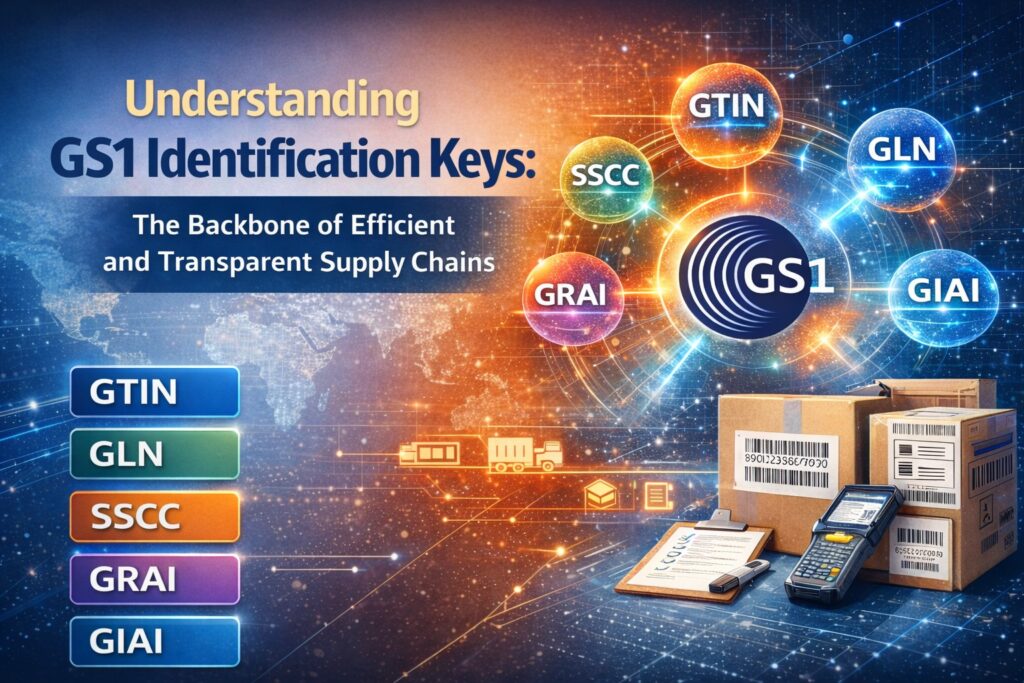
GS1 has developed 12 identification keys, each designed for a specific purpose. Some of the most widely used keys across supply chains include:
1. Global Trade Item Number (GTIN): GTIN uniquely identifies trade items—products and services that are priced, ordered, or invoiced at any point in the supply chain. Every retail product requires a GTIN to ensure accurate identification in the marketplace. GTINs are constructed using a company’s GS1 Global Company Prefix (GCP) and may appear in 8-digit, 12-digit, or 13-digit formats. They can be encoded in both 1D and 2D barcodes, enabling compatibility across retail, warehousing, and digital platforms.
2. Global Location Number (GLN):The GLN is a 13-digit identifier used to uniquely identify locations and entities within the supply chain. It can represent:
- Legal entities such as businesses, government bodies, or organizations
- Physical locations including warehouses, factories, or retail stores
- Functional locations like departments or cost centers
- Digital locations used for electronic communication
GLNs ensure clarity in transactions, deliveries, and data exchange across partners.
3. Serial Shipping Container Code (SSCC): SSCC is an 18-digit identification key used to uniquely identify logistic units, such as pallets or cartons prepared for shipment. It enables precise tracking of shipments from origin to destination and is critical for warehouse management and transport operations.
4. Global Returnable Asset Identifier (GRAI): GRAI is used to identify returnable or reusable assets such as pallets, crates, or containers. It typically consists of 13 digits, expandable up to 29 digits with a serial component, allowing businesses to track assets across multiple supply chain cycles.
5. Global Individual Asset Identifier (GIAI): GIAI uniquely identifies individual fixed assets such as machinery, vehicles, or equipment. With a capacity of up to 30 digits, GIAI enables precise asset tracking, maintenance planning, and lifecycle management.
📞 Contact our barcode experts at +91 729705118 and +91 8949793519.
Benefits of Implementing GS1 Identification Keys
Adopting GS1 identification keys delivers measurable benefits across industries:
- Enhanced Traceability: Enables real-time tracking of products and assets, improving recall management and inventory accuracy.
- Operational Efficiency: Reduces manual errors in ordering, shipping, and receiving processes, leading to cost savings.
- Improved Trust and Collaboration: Ensures all stakeholders operate with consistent and reliable data.
- Facilitated Global Trade: Supports cross-border commerce by aligning identification with international standards and regulatory requirements.
Conclusion
GS1 identification keys are far more than numerical codes—they are the foundation of efficient, transparent, and reliable global supply chains. By standardizing how products, locations, and assets are identified, GS1 enables businesses to operate with greater accuracy, visibility, and confidence. As supply chains grow more complex and data-driven, adopting GS1 identification standards is no longer optional—it is essential. Businesses that embrace this common language of commerce position themselves for operational excellence, regulatory compliance, and sustainable growth in an increasingly interconnected world.
📞 Contact our barcode experts at +91 729705118 and +91 8949793519.