
Introduction
Over the past decade, Dubai has evolved from a dynamic regional hub into what many global investors now regard as the world’s most attractive real estate market. Once known primarily for its skyline and luxury developments, the city has matured into a strategic, policy-driven investment ecosystem that consistently attracts international capital. In 2025 alone, Dubai recorded more than 200,000 property transactions, drawing billions in foreign direct investment. Buyers from Europe, Asia, Africa, and the Americas increasingly view the emirate as a destination for both wealth preservation and long-term growth. This transformation was not accidental. It was engineered through visionary leadership, regulatory reform, infrastructure investment, and global economic positioning. Here’s a deeper look at the structural forces that propelled Dubai to the top of the global property market.
1. A Truly Tax-Efficient Investment Climate
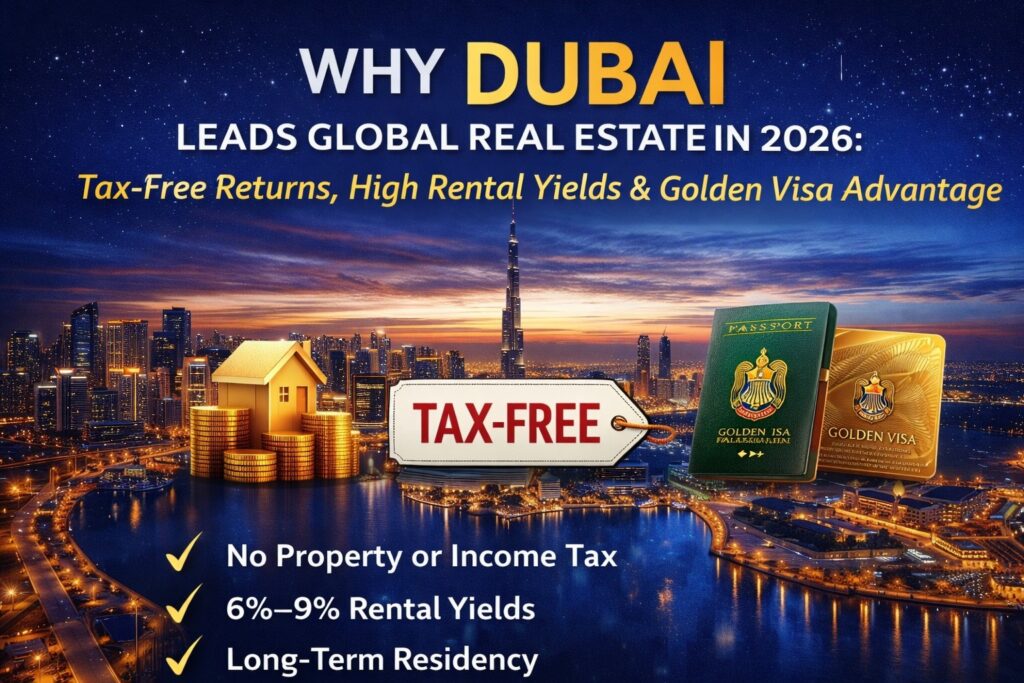
One of Dubai’s most powerful competitive advantages is its tax structure. Unlike most major global cities, Dubai offers:
- No annual property tax
- No capital gains tax
- No income tax on rental earnings
- No inheritance tax
For investors accustomed to heavy tax burdens in markets like London, New York, or Paris, this dramatically increases net returns. The absence of recurring taxation significantly improves long-term ROI and makes Dubai exceptionally attractive for income-generating assets.
2. Rental Yields That Outperform Global Markets
Dubai consistently delivers higher rental yields compared to most mature property markets. While cities such as London or Hong Kong often generate 2–4% annual yields, Dubai commonly offers:
- 6–9% average rental yields
- Even higher returns in short-term rental segments
This dual advantage—capital appreciation combined with strong rental income—makes Dubai a performance-driven market rather than a purely speculative one.
3. Strategic Global Connectivity
Geographically, Dubai sits at the crossroads of Europe, Asia, and Africa. Within an eight-hour flight radius, it connects to two-thirds of the world’s population. Dubai International Airport consistently ranks among the busiest airports globally, reinforcing Dubai’s role as a logistics, tourism, and business hub. This connectivity drives demand for residential, hospitality, and commercial real estate, creating sustained property absorption.
4. Visionary Urban Planning and Infrastructure
Dubai’s growth is rooted in forward-thinking governance. Massive investments in infrastructure have created a city designed for global competitiveness. Iconic developments such as:
- Burj Khalifa
- Palm Jumeirah
are not merely architectural achievements—they are branding tools that elevate global investor perception. Beyond landmarks, Dubai has built world-class roads, public transport systems, smart-city initiatives, and master-planned communities. Development is proactive rather than reactive, aligned with long-term population growth and investor demand.
5. Political Stability and Safe-Haven Appeal
In a period marked by geopolitical uncertainty and economic volatility, capital naturally flows toward stability. Dubai has positioned itself as a secure, business-friendly jurisdiction with strong governance and low crime rates. This safe-haven perception has accelerated capital migration from Europe, Russia, Asia, and other regions. For many investors, Dubai represents not just opportunity—but strategic asset protection.
6. The Golden Visa Effect
A pivotal reform reshaping the market has been the introduction of long-term residency programs. UAE Golden Visa allows qualifying property investors to obtain 5- or 10-year residency. This policy fundamentally changed buyer behavior. What was once a predominantly short-term investor market now includes:
- End-users relocating families
- Entrepreneurs establishing businesses
- Long-term residents seeking permanent roots
This structural shift adds depth and stability to property demand.
7. Economic Diversification Beyond Oil
Unlike many resource-dependent economies, Dubai successfully diversified its economic base. Today, its growth is driven by:
- Tourism and hospitality
- Financial services
- Technology and innovation
- Global trade and logistics
- Real estate and construction
This diversified framework ensures sustainable employment growth and population inflows—both essential drivers of long-term property demand.
8. Strong Regulatory Oversight and Transparency
The establishment of the Dubai Land Department and Real Estate Regulatory Agency significantly strengthened investor protection. These institutions ensure:
- Escrow protection for off-plan projects
- Developer compliance
- Transparent ownership registration
- Structured dispute resolution
Compared to the speculative early 2000s, today’s market operates within a far more regulated and transparent framework.
To know more about this, please check the link below.
9. Lifestyle as an Economic Driver
Dubai’s appeal goes beyond financial metrics. It offers:
- Year-round sunshine
- Luxury retail and fine dining
- Beaches and waterfront living
- International schools
- Advanced healthcare facilities
This lifestyle proposition attracts professionals, entrepreneurs, retirees, and families—creating sustained, organic housing demand.
10. A Strong Post-Pandemic Rebound
Dubai’s swift pandemic response enhanced its global reputation. Rapid reopening strategies and business continuity measures allowed the city to recover faster than many Western markets. As remote work expanded globally, Dubai emerged as a relocation hotspot for digital entrepreneurs and international professionals seeking safety, tax efficiency, and quality of life. Property demand accelerated significantly between 2021 and 2024, reinforcing market momentum.
A Market That Has Matured
Unlike the 2008 cycle, today’s Dubai property market reflects greater maturity:
- A high percentage of cash transactions
- Strong rental fundamentals
- Increasing end-user participation
- Enhanced regulatory oversight
Rather than a speculative surge, Dubai’s real estate ecosystem is increasingly integrated into global capital markets.
Conclusion
Dubai’s emergence as the world’s leading property investment destination is the result of deliberate strategy—not chance. Tax efficiency, high rental yields, regulatory transparency, global connectivity, residency reforms, and infrastructure excellence have collectively created a compelling investment environment. In a world where investors prioritize stability, profitability, and global mobility, Dubai offers a rare convergence of all three. While market cycles will naturally evolve, the structural advantages that positioned Dubai at the forefront of global real estate remain firmly intact. Dubai is no longer just a fast-growing city—it is a globally integrated investment powerhouse.