
Introduction
Legal disputes often begin with one simple issue—unclear ownership.
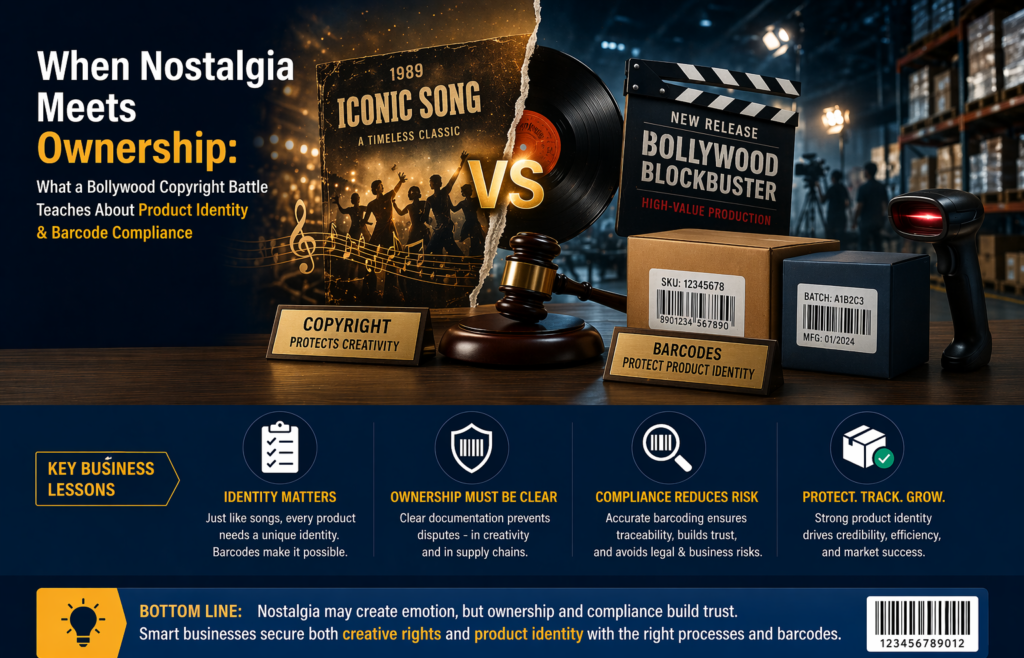
A recent high-profile copyright conflict in the entertainment industry demonstrates how valuable intellectual property can become a source of dispute when permissions and rights are not properly documented. While the case centers around music and film content, the lesson applies equally to physical products and branded goods.
In business environments, product identity works much like copyright ownership. Without proper documentation—such as barcodes, product records, and licensing permissions—companies risk confusion, duplication, and even legal conflict.
For manufacturers, distributors, and brand owners, this situation reinforces a critical truth:
Every product must have a clear, traceable identity.
Why This Case Matters to Barcode Users
Although the dispute involves creative content, its underlying issue—ownership clarity—is highly relevant to businesses managing product inventories and brand portfolios.
In the same way that songs and compositions must have defined ownership, products must have unique identifiers, typically in the form of barcodes.
When ownership or authorization is unclear, businesses may face:
- Product duplication disputes
- Unauthorized product copying
- Brand confusion in the marketplace
- Supply chain inconsistencies
- Legal liability for improper use of assets
Barcodes serve as the legal and logistical identity of products, ensuring that every item is uniquely identifiable and traceable.
The Legal Lesson: Ownership Must Be Documented
In intellectual property law, ownership is not assumed—it must be clearly documented and traceable.
Similarly, in product-based businesses:
- Each product must have a unique barcode
- Product ownership records must be maintained
- Licensing permissions must be verified
- Supply chain documentation must remain consistent
Without proper documentation, businesses risk disputes similar to copyright conflicts—where identifying the rightful owner becomes complicated and costly.
This highlights the importance of barcode allocation and proper product mapping, ensuring that every product is legally and operationally traceable.
To know more about this, click the link below
The Role of Barcodes in Preventing Business Disputes
Barcodes are not just retail tools—they are business protection mechanisms.
They help companies:
1. Establish Product Ownership
Just as legal documentation proves copyright ownership, barcodes provide verifiable identity to products.
2. Prevent Product Confusion
Similar packaging or branding can create confusion in markets. Barcodes eliminate ambiguity by assigning unique numeric identities.
3. Improve Supply Chain Transparency
With proper barcode systems, businesses can track:
- Manufacturing origin
- Distribution routes
- Sales locations
- Product authenticity
4. Strengthen Brand Protection
Unauthorized duplication is a major risk in competitive industries. Barcode systems help brands protect their reputation by enabling authentication and traceability.
Inspiration vs Duplication: A Business Perspective
One of the central issues in copyright disputes is determining whether something is inspired or copied.
The same principle applies to physical goods.
Businesses often create products inspired by market trends—but without clear identification systems, similar products may lead to:
- Trademark conflicts
- Packaging disputes
- Counterfeit allegations
- Marketplace confusion
Using standardized barcode systems ensures that even similar products remain distinct and legally identifiable.
Why Traceability Matters More Than Ever
Today’s supply chains operate across multiple locations, platforms, and markets.
Without traceability systems, businesses face:
- Counterfeiting risks
- Inventory mismatches
- Regulatory compliance issues
- Consumer trust challenges
Barcodes act as digital fingerprints for products, helping businesses maintain control over product movement and authenticity.
Key Takeaways for Businesses
This legal dispute highlights several practical lessons relevant to manufacturers, traders, and brand owners:
✔ Maintain clear ownership records
✔ Use standardized barcode systems
✔ Ensure licensing permissions are documented
✔ Avoid unauthorized duplication of intellectual assets
✔ Implement product traceability across supply chains
Businesses that neglect identification and documentation systems expose themselves to operational and legal vulnerabilities.
Conclusion: Identity Protects Value
Whether it is music, film content, or physical products, one principle remains constant—ownership must be clear and verifiable.
The modern business landscape demands transparency, traceability, and authenticity. Barcodes provide the infrastructure that supports all three.
For companies investing in brand growth, product launches, and distribution networks, barcode registration is not merely a compliance step—it is a strategic safeguard.
Because in business, just like in law,
what cannot be identified cannot be protected.