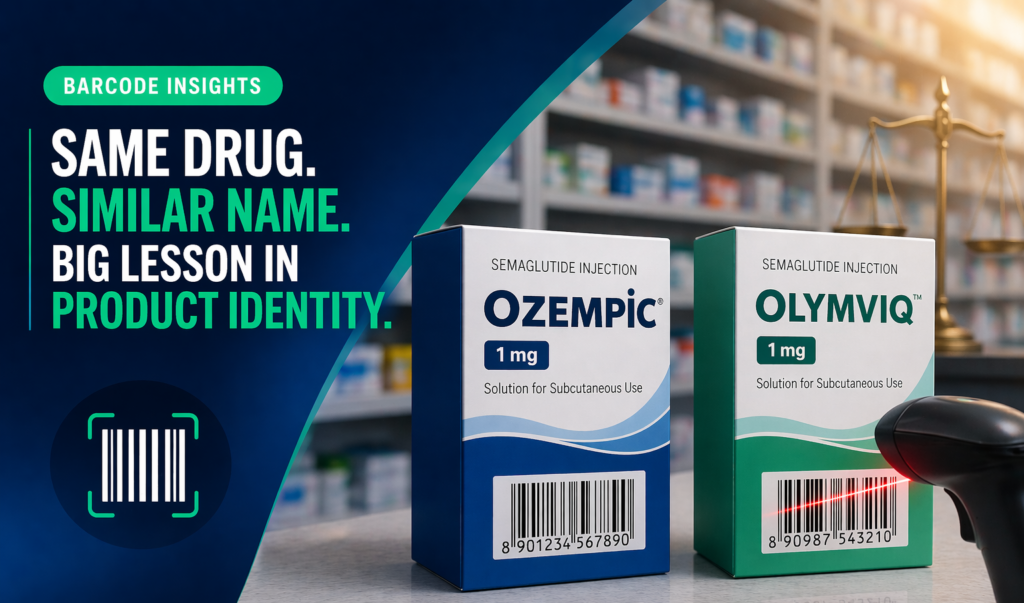
When Patent Protection Ends, Product Identity Becomes Critical
Patent expiry often creates a surge of generic manufacturers entering the market. This leads to:
- Increased competition
- Lower product prices
- Wider product availability
- Multiple similar-looking products
While the formula becomes publicly available, the brand identity and product presentation remain protected assets.
In industries such as pharmaceuticals, where many companies sell identical formulations, clear identification through packaging and barcodes becomes a business necessity—not just a compliance step.
The Real Risk: Similar Names and Confusing Product Identity
A pharmaceutical company launched its generic version of a well-known medicine under a brand name that closely resembled an existing trademark.
This raised concerns that:
- Doctors or pharmacists might confuse products
- Patients could receive incorrect medication
- Supply chains could face identification errors
- Inventory systems could misclassify products
This situation highlights a key barcode principle:
To know more about this, click the link below.
If products look or sound similar, barcode-level differentiation becomes essential to avoid operational errors.
Why Barcode Clarity Matters in Pharmaceutical Products
Pharmaceutical products require precise identification at every stage:
- Manufacturing
- Packaging
- Distribution
- Retail dispensing
- Hospital administration
Barcodes act as the digital identity of a product.
Without clear and unique barcoding:
- Similar product names may cause confusion
- Inventory tracking errors may increase
- Regulatory compliance risks may arise
- Patient safety may be compromised
This case demonstrates how branding confusion and identification challenges are closely connected in regulated industries.
The Legal Outcome: A Practical Lesson in Product Management
Instead of immediately banning the product, the court adopted a balanced solution:
- The company agreed to change the product name
- Existing stock was allowed to be sold for a limited period
- Remaining stock was redirected to public healthcare institutions
From a business perspective, this decision highlights:
- The cost of incorrect brand selection
- The risks of launching products without identity verification
- The importance of traceable product inventory
For barcode users, this reinforces the importance of unique product identifiers before large-scale distribution begins.
What This Case Teaches About Barcode Compliance
This dispute offers several valuable lessons for companies using barcode systems.
1. Every Product Needs a Unique Identity
A barcode is more than a technical label—it represents:
- Product authenticity
- Brand ownership
- Distribution accuracy
- Market credibility
Duplicate or confusing identifiers can create:
- Logistics errors
- Retail confusion
- Legal exposure
2. Similar Branding Requires Strong Packaging Differentiation
When products share:
- Similar names
- Similar packaging
- Similar color schemes
Barcode placement and packaging clarity become critical tools to prevent confusion.
Best practices include:
- Clear barcode positioning
- Distinct product labeling
- Unique SKU mapping
- Verified packaging differentiation
3. Traceability Protects Businesses and Consumers
Barcode-enabled traceability helps:
- Track product movement
- Prevent counterfeit risks
- Ensure product recall efficiency
- Maintain regulatory compliance
In sensitive sectors such as healthcare, traceability is not optional—it is essential.
Business Impact: Barcode Systems as Risk Management Tools
Modern businesses rely on barcode systems not just for scanning—but for risk control and compliance assurance.
Companies that implement proper barcode strategies benefit from:
- Faster inventory control
- Reduced distribution errors
- Improved product accountability
- Stronger regulatory compliance
This case illustrates how unclear product identity can escalate into major operational and legal challenges.
Industry-Wide Relevance Beyond Pharmaceuticals
Although this case arose in the pharmaceutical sector, the lessons apply to multiple industries, including:
- Cosmetics
- Nutraceuticals
- Food products
- Medical devices
- Consumer packaged goods
- Healthcare supplies
Any industry handling large product volumes must ensure that barcode-based identification systems are robust and accurate.
Practical Takeaways for Manufacturers and Brand Owners
Businesses launching new products should prioritize:
✔ Unique product naming
✔ Barcode registration before launch
✔ Packaging clarity
✔ Product traceability systems
✔ Trademark clearance checks
✔ SKU-level differentiation
When implemented together, these steps significantly reduce both legal risks and operational confusion.
Conclusion: Product Identity Is More Than a Name
This case reinforces a modern business truth:
Product identity is not defined only by a brand name—it is secured through packaging clarity, barcode precision, and traceable distribution systems.
As markets grow more competitive and products become increasingly similar, businesses that invest in clear product identification and barcode compliance will be better positioned to protect their brand reputation, avoid confusion, and maintain consumer trust.