
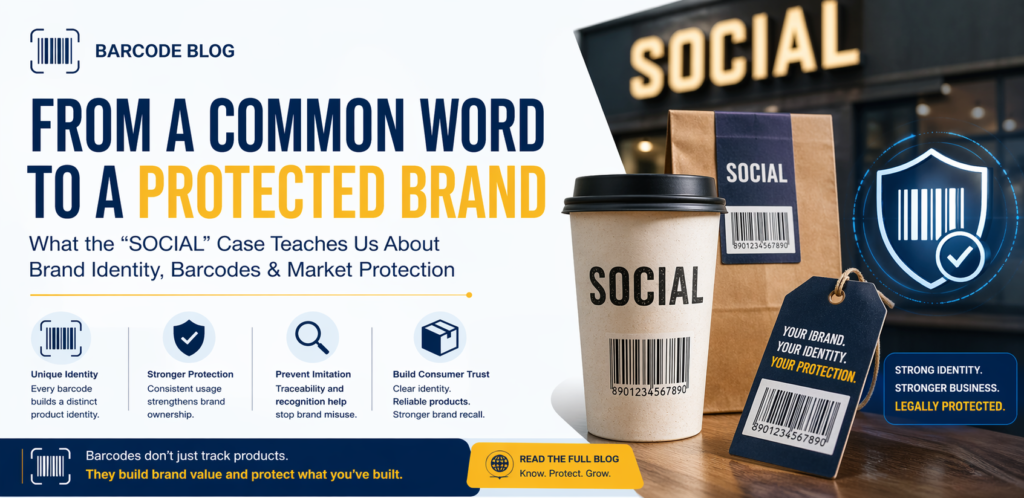
Introduction: When Identity Becomes an Asset
In today’s competitive marketplace, businesses are not just selling products—they are selling recognizable identities. Whether through packaging labels, barcode numbers, or brand names, identity is what connects a product to its reputation.
The legal battle involving the brand “SOCIAL” illustrates how even a commonly used word can become legally protected when it gains strong consumer association. For barcode-driven businesses, this raises an important question:
Is your product identity strong enough to be recognized—and protected—across markets?
Brand Growth and the Role of Recognizable Identity
The brand “SOCIAL” began as a hospitality concept in 2014 and rapidly expanded across India. Its growth was not accidental—it was supported by:
- Consistent brand usage
- Strong consumer recall
- Extensive market presence
- Heavy investment in promotion
- Uniform brand presentation across locations
In barcode-driven industries, similar growth depends on:
- Consistent SKU identification
- Standardized barcode allocation
- Uniform product naming
- Reliable packaging identity
These elements create a recognizable footprint—just like a strong trademark.
Well-Known Trademark Status and Cross-Market Recognition
A major turning point in the case was the recognition of “SOCIAL” as a well-known trademark.
This designation means:
- The brand is widely recognized
- Protection extends beyond its original sector
- Unauthorized usage becomes easier to challenge
From a barcode and product identity perspective, this mirrors what happens when:
- A barcode becomes linked to trusted quality
- A brand name becomes associated with consistent product performance
- Customers identify authenticity through packaging and codes
In essence:
Recognition builds protection.
To know more about this, click the link below
Trademark Squatting vs. Authentic Market Presence
Another key issue in the dispute involved trademark squatting—registering marks without genuine usage.
The Court emphasized:
- Marks must be used in real business
- Unused registrations can be removed
- Genuine market presence carries legal strength
For product-based businesses, this translates into:
- Assigning barcodes but not using them weakens traceability
- Registering identifiers without active product circulation creates risk
- Active usage strengthens ownership credibility
A barcode that is actively used and visible in the supply chain becomes stronger evidence of commercial presence.
Secondary Meaning: When Identity Becomes Recognizable
A powerful concept highlighted in the case is secondary meaning.
This occurs when:
- A generic word becomes strongly associated with one brand
- Consumers automatically link the term to a specific business
In product ecosystems, this is similar to:
- A barcode becoming linked to a trusted manufacturer
- Packaging colors becoming instantly recognizable
- Product layouts becoming part of brand recall
Over time, repetition builds identity.
Identity builds recognition.
Recognition builds protection.
Why Barcode Systems Strengthen Brand Protection
Although the case focuses on trademarks, its lessons extend directly into barcode strategy and product identification systems.
Businesses using structured barcode systems benefit from:
1. Product Traceability
Each barcode creates a unique identity for products.
2. Market Recognition
Uniform coding improves brand reliability.
3. Anti-Counterfeiting Support
Barcode-linked identity helps detect imitation.
4. Legal Evidence Support
Consistent product identifiers can strengthen claims of usage.
In modern commerce, barcode identity supports trademark identity.
Industry Lessons for Product-Based Businesses
This case delivers several important lessons for manufacturers, retailers, and brand owners.
1. Identity Must Be Consistent
Use:
- Standardized product names
- Consistent packaging
- Unique barcode numbers
Consistency builds recognition.
2. Usage Matters More Than Registration
Registering trademarks or barcodes is only the first step.
Regular usage:
- Builds reputation
- Strengthens ownership
- Reduces vulnerability
3. Branding Requires Long-Term Investment
The “SOCIAL” brand invested heavily in visibility.
Similarly, barcode-driven brands must invest in:
- Packaging design
- Product standardization
- Distribution accuracy
Brand value grows through disciplined execution.
4. Traceable Identity Reduces Market Confusion
Clear product identifiers help:
- Prevent imitation
- Improve consumer trust
- Simplify supply chain management
Barcode clarity equals brand clarity.
The Bigger Message: Identity Is the New Currency
Modern brands are not just defined by logos or words.
They are defined by:
- Product identifiers
- Packaging systems
- Market presence
- Consumer association
The stronger the identity, the stronger the protection.
This case demonstrates that even an everyday word can become a powerful asset when consistently used and properly managed.
Conclusion: Build Identity Before You Need Protection
The “SOCIAL” case sends a powerful message to businesses:
Identity is not accidental—it is engineered.
For barcode-enabled businesses, this means:
- Register your identifiers early
- Use them consistently
- Maintain traceability
- Strengthen recognition
Because in the modern marketplace:
Your barcode is not just a number—
it is proof of ownership, credibility, and market presence.
And when identity is strong enough,
even the most common words can become extraordinary assets.