
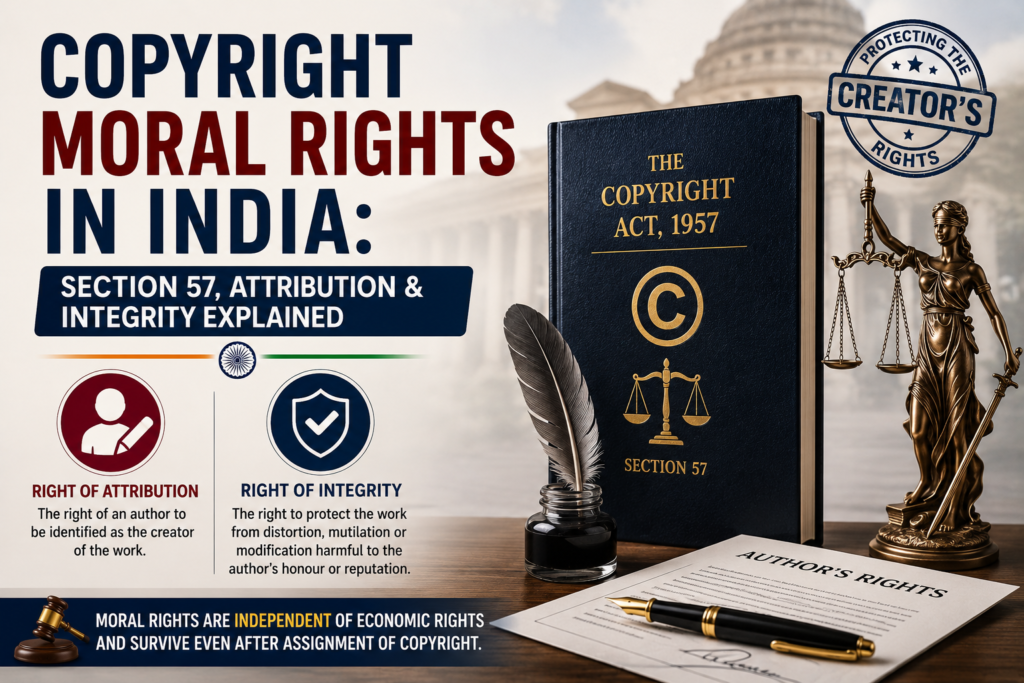
Moral rights of authors under Indian copyright law protect the personal and reputational connection between an author and their creative work. Unlike economic rights, which primarily concern the commercial exploitation of copyright, moral rights protect the author’s identity, reputation and relationship with the work.
In India, moral rights are principally recognised under Section 57 of the Copyright Act, 1957. These rights are also connected with the international protection provided by Article 6bis of the Berne Convention.
Moral rights are particularly important where an author has assigned or transferred the economic rights in a work to another person. Even after such a transfer, certain rights relating to authorship and integrity of the work may continue to be exercised by the author.
This article explains moral rights under Indian copyright law, including the right of attribution, right of integrity, Section 57, the landmark Amar Nath Sehgal v. Union of India judgment, and the position of moral rights after assignment of copyright.
What Are Moral Rights in Copyright Law?
Moral rights are rights that protect the personal and reputational interests of an author in relation to their creative work.
Copyright generally provides two broad categories of rights:
- Economic rights – rights concerning the commercial exploitation of the work; and
- Moral rights – rights protecting the author’s personal connection with and reputation associated with the work.
For example, an author may sell or assign the copyright in a book to a publisher. However, the author may still have an interest in being identified as the creator and in preventing certain distortions or modifications that harm their reputation.
Thus, moral rights recognise that a creative work can be more than a commercial asset—it can also represent the personality, creativity and reputation of its author.
Section 57 of the Copyright Act, 1957
The principal statutory provision dealing with moral rights in India is Section 57 of the Copyright Act, 1957.
Section 57 provides special rights to the author of a work, including rights relating to:
- Claiming authorship of the work; and
- Preventing or claiming damages for certain distortions, mutilations, modifications or other acts relating to the work where the statutory requirements are satisfied.
An important feature of Section 57 is that these rights are independent of the economic copyright and can continue to be exercised even after the assignment of copyright, subject to the statutory framework.
Types of Moral Rights Under Indian Copyright Law
The two principal moral rights generally associated with Section 57 are:
1. Right of Paternity or Attribution
The right to claim authorship of a work.
2. Right of Integrity
The right to protect the work against certain distortion, mutilation, modification or other acts that are prejudicial to the author’s honour or reputation.
These rights serve different purposes but together protect the author’s continuing relationship with their creative work.
1. Right of Paternity or Attribution
The right of paternity, commonly known as the right of attribution, allows an author to claim authorship of their work.
The right essentially protects the author’s identity as the creator.
For example, if a painting created by an artist is published without credit, or if another person is falsely presented as its creator, the author’s right of attribution may become relevant.
The right can also be important where a work is commercially exploited after its copyright has been assigned to another party.
Why Is the Right of Attribution Important?
Attribution serves several purposes:
- It recognises the author’s creative contribution;
- Protects professional reputation;
- Prevents false attribution;
- Maintains the author’s connection with the work; and
- Helps preserve the author’s identity in the public record.
For authors, artists, photographers, musicians, filmmakers and other creators, attribution can have significant professional and reputational value.
2. Right of Integrity
The right of integrity protects an author’s work against certain forms of distortion, mutilation, modification or other acts that are prejudicial to the author’s honour or reputation.
Section 57(1)(b) is therefore concerned not simply with whether a work has been changed, but with whether the relevant act has caused the type of prejudice contemplated by the provision.
Examples of Potential Issues
Depending on the facts, disputes may arise where:
- An artwork is substantially mutilated;
- A literary work is materially distorted;
- An artistic work is altered in a manner damaging to the creator’s reputation;
- A work is modified in a way that misrepresents the author’s creative expression; or
- A culturally significant work is destroyed or seriously altered.
The right of integrity is therefore an important safeguard against harmful treatment of an author’s creative expression.
Does Assignment of Copyright Affect Moral Rights?
One of the most important aspects of Indian copyright law is that moral rights are distinct from economic copyright.
An author may assign economic rights to:
- A publisher;
- Film producer;
- Music company;
- Production house;
- Media organisation; or
- Other commercial entity.
However, Section 57 expressly recognises the author’s ability to exercise the specified special rights even after assignment of copyright, subject to the statutory requirements.
Therefore:
Assignment of copyright ≠ automatic elimination of moral rights.
This distinction is particularly important in industries where copyright is routinely transferred or licensed.
Moral Rights and Economic Rights: Key Difference
| Basis | Economic Rights | Moral Rights |
|---|---|---|
| Primary purpose | Commercial exploitation | Protect author’s personal and reputational interests |
| Examples | Reproduction, communication to public, adaptation | Attribution and integrity |
| Transferability | Can generally be assigned/licensed | Distinct statutory protection |
| Focus | Commercial value | Author’s relationship with the work |
| Section | Various provisions of Copyright Act | Section 57 |
Understanding this distinction is essential when negotiating copyright assignments and licensing agreements.
Can an Author Exercise Moral Rights After Selling Copyright?
Yes, subject to the Copyright Act and the specific facts of the case.
Section 57 states that the special rights of the author are independent of the author’s copyright and may be exercised even after the assignment of copyright.
Consequently, transferring economic rights does not necessarily mean that the creator loses every legal interest in how the work is identified or treated.
This is particularly relevant to authors who transfer copyright to publishers, producers, companies or other commercial entities.
Duration of Moral Rights in India
The Copyright Act does not establish a completely separate, standalone duration for moral rights in the same manner as it provides a term for economic copyright.
The statutory treatment of moral rights, particularly after the author’s death, must therefore be examined in light of Section 57 and the relevant provisions concerning authorship and legal representatives.
The position can also vary depending on the nature of the work and the particular right being asserted.
Accordingly, questions concerning the enforcement of moral rights after the author’s death should be assessed on the specific facts and applicable statutory provisions.
Remedies for Violation of Moral Rights
Where a violation of Section 57 is established, an author may seek appropriate legal remedies depending on the circumstances.
Potential remedies may include:
- Injunctions;
- Damages;
- Restoration-related relief;
- Directions concerning treatment of the work; and
- Other appropriate relief available under law.
The Amar Nath Sehgal decision demonstrates that Indian courts can grant meaningful remedies where the integrity of a protected work has been seriously compromised.
Moral Rights in Films, Music, Art and Literature
Moral rights can arise across different creative industries.
Films
Authors, screenwriters, directors, composers and other creators may face issues involving attribution or modification of their creative contributions.
Music
Composers, lyricists and performers may have concerns relating to attribution and unauthorised alteration of creative works.
Literature
Authors may object where their literary work is substantially modified in a manner that harms their reputation.
Visual Arts
Artists and sculptors may particularly rely on integrity rights where their works are altered, mutilated or destroyed.
Photography and Digital Content
Photographers and digital creators may also encounter attribution and modification disputes when their work is reproduced or commercially exploited.
Moral Rights and Copyright Assignment Agreements
Creators should carefully review copyright agreements before assigning or licensing their work.
A copyright agreement should clearly address issues such as:
- Attribution;
- Permitted modifications;
- Adaptations;
- Editing rights;
- Credit placement;
- Publication rights;
- Commercial exploitation;
- Approval mechanisms, where applicable; and
- Treatment of the work after assignment.
Although contractual provisions cannot simply be assumed to eliminate statutory rights, clear drafting can help reduce disputes between creators and copyright owners.
How to Protect Your Moral Rights as an Author
Authors and creators can take several practical steps to protect their interests.
Maintain Evidence of Authorship
Keep original drafts, source files, creation records, dated files and other evidence establishing authorship.
Clearly Identify Yourself
Use appropriate author or creator credits when publishing or licensing the work.
Review Copyright Agreements Carefully
Do not focus only on payment and economic rights. Examine clauses concerning editing, modification, adaptation and attribution.
Document Unauthorised Changes
If a work is altered or mutilated, preserve copies, photographs, communications and other evidence.
Seek Legal Advice Promptly
Where serious unauthorised modification or false attribution occurs, early legal advice can help determine the appropriate remedy.
Conclusion
Moral rights under Indian copyright law provide important protection for the personal and reputational interests of creators. Section 57 of the Copyright Act, 1957 recognises rights relating to authorship and the integrity of creative works and distinguishes these rights from economic copyright.
For authors, artists, filmmakers, musicians, photographers and other creators, understanding moral rights is especially important when entering into copyright assignments, licensing agreements and commercial arrangements.
Ultimately, copyright law does more than protect the commercial value of a creative work. It also recognises the enduring connection between the creator and their creation.