
Introduction
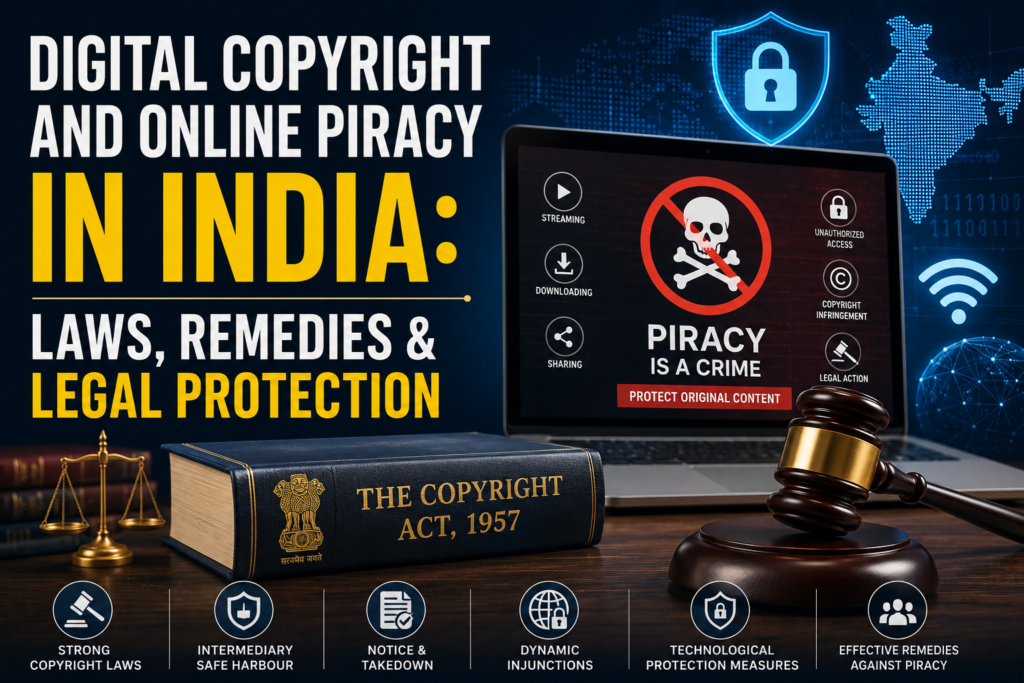
The rapid growth of the internet, digital content platforms, streaming services and social media has transformed the way copyrighted works are created, distributed and consumed. At the same time, it has made online copyright infringement and digital piracy in India easier and faster than ever before.
Movies, music, television programmes, books, software, live sports broadcasts and other digital content can be copied and redistributed across websites and online platforms within minutes. Pirated content can also move from one domain to another through mirror, redirect and proxy websites, making traditional copyright enforcement increasingly difficult.
Indian copyright law has therefore evolved to address the specific challenges created by the digital environment. The legal framework combines statutory protections for copyright owners with intermediary obligations and judicial remedies such as dynamic injunctions and dynamic-plus injunctions.
This article explains the major legal mechanisms available for protecting and enforcing digital copyright in India.
What Is Digital Copyright?
Digital copyright refers to the protection of copyright-protected works when they are created, stored, distributed, communicated or accessed through digital technologies.
Copyright protection may extend to digital versions of works such as:
- Films and web series
- Music and sound recordings
- E-books and written content
- Photographs and artwork
- Software and computer programmes
- Digital illustrations
- Online courses and educational material
- Video content
- Broadcasts and streaming content
Unauthorised copying, uploading, downloading, streaming, distribution or communication of protected content may constitute copyright infringement, depending on the circumstances and applicable statutory exceptions.
The internet has made enforcement particularly challenging because infringing material can be duplicated and redistributed rapidly across multiple platforms and jurisdictions.
Online Copyright Piracy in India
Online piracy generally involves the unauthorised reproduction, distribution, communication or commercial exploitation of copyrighted material through digital platforms.
Common examples include:
- Uploading a copyrighted film without permission
- Providing links to pirated content
- Operating websites dedicated to distributing unauthorised copies
- Streaming copyrighted content without authorisation
- Sharing copyrighted works through unauthorised platforms
- Creating mirror websites after an earlier piracy website has been blocked
One of the major challenges for copyright owners is that shutting down one website may not permanently stop the infringement. Operators may quickly establish a new domain containing substantially the same infringing material.
This has encouraged Indian courts to develop more flexible enforcement mechanisms.
Intermediary Liability and Safe Harbour in India
Online platforms and internet service providers may, in certain circumstances, qualify as intermediaries under Indian information technology law.
The Information Technology Act, 2000 and related rules provide a framework governing intermediary liability and the circumstances in which intermediaries may receive safe-harbour protection for third-party information.
The underlying principle is that an intermediary that merely facilitates online communication should not automatically be treated as the author of every piece of content uploaded by its users.
However, safe harbour is not an unrestricted immunity.
The availability of protection depends on compliance with the applicable statutory requirements and intermediary obligations.
Copyright owners can also rely on remedies available under copyright legislation where their protected works are being unlawfully used or distributed online.
What Is Safe Harbour Protection?
Safe harbour essentially provides conditional protection to eligible intermediaries from liability arising from third-party content.
The legal framework considers factors such as:
- The intermediary’s role in transmitting or hosting information
- Whether the intermediary initiated the transmission
- Whether it selected the recipient
- Whether it exercised prohibited control over the information
- Compliance with applicable due-diligence requirements
- Knowledge or notification concerning unlawful content
The important point is that an intermediary cannot simply rely on the word “platform” or “intermediary” to avoid all responsibility.
The precise scope of intermediary protection depends on the statutory framework and the facts of the particular case.
Notice-and-Takedown Mechanism for Copyright Infringement
One of the important tools available for dealing with online copyright infringement is the notice-and-takedown mechanism.
When a copyright owner identifies allegedly infringing material hosted or made available through an online intermediary, the owner may take steps to notify the relevant intermediary and seek removal or disabling of access to the material in accordance with the applicable legal framework.
The Copyright Act also contains provisions concerning certain intermediary obligations in relation to infringing copies.
The objective is to provide copyright owners with a mechanism to respond quickly to online infringement without necessarily commencing a full legal proceeding against every individual instance of unauthorised content.
However, the exact statutory requirements, timelines and procedures should be carefully examined before relying on a notice-and-takedown mechanism.
The Challenge of Mirror and Redirect Websites
Traditional website-blocking orders can become ineffective when dealing with sophisticated online piracy networks.
For example, suppose a court orders the blocking of:
piratewebsite.com
The operators may simply create:
- piratewebsite1.com
- piratewebsite2.com
- piratewebsite-new.com
or use mirror and redirect domains that provide substantially the same infringing content.
This creates what courts have described as a “hydra-headed” problem—blocking one domain may result in several new domains appearing almost immediately.
This challenge led to the development of more flexible judicial remedies.
What Is a Dynamic Injunction?
A dynamic injunction is a judicial remedy designed to address online infringement where infringing websites or domains may change rapidly.
The concept allows courts, in appropriate circumstances, to provide relief that can extend beyond the specific website or domain originally identified in the proceedings.
This can allow copyright owners to address newly discovered mirror or redirect websites without having to initiate entirely separate proceedings for every new domain.
Dynamic injunctions are particularly valuable where:
- Infringing websites operate anonymously
- Piracy is systematic or commercial
- New mirror websites appear frequently
- Blocking one domain does not effectively stop infringement
- The infringing activity causes continuing or irreversible harm
UTV Software Communication Ltd. v. 1337X: The Rogue Website Doctrine
One of the most significant Indian decisions concerning online piracy is UTV Software Communication Ltd. v. 1337X.to before the Delhi High Court.
The Court considered the practical difficulties faced by copyright owners in dealing with websites whose primary purpose was to facilitate copyright infringement.
The Court developed the concept of a “rogue website.”
A rogue website may generally be characterised by factors such as:
- Its primary purpose being to facilitate copyright infringement
- A high degree of infringement
- Lack of legitimate content or activity
- Anonymous or difficult-to-identify operators
- Repeated or systematic infringement
- Circumvention of previous blocking measures
The decision recognised that traditional website-by-website enforcement may be inadequate in the digital environment.
The case therefore became an important development in Indian copyright jurisprudence concerning website blocking and online piracy.
What Is a Dynamic-Plus Injunction?
The judicial approach has subsequently developed further through what are commonly described as dynamic-plus injunctions.
A dynamic-plus injunction can provide protection not only against currently identified infringing websites but, in appropriate cases, can also address future websites or domains that are created to circumvent an existing blocking order.
This can be particularly important where infringement occurs within a short and commercially critical time period.
For example, during:
- Live sports broadcasts
- Film releases
- Major entertainment events
- Paid digital broadcasts
- Exclusive streaming events
a pirated copy may be distributed to thousands or millions of viewers within a very short period.
Once that content has been widely distributed, the commercial damage to the copyright owner may be difficult or impossible to reverse.
Dynamic and dynamic-plus injunctions therefore seek to make judicial enforcement more responsive to the speed at which digital infringement occurs.
Technological Protection Measures Under Indian Copyright Law
Legal remedies are not the only mechanism for protecting digital content.
Copyright owners can also use technological protection measures (TPMs) to control unauthorised access to or use of copyrighted works.
Examples may include:
- Digital rights management (DRM)
- Encryption
- Access-control systems
- Authentication mechanisms
- Copy-protection technologies
- Digital licensing systems
The Copyright Act, 1957 contains provisions addressing the circumvention of technological protection measures.
Section 65A: Protection Against Circumvention of Technological Measures
The 2012 amendment to the Copyright Act introduced Section 65A, which addresses the circumvention of effective technological measures applied by copyright owners to protect their rights.
The provision is intended to discourage deliberate circumvention of technological measures used to protect copyrighted works.
However, the provision operates subject to statutory conditions and exceptions.
Therefore, not every act involving technological access or circumvention will automatically constitute an offence. The circumstances and purpose of the conduct must be considered under the applicable law.
Section 65B: Rights Management Information
Section 65B deals with the protection of rights management information (RMI).
Rights management information can help identify the copyright owner, rights associated with a work, licensing information or other information used for managing digital rights.
The provision addresses unauthorised removal or alteration of such information in circumstances covered by the Act.
This is particularly relevant in the digital environment, where copyright ownership and licensing information may be embedded electronically within or associated with digital content.
Digital Copyright and International Copyright Standards
India’s approach to technological protection measures and rights management information broadly reflects international developments in digital copyright protection.
Sections 65A and 65B were introduced as part of the significant copyright amendments made in 2012.
These provisions reflect principles associated with the international framework for digital copyright protection, including concepts addressed by the WIPO Copyright Treaty (WCT) and the WIPO Performances and Phonograms Treaty (WPPT).
Challenges in Enforcing Digital Copyright in India
Despite the availability of statutory and judicial remedies, copyright owners continue to face several practical challenges.
1. Anonymous Infringers
Piracy websites may conceal the identity and location of their operators.
2. Multiple Jurisdictions
Infringing websites, servers, operators and users may be located in different jurisdictions.
3. Rapid Domain Changes
Piracy operators can establish new domains shortly after an existing domain is blocked.
4. Instant Digital Replication
Digital content can be copied and redistributed almost instantly.
5. Social Media and Messaging Platforms
Infringing content can spread through multiple online channels before enforcement action is completed.
6. Live Streaming Piracy
Live sporting and entertainment events are particularly vulnerable because the commercial value of the content may be concentrated within a very short period.
Practical Steps for Copyright Owners
Copyright owners can adopt a combination of legal and technological strategies to protect their digital content.
Monitor Online Platforms
Regularly monitor websites, search engines, social media and other platforms for unauthorised use of copyrighted material.
Maintain Evidence
Preserve screenshots, URLs, timestamps, copies of infringing material and other evidence before taking enforcement action.
Use Appropriate Notices
Where applicable, issue properly prepared copyright infringement notices to intermediaries and platforms.
Seek Website Blocking Orders
Where infringement is systematic or commercial, judicial remedies may be appropriate.
Consider Dynamic Injunctions
Where mirror and redirect websites are repeatedly appearing, a dynamic injunction may provide a more effective enforcement mechanism.
Use Technological Protection Measures
DRM, encryption and access-control systems can provide an additional layer of protection.
Maintain Clear Ownership Records
Copyright owners should maintain agreements, assignments, licences and other documents establishing their rights.
Difference Between Static and Dynamic Injunctions
| Static Injunction | Dynamic Injunction |
|---|---|
| Generally targets specifically identified websites | Can address evolving or newly identified infringing websites |
| More limited in scope | More flexible |
| May require additional proceedings for new domains | Can facilitate action against mirror/redirect websites |
| Less adaptable to rapidly changing piracy networks | Better suited to dynamic online infringement |
| Primarily addresses identified infringement | Can respond to continuing or emerging infringement |
The appropriate remedy depends on the facts and the court’s assessment of the infringement.
Conclusion
The growth of digital content has fundamentally changed the nature of copyright enforcement in India. Unlike traditional infringement, online piracy can occur at extraordinary speed and can move between websites, platforms and jurisdictions almost immediately.
Indian copyright law addresses these challenges through a combination of statutory rights, intermediary obligations, notice-and-takedown mechanisms, website-blocking orders and technological protection measures.
Judicial developments concerning dynamic injunctions and dynamic-plus injunctions have been particularly important in addressing the problem of mirror and redirect websites. The decision in UTV Software Communication Ltd. v. 1337X.to represents a significant step toward adapting copyright remedies to the realities of the modern internet.
For copyright owners, effective digital enforcement requires more than simply identifying a single infringing website. A comprehensive strategy may involve continuous online monitoring, preservation of evidence, appropriate intermediary notices, technological protection measures and timely judicial intervention.
As streaming, artificial intelligence, social media and digital distribution continue to expand, the protection and enforcement of digital copyright in India will remain an increasingly important area of intellectual property law.