
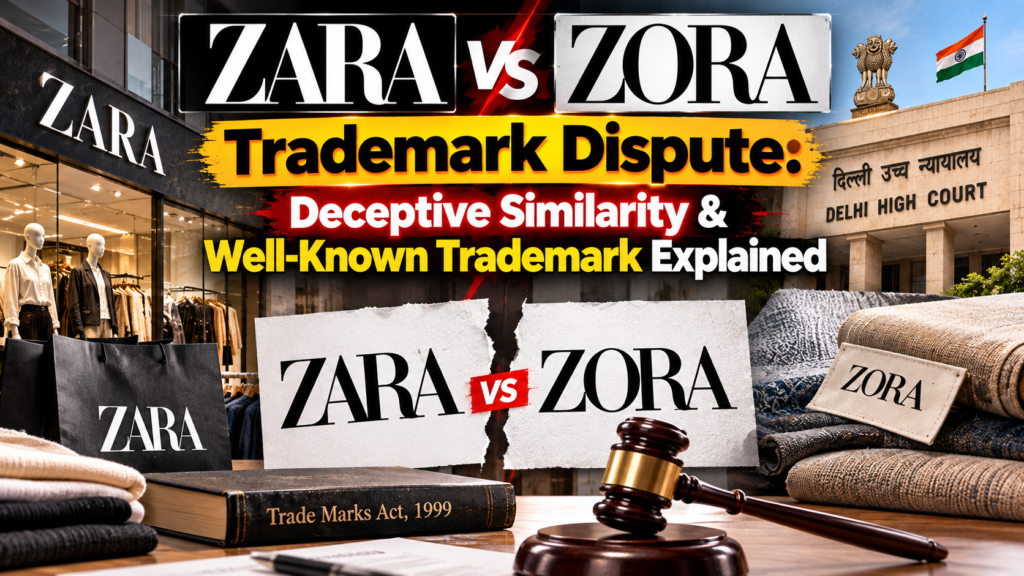
ZARA vs ZORA Trademark Dispute | Deceptive Similarity | Well-Known Trademark | Section 11(2) Trade Marks Act | Anti-Dissection Principle
The Delhi High Court has delivered an important judgment in the ZARA vs ZORA trademark dispute, examining the protection available to well-known trademarks, deceptive similarity and the scope of Section 11(2) of the Trade Marks Act, 1999.
In Industria De Diseno Textil, S.A. v. Registrar of Trade Marks & Anr., decided on 6 July 2026, the Court allowed the appeal filed by the proprietor of the ZARA trademark and directed the removal of the ZORA trademark registration in Class 24.
The judgment is particularly important because the Court examined the similarity between ZARA and ZORA not merely by comparing individual letters, but by considering their overall visual, phonetic and structural impression.
The Court also considered whether ZARA could claim protection as a well-known trademark under Section 11(2) even without relying solely on a separate formal declaration of well-known status.
ZARA vs ZORA: What Is the Trademark Dispute?
The dispute began when Industria De Diseno Textil, S.A., proprietor of the ZARA trademark, opposed the registration of ZORA.
The ZORA mark was applied for registration in Class 24, covering textile and fabric-related goods, with a claimed user date of 3 June 2016.
The Registrar of Trade Marks rejected ZARA’s opposition through an order dated 8 February 2024.
Aggrieved by the decision, the proprietor of ZARA approached the Delhi High Court under Section 91 of the Trade Marks Act, 1999.
The High Court ultimately allowed the appeal and directed cancellation of the ZORA registration.
What Did the Delhi High Court Decide in the ZARA Trademark Case?
The Delhi High Court considered several important issues relating to trademark protection.
The Court:
- Allowed the appeal filed by the proprietor of ZARA;
- Set aside the Registrar’s order dated 8 February 2024;
- Considered ZARA’s entitlement to protection under Section 11(2);
- Found the marks ZARA and ZORA deceptively similar;
- Applied the anti-dissection principle;
- Directed cancellation of ZORA Registration No. 4310686 in Class 24; and
- Directed removal of the ZORA entry from the Register of Trade Marks.
The decision demonstrates how reputation, deceptive similarity, well-known trademark protection and the statutory framework under Section 11 can operate together in a trademark dispute.
Why Is ZARA a Well-Known Trademark?
A major part of the case concerned the reputation and commercial strength of the ZARA brand.
The proprietor placed substantial material before the Court relating to:
- Sales and commercial activity;
- Advertising expenditure;
- Retail presence;
- Online presence;
- International recognition;
- Brand promotion;
- Trademark registrations;
- Product expansion; and
- Transborder reputation.
The Court considered the evidence relating to ZARA’s longstanding commercial presence and its registrations across multiple classes.
The Court also considered an earlier Delhi High Court decision in which ZARA had been recognised as a well-known trademark.
This highlights an important point for brand owners:
A claim that a trademark is “famous” should ideally be supported by documentary evidence demonstrating its reputation and recognition.
Section 11(2) of the Trade Marks Act Explained
Section 11(2) of the Trade Marks Act, 1999 is particularly relevant when dealing with reputed or well-known trademarks.
The provision addresses circumstances where a later trademark is identical or similar to an earlier trademark that has a reputation in India and where use of the later mark, without due cause, may:
- Take unfair advantage of the earlier trademark; or
- Be detrimental to its distinctive character; or
- Be detrimental to its repute.
Therefore, the protection contemplated by Section 11(2) can extend beyond situations where two parties sell exactly the same goods or services.
In the ZARA vs ZORA dispute, the Court examined whether the statutory requirements for protection under Section 11(2) were satisfied.
The Court found that the necessary requirements could be established through evidence and that a separate formal declaration of well-known status was not necessarily an absolute precondition for invoking Section 11(2) in opposition proceedings.
Does a Trademark Need a Formal Well-Known Declaration?
One of the key takeaways from the ZARA trademark judgment is that a proprietor may be able to establish the necessary reputation through evidence placed before the Court.
The Court considered:
- Section 2(1)(zg);
- Section 11(2);
- Section 11(6); and
- Section 11(7) of the Trade Marks Act.
The absence of a separate formal declaration therefore did not prevent ZARA from seeking protection under Section 11(2), provided that the relevant statutory requirements could be established through evidence.
However, this does not mean that every popular or commercially successful trademark automatically becomes a well-known trademark.
The proprietor still needs to establish the relevant statutory factors.
What Is a Well-Known Trademark in India?
Under Section 2(1)(zg) of the Trade Marks Act, a well-known trademark is one that has become known to a substantial segment of the relevant public in such a manner that use of the mark in relation to other goods or services may indicate a connection with the proprietor.
Section 11(6) provides factors that may be considered when determining whether a trademark is well known.
These include:
- Knowledge or recognition of the mark among the relevant public;
- Duration, extent and geographical area of use;
- Duration, extent and geographical area of promotion;
- Registration and applications for registration;
- Successful enforcement of trademark rights; and
- Recognition of the trademark by a Court or Registrar.
The ZARA case demonstrates why businesses seeking well-known trademark protection should maintain proper evidence of their sales, advertising, registrations, market presence and enforcement history.
ZARA vs ZORA: Are the Marks Deceptively Similar?
The two competing marks were:
ZARA
vs.
ZORA
At first glance, the difference appears to be the middle vowel.
However, trademark law does not generally require courts to conduct a simple letter-by-letter comparison.
Instead, the overall impression created by the competing marks can be relevant.
The Court considered factors including:
- The four-letter structure of both marks;
- The common initial letter “Z”;
- The common ending “RA”;
- Similar consonant structure; and
- The difference primarily arising from the middle vowel.
The Court ultimately found the marks to be phonetically deceptively similar and sufficiently similar from a visual perspective as well.
What Is the Anti-Dissection Principle?
The anti-dissection principle is an important concept in trademark law.
It means that competing trademarks should generally be considered as a whole, rather than being broken into individual letters, words or elements and compared separately.
For example, a simple argument that:
“ZARA and ZORA are different because A and O are different”
does not necessarily resolve the trademark question.
Consumers encounter trademarks as complete brand identifiers.
Therefore, the Court considered the overall visual, phonetic and structural impression created by ZARA and ZORA.
The judgment indicates that the Registrar’s approach did not adequately account for the overall similarity between the marks.
Can Changing One Letter Make a Trademark Safe?
A common misconception among businesses is that changing one letter in an existing brand name automatically creates a sufficiently different trademark.
The ZARA vs ZORA dispute illustrates why this approach can be risky.
Changing one letter does not automatically eliminate trademark concerns.
A proper assessment may consider:
- Visual similarity;
- Phonetic similarity;
- Overall structure;
- Nature of goods or services;
- Reputation of the earlier mark;
- Commercial context;
- Consumer perception;
- Potential unfair advantage; and
- Potential damage to the earlier mark’s distinctive character or reputation.
Therefore, minor spelling changes should not be treated as a substitute for proper trademark clearance.
Does Trademark Class Decide Everything?
No.
Trademark classification is important, but the class number alone does not determine every trademark dispute.
In this case, ZORA was registered in Class 24, while the proprietor of ZARA relied upon the broader reputation and commercial activities associated with the ZARA brand.
The Court also considered the protection available to a reputed trademark under Section 11(2).
This demonstrates why businesses should not assume:
“Different trademark class means there is no trademark problem.”
The nature of the goods, reputation of the earlier mark, commercial context and statutory requirements can all become relevant.
ZARA’s Reputation Beyond Fashion
Another important aspect of the judgment was the breadth of the ZARA brand.
The evidence before the Court referred to ZARA’s presence across several product categories, including:
- Apparel;
- Bags;
- Footwear;
- Headwear;
- Accessories;
- Home products;
- Textiles; and
- Home linen.
The proprietor also relied upon the ZARA HOME brand and its presence in home-related products.
This wider commercial presence was relevant when considering the reputation and strength of the ZARA trademark.
Why Did the Commercial Context Matter?
The Court did not examine ZORA merely as an isolated four-letter word.
It also considered the manner in which ZORA was used in the marketplace.
The judgment records that the ZORA mark appeared prominently on packaging associated with polyester fabric and related materials.
The commercial environment in which a trademark is used can be relevant because trademark law deals with the way consumers encounter and understand brands in the course of trade.
Thus, the nature of the goods, packaging and trade channels formed part of the overall analysis.
Can a Well-Known Trademark Be Protected Beyond Its Original Goods?
Yes, in appropriate circumstances.
Section 11(2) recognises protection for certain reputed trademarks where the use of a later similar mark, without due cause, may take unfair advantage of or cause detriment to the distinctive character or repute of the earlier mark.
This is different from simply asking whether two businesses sell identical products.
The ZARA judgment therefore provides an important example of how well-known trademark protection can operate beyond a narrow product-to-product comparison.
What Is Trademark Dilution?
Trademark dilution generally refers to harm to the distinctiveness or reputation of a strong trademark caused by unauthorised use of a similar mark.
Depending upon the facts, such use may potentially:
- Weaken the distinctiveness of the earlier mark;
- Create an unwanted association;
- Enable another business to benefit from existing brand recognition; or
- Affect the reputation associated with the earlier trademark.
The ZARA–ZORA dispute considered these issues in the context of Section 11(2) and well-known trademark protection.
Evidence Is Critical for Well-Known Trademark Protection
One of the biggest practical lessons from the ZARA case is the importance of documentary evidence.
A business seeking to establish substantial reputation should maintain evidence relating to:
Sales & Revenue
Invoices, sales figures and market presence.
Advertising & Promotion
Advertising expenditure, campaigns and promotional material.
Digital Presence
Website activity, online platforms and social-media presence.
Market Reach
Retail stores, distributors and geographical expansion.
Trademark Portfolio
Registrations and applications in India and other jurisdictions.
Enforcement
Oppositions, infringement proceedings and successful enforcement actions.
Brand Recognition
Media coverage, consumer recognition and other evidence demonstrating market awareness.
The ZARA proprietor placed extensive evidence concerning its reputation and commercial presence before the Court.
What Happened to the ZORA Trademark?
The Delhi High Court ultimately allowed the appeal filed by the proprietor of ZARA.
The Court:
- Set aside the Registrar’s order dated 8 February 2024;
- Cancelled ZORA Registration No. 4310686 in Class 24; and
- Directed the Registrar to remove the ZORA entry from the Register of Trade Marks and rectify the Register within two months.
7 Key Lessons from the ZARA vs ZORA Trademark Case
1. Well-known trademarks can receive broader protection
Where the statutory requirements are satisfied, protection may extend beyond identical goods or services.
2. A separate declaration is not always essential
The proprietor may establish the relevant statutory requirements through evidence.
3. One-letter differences may not be sufficient
A minor spelling variation does not automatically make a trademark legally distinct.
4. Trademarks are generally compared as a whole
The anti-dissection principle prevents an overly mechanical letter-by-letter comparison.
5. Trademark classes are only one part of the analysis
Reputation, similarity, commercial context and statutory provisions can also matter.
6. Reputation must be proved
Strong claims of brand reputation should be supported with credible documentary evidence.
7. Actual marketplace use matters
Packaging, trade channels, product categories and the way consumers encounter the mark can be relevant.
What Does the ZARA vs ZORA Judgment Mean for Startups?
The case contains an important lesson for startups, founders, manufacturers and brand owners.
Before finalising a brand name, businesses should conduct a comprehensive trademark clearance search.
The search should cover:
- Exact trademark matches;
- Phonetic similarities;
- Similar spellings;
- Visually similar marks;
- Existing registrations;
- Pending applications;
- Well-known trademarks;
- Related goods and services;
- Domain names;
- Social-media handles; and
- Existing market usage.
A brand that differs from an existing trademark by only one letter should receive particular scrutiny before the business invests heavily in packaging, advertising, domain names and marketing.
Conclusion
The ZARA vs ZORA trademark dispute is an important development in Indian trademark law because it demonstrates that trademark similarity cannot always be determined by simply counting letters or identifying a single spelling difference.
The Delhi High Court considered the overall similarity of ZARA and ZORA, the reputation of ZARA, the commercial context, the statutory framework for well-known trademarks and the potential impact on the distinctive character and reputation of the earlier mark.
The judgment also highlights the importance of Section 11(2) of the Trade Marks Act, 1999, particularly in cases involving reputed trademarks and potentially dissimilar goods or services.
For businesses, the message is practical:
Changing one letter is not necessarily enough to create a safe trademark.
Before launching a new brand, businesses should conduct a detailed trademark search, evaluate phonetic and visual similarity, examine relevant trademark classes and investigate whether an existing brand has substantial reputation.
A strong trademark strategy should therefore begin before the brand is launched, rather than after a trademark objection or dispute arises.
Case Details
Case Name: Industria De Diseno Textil, S.A. v. Registrar of Trade Marks & Anr.
Court: Delhi High Court
Judge: Justice Jyoti Singh
Case No.: C.A.(COMM.IPD-TM) 52/2024
Decision Date: 6 July 2026
Citation: 2026 SCC OnLine Del 5181; 2026:DHC:5373
Earlier Mark: ZARA
Disputed Mark: ZORA
Class: 24
ZORA Registration No.: 4310686
Relevant Provisions: Sections 2(1)(zg), 11(2), 11(6), 11(7) and 91 of the Trade Marks Act, 1999