
Introduction
In today’s digital economy, a brand can acquire substantial recognition far beyond the physical products or services with which it initially became associated. As businesses expand across digital platforms and new commercial sectors, the risk of third parties adopting similar names can also increase.
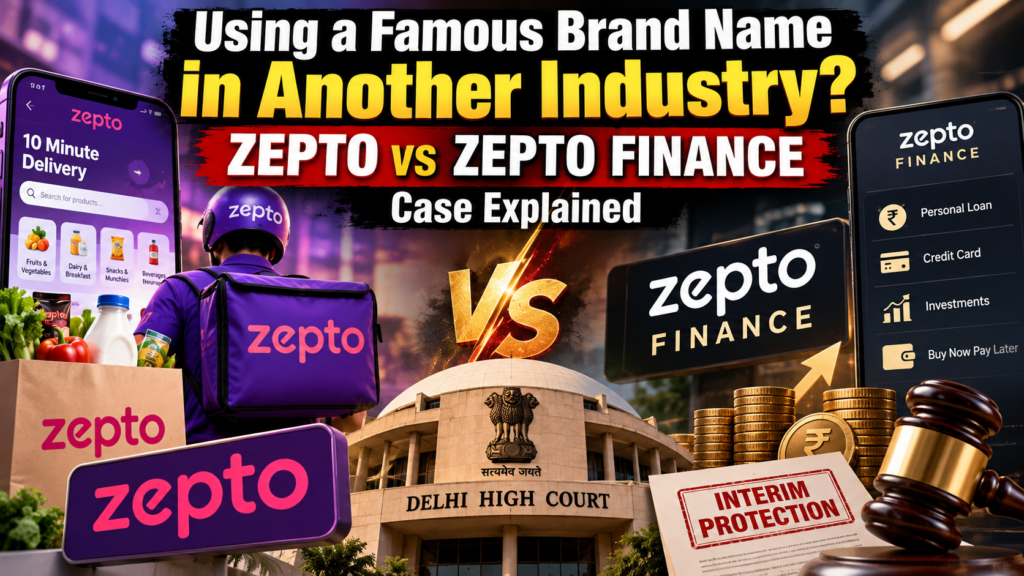
The ZEPTO v. ZEPTO FINANCE dispute before the Delhi High Court is an important illustration of this issue.
On 22 July 2026, the Delhi High Court granted interim protection to the plaintiffs’ ZEPTO trademarks in proceedings concerning the use of “ZEPTO FINANCE” and other similar marks in relation to financial services.
The Court found that the plaintiffs had established a prima facie case, taking into account the goodwill and reputation associated with the ZEPTO marks, their extensive commercial and digital presence, and the similarity between the competing marks.
The defendants were restrained, pending further proceedings, from rendering, advertising, promoting or marketing services under ZEPTO FINANCE or other marks identical or deceptively similar to the plaintiffs’ ZEPTO marks.
Importantly, the order was an interim decision and not a final determination of all issues in the suit.
1. The ZEPTO Brand
ZEPTO has developed as a prominent technology-driven consumer brand with a strong digital presence.
In the trademark proceedings, the plaintiffs relied upon their registered ZEPTO trademarks and device/image marks, together with evidence relating to their commercial activities, digital presence, advertising and promotional efforts.
The plaintiffs’ case was not limited to ownership of a particular registered trademark. They also relied upon the goodwill and reputation that the ZEPTO brand had developed through its use in the marketplace.
2. The Disputed Mark: “ZEPTO FINANCE”
The defendants were using “ZEPTO FINANCE” and other similar marks in connection with financial services.
One of the important issues was whether the addition of the word “FINANCE” was sufficient to distinguish the defendants’ mark from the plaintiffs’ ZEPTO trademarks.
At the interim stage, the Court considered whether the prominent use of ZEPTO in the disputed expression could create an impression that the financial services were connected with, sponsored by or otherwise associated with the established ZEPTO brand.
This demonstrates an important principle in trademark analysis: simply adding another descriptive or industry-specific word to an existing distinctive mark does not necessarily eliminate the possibility of deceptive similarity.
3. Goodwill and Reputation in the Digital Economy
The Court considered material relating to the plaintiffs’ goodwill and reputation.
Traditionally, brand reputation was often demonstrated through physical sales, advertising campaigns, distribution networks and market presence.
Digital businesses, however, can build substantial goodwill through:
- Websites;
- Mobile applications;
- Social-media platforms;
- Online advertising;
- Digital campaigns;
- Search visibility;
- Customer reach;
- App-based services; and
- Expansion into related commercial activities.
Such evidence can become particularly relevant when a later user adopts a similar mark in a different category of services.
The ZEPTO dispute therefore demonstrates how digital reputation can become an important component of modern trademark litigation.
4. What Is the Legal Test at the Interim Stage?
The Delhi High Court was not conducting the final trial of the entire dispute.
The proceedings involved an application seeking an ex parte ad interim injunction under Order 39 Rules 1 and 2 read with Section 151 of the Code of Civil Procedure, 1908.
At this stage, the Court examines whether the material placed before it establishes a sufficient prima facie case and whether interim protection is warranted in the circumstances.
The Court’s assessment at this stage is therefore different from the final adjudication that may follow after the parties have presented their complete evidence and arguments.
5. Deceptive Similarity: Is “FINANCE” Enough to Distinguish the Mark?
The Court found the impugned marks to be prima facie deceptively similar to the plaintiffs’ ZEPTO marks.
A significant aspect of the dispute was the treatment of the word “FINANCE.”
The addition of a word describing the nature of services does not necessarily create a completely independent commercial identity when the earlier distinctive mark remains the dominant or prominent element.
For example:
ZEPTO + FINANCE
may still be perceived differently from an entirely unrelated financial-services brand because the consumer’s attention may primarily be drawn to the distinctive ZEPTO element.
The ultimate assessment, however, depends upon the applicable statutory provisions and the facts and circumstances of each case.
6. Risk of False Commercial Association
The plaintiffs argued that consumers encountering ZEPTO FINANCE could believe that the financial services were connected with the ZEPTO business.
This raises the issue of false association.
In today’s digital environment, consumers frequently encounter businesses through:
- Google and other search results;
- Mobile applications;
- Social-media accounts;
- Digital advertisements;
- Online directories;
- Websites; and
- Business listings.
A consumer may therefore encounter a brand name without ever visiting a physical store.
For technology-driven brands, the possibility of a similar name appearing in a completely different digital environment can create concerns about commercial association, sponsorship or affiliation.
7. The Interim Injunction Granted by the Delhi High Court
The Delhi High Court granted interim protection in favour of the plaintiffs.
The defendants and persons acting on their behalf were restrained from directly or indirectly:
- Rendering services;
- Advertising services;
- Promoting services;
- Marketing services; or
- Using ZEPTO FINANCE or other marks identical or deceptively similar to the plaintiffs’ ZEPTO marks and variants.
The restraint was operative pending the next stage of proceedings.
This distinction is important because the order represents temporary judicial protection, rather than a final decree after a complete trial.
8. Compliance with Order 39 Rule 3
Because the injunction was granted in the context of an ex parte interim application, procedural compliance was also relevant.
The plaintiffs were directed to comply with the requirements of Order 39 Rule 3 of the Code of Civil Procedure.
Where an injunction is granted without first hearing the opposite party, the procedural requirements relating to service and disclosure of the order become particularly significant.
This ensures that the affected party receives the necessary information and documents concerning the interim order.
9. Why Digital Trademark Disputes Are Different
The ZEPTO dispute reflects a broader transformation in trademark law.
A modern brand can exist simultaneously across multiple digital touchpoints:
Website → Mobile App → Social Media → Search Engine → Online Advertising → Digital Marketplace
As a result, trademark confusion may arise without any physical product being placed next to another product on a retail shelf.
For digital businesses, brand identity can be encountered through a simple search query, an app icon, a social-media handle or an online advertisement.
Courts therefore increasingly have to consider the real-world and digital ways in which consumers encounter brands.
10. Does Operating in a Different Trademark Class Automatically Protect You?
No.
The fact that two businesses operate in different goods or services categories does not necessarily end the trademark analysis.
Trademark law recognises circumstances where the reputation of an earlier mark may extend beyond the exact goods or services for which it is traditionally known.
The analysis may involve factors such as:
- The strength and reputation of the earlier mark;
- The similarity between the competing marks;
- The nature of the later services;
- The relationship between the businesses;
- The likelihood of consumer association;
- The possibility of unfair advantage; and
- The circumstances in which the later mark is being used.
Therefore, different business sectors do not automatically eliminate every possible trademark concern.
11. Brand Extension and the Scope of Trademark Protection
The dispute also raises an interesting question about brand extension.
A strong brand may become recognised beyond its original category. Consumers may associate the brand with multiple products, services or commercial ventures.
However, this does not mean that every later use of a similar word is automatically prohibited.
Courts must examine the specific facts, statutory requirements, strength of the earlier mark and nature of the alleged use.
The ZEPTO dispute is therefore useful in understanding the balance between legitimate commercial use and protection against potentially misleading association.
12. What the July 2026 Order Does Not Decide
The Delhi High Court’s July 2026 order should be understood within its interim procedural context.
The Court’s finding that the plaintiffs established a prima facie case does not mean that every issue in the litigation has been finally determined.
The defendants remain entitled to contest the plaintiffs’ allegations during the subsequent proceedings.
Issues relating to evidence, statutory defences, the precise scope of trademark rights and other arguments may therefore continue to be considered as the litigation progresses.
The significance of the order lies in the Court’s prima facie assessment and the interim protection granted on that basis.
13. Digital Brand Clearance: A Lesson for Businesses
The dispute provides an important practical lesson for businesses launching a new digital brand.
Trademark clearance should not necessarily stop at searching the trademark registry.
Businesses should also consider checking:
- Domain names;
- Mobile application names;
- Social-media handles;
- Search-engine results;
- Business directories;
- Online marketplaces;
- Existing digital brands; and
- Similar names being used commercially.
A name that appears available in one database may nevertheless create problems if another business has already developed significant goodwill under a similar identity.
Proper brand clearance before launch can reduce the risk of expensive disputes later.
14. Evidence of Digital Reputation Matters
Businesses should preserve evidence demonstrating how their brands have been used and promoted online.
Potentially relevant records may include:
- Website analytics;
- Advertising campaigns;
- Social-media statistics;
- App-download information;
- Search-engine visibility;
- Online advertisements;
- Customer reach;
- Promotional expenditure;
- Press coverage; and
- Records of commercial expansion.
Such evidence can help demonstrate the extent, duration and nature of a brand’s commercial presence.
For technology-led businesses, digital evidence may therefore become an important part of trademark enforcement.
15. Key Takeaways from the ZEPTO Finance Dispute
The case provides several practical lessons for brand owners.
1. A Strong Brand Needs Active Protection
Trademark registration provides an important foundation, but businesses should also monitor potentially conflicting uses.
2. Adding a Descriptive Word May Not Eliminate Similarity
The addition of a word such as “FINANCE” does not automatically remove concerns where another distinctive mark remains the prominent element.
3. Digital Reputation Can Be Valuable Evidence
Websites, applications, online advertising and social-media activity can contribute to a brand’s commercial reputation.
4. Different Business Categories Do Not Automatically End the Analysis
The reputation of a strong mark may have relevance beyond its original commercial category depending upon the facts and applicable law.
5. Interim Injunctions Can Provide Immediate Protection
Where a court finds a sufficient prima facie case, interim relief can temporarily prevent continued use while the litigation proceeds.
Conclusion
The ZEPTO v. ZEPTO FINANCE dispute is a useful example of how Indian trademark law is adapting to the realities of the digital economy.
The Delhi High Court’s interim assessment focused on the strength and reputation of the ZEPTO marks, the plaintiffs’ digital and commercial presence, the similarity created by the disputed branding and the possibility of a false commercial association.
The case also demonstrates that trademark protection is not necessarily confined to identical goods or services. Depending on the circumstances, the reputation of an established mark and the nature of a later use can become important considerations.
For digital businesses, the message is practical: brand protection should begin before launch and should extend beyond the trademark registry to the wider digital ecosystem.
At the same time, the July 2026 order remains an interim decision. The final outcome of the litigation will depend upon the evidence and arguments presented in the subsequent proceedings.