
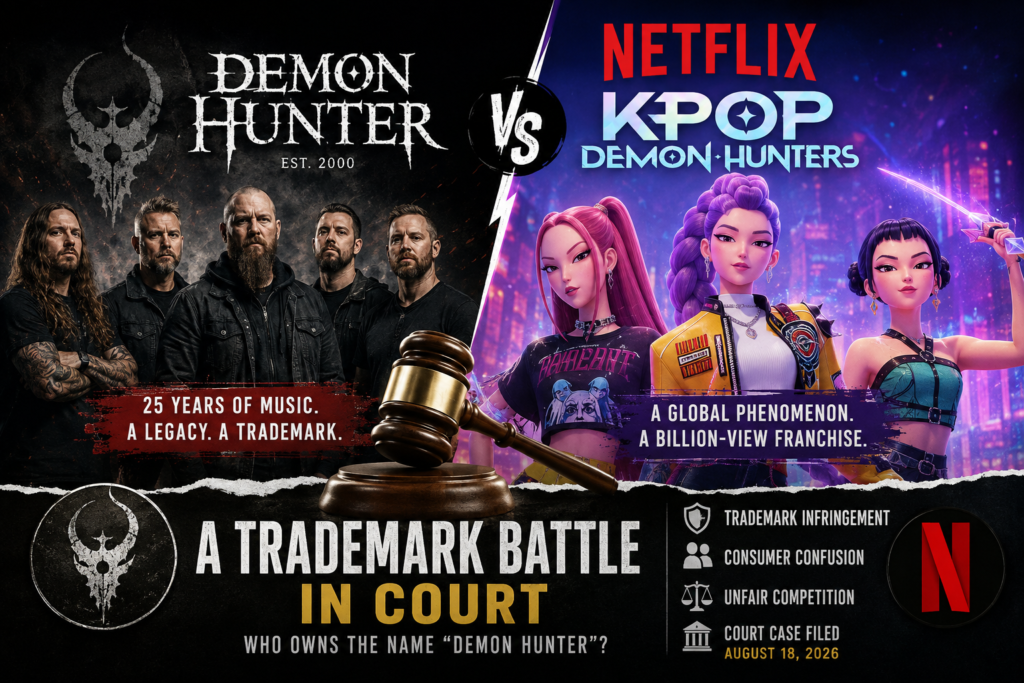
Filed: August 18, 2026
Court: Central District of California, USA
Introduction
Trademark disputes often involve businesses fighting over brand names, logos, products, or services. But the latest Demon Hunter trademark dispute involving Netflix presents a particularly interesting legal battle between a long-established Christian metal band and one of the world’s largest entertainment companies.
The 25-year-old Christian metal band Demon Hunter, through its company Hyde Lane, has filed a lawsuit against Netflix, Netflix Studios, and AEG Presents, alleging trademark infringement and other forms of unfair competition relating to Netflix’s highly successful animated film KPop Demon Hunters.
The dispute has attracted attention because the two sides operate on dramatically different scales. Demon Hunter has built its identity through decades of music, albums, merchandise, and live performances, while KPop Demon Hunters has rapidly become a global entertainment phenomenon involving music, merchandise and an upcoming international concert tour.
At the heart of the dispute is a fundamental trademark question:
Can a massive entertainment company use a name that overlaps with the trademark of an earlier, smaller brand when the parties’ products and services increasingly compete in the same commercial space?
The lawsuit filed on August 18, 2026, could provide an interesting example of trademark infringement, likelihood of confusion, senior trademark rights and reverse confusion under U.S. trademark law.
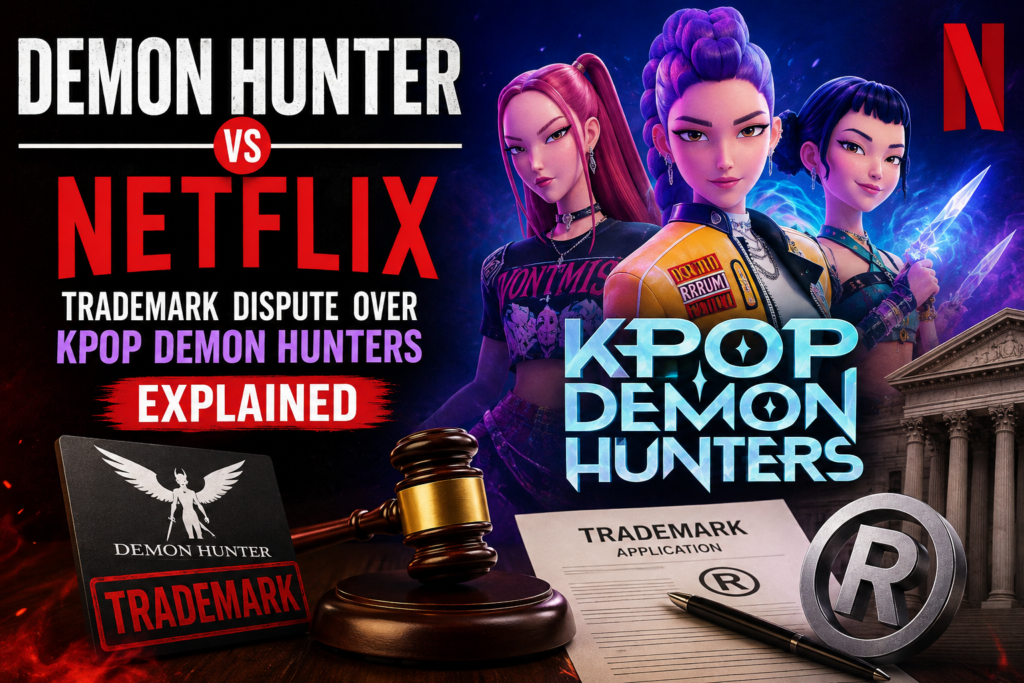
Who Owns the “Demon Hunter” Trademark?
The name Demon Hunter has been associated with a Christian metal band for approximately 25 years.
The band was founded by the Clark brothers in Seattle around 2000. Over the years, Demon Hunter released approximately a dozen studio albums, performed extensively on tour and developed a dedicated fanbase.
The band’s business expanded beyond music into merchandise and live performances.
According to the complaint, Hyde Lane officially registered “Demon Hunter” as a trademark for music and merchandise in 2022 and also sought trademark protection relating to live music and touring services.
This history is important because trademark disputes often involve determining which party has priority and whether consumers are likely to believe that two businesses are commercially connected.
What Is KPop Demon Hunters?
In 2025, Netflix launched KPop Demon Hunters, an animated film centered on the fictional K-pop girl group HUNTR/X.
The group consists of Rumi, Mira and Zoey, who live dual lives as pop stars and secret demon hunters.
The film, directed by Maggie Kang and Chris Appelhans, became a major global entertainment success.
According to the source material, the film achieved significant commercial and cultural success, including an Academy Award, a highly successful soundtrack and an extensive merchandise business.
The dispute became particularly significant after the announcement of a global KPop Demon Hunters concert tour covering 150 cities through 2027, produced in collaboration with AEG Presents.
Why Did Demon Hunter Sue Netflix?
On August 18, 2026, Hyde Lane filed a lawsuit in the Central District of California against Netflix, Netflix Studios and AEG Presents.
The complaint reportedly raises three principal legal claims:
- Trademark infringement
- False designation of origin
- Unfair competition
The central allegation is that Netflix’s use of the Demon Hunter-related name has created significant overlap with the goods and services historically offered by the band.
The complaint argues that Netflix has expanded the KPop Demon Hunters brand beyond an animated movie into areas including:
- Music
- Soundtracks
- Merchandise
- Live performances
- Concert tours
These categories allegedly overlap substantially with the commercial activities carried out by Demon Hunter for years.
Trademark Infringement: What Is the Legal Issue?
A trademark generally identifies the commercial source of goods or services.
The key issue in an infringement dispute is not simply whether two names contain similar words. Courts examine whether the use of the allegedly infringing mark is likely to confuse consumers about the source, sponsorship, affiliation or endorsement of the goods or services.
In this case, Demon Hunter’s legal position appears to focus on the combination of:
- Similar terminology
- Overlapping entertainment-related services
- Existing trademark rights
- Consumer confusion
- Commercial expansion into music, merchandise and live events
The band argues that Netflix’s enormous marketing reach could have a particularly significant impact on the distinctiveness and commercial identity of its earlier brand.
Netflix vs Demon Hunter: The David vs. Goliath Problem
One of the most striking aspects of the dispute is the enormous difference in audience size between the two brands.
According to the complaint, Demon Hunter has approximately 350,000 monthly Spotify listeners.
By comparison, the KPop Demon Hunters soundtrack has approximately 27 million monthly listeners.
That represents a difference of nearly 80 times in monthly listeners.
Of course, being a smaller business does not automatically create trademark rights, nor does being a larger company automatically create trademark liability.
However, the band argues that Netflix’s enormous marketing and commercial power could potentially eclipse the earlier Demon Hunter brand in the marketplace.
This raises an important trademark concept known as reverse confusion.
What Is Reverse Confusion in Trademark Law?
Traditional trademark infringement often involves a smaller or newer business allegedly benefiting from the reputation of a larger, established brand.
Reverse confusion works differently.
In a reverse confusion scenario, a larger or more powerful company enters the market using a mark similar to that of an earlier, smaller trademark owner.
Because the larger company has substantially greater advertising, distribution and marketing resources, consumers may eventually believe that the smaller, earlier business is actually connected to the larger company.
The Demon Hunter dispute presents an interesting potential example of this theory.
The band alleges that Netflix’s massive commercial reach could overshadow the identity that Demon Hunter developed over decades.
Evidence of Actual Consumer Confusion
One of the most important aspects of the lawsuit is the alleged evidence of actual consumer confusion.
The complaint reportedly identifies several examples.
1. Confusion Over Concert Tickets
According to the complaint, a fan allegedly paid approximately $500 for VIP tickets to a Demon Hunter concert in Albany, New York, believing that the event was a kid-friendly event associated with the Netflix film.
If established, an incident like this could potentially support the argument that consumers are actually confusing the two brands.
2. Television Producer Contacted the Band
The complaint also alleges that a television producer contacted Demon Hunter’s management believing that the band was affiliated with the Netflix movie.
This could provide another example of alleged marketplace confusion.
3. Social Media Confusion
Fans and viewers have reportedly tagged Demon Hunter’s official social media accounts when discussing or promoting KPop Demon Hunters online.
These examples are significant because actual consumer confusion can be an important piece of evidence in trademark litigation.
What Does Demon Hunter Want From Netflix?
Hyde Lane is seeking several forms of relief in the lawsuit.
According to the source material, the company is seeking:
- A jury trial
- An injunction restricting Netflix and AEG’s continued use of the disputed name in overlapping categories
- Disgorgement of profits allegedly connected with the infringement
- Treble damages
- Exemplary damages
- Attorneys’ fees
- Other appropriate legal relief
The requested remedies could therefore have significant financial and commercial consequences if the plaintiff ultimately succeeds.
Netflix Responds to the Trademark Lawsuit
Netflix has rejected the allegations.
A Netflix spokesperson reportedly described the claims as “baseless” and emphasized the global success of KPop Demon Hunters.
Netflix stated that the film has connected with audiences through its:
- Music
- Story
- Characters
- Global entertainment appeal
Netflix has also indicated that it intends to strongly defend the lawsuit.
AEG Presents, the live-events company involved with the concert tour, had not publicly commented according to the source material.
It is important to remember that these are allegations contained in a pending lawsuit, and the court has not necessarily determined that trademark infringement occurred.
Senior User vs. Junior User: Why Trademark Priority Matters
One of the most important legal concepts in this dispute is the distinction between a senior user and a junior user.
Demon Hunter argues that it developed and used the name long before Netflix introduced KPop Demon Hunters.
According to the source material, the band was operating under the Demon Hunter name for decades and obtained trademark registration for music and merchandise in 2022.
The animated Netflix film was launched in 2025.
Under U.S. trademark principles, priority can be highly significant because an earlier user may have superior rights within the relevant goods and services, depending on the specific circumstances.
Therefore, the timeline of the two brands could become an important part of the litigation.
Likelihood of Confusion: The Central Trademark Question
The concept of likelihood of confusion is central to many trademark infringement disputes.
Courts may consider multiple factors, including:
- Similarity between the marks
- Similarity or relatedness of the goods and services
- Evidence of actual consumer confusion
- Channels of trade
- Strength of the earlier mark
- Consumer sophistication
- Marketing and advertising methods
- Other circumstances surrounding the marketplace
In the Demon Hunter dispute, the plaintiff appears to rely heavily on the overlap between music, merchandise and live entertainment, as well as the alleged examples of actual consumer confusion.
The court will ultimately determine how these factors apply to the specific facts and claims presented in the lawsuit.
Why the Demon Hunter vs Netflix Case Is Important for Trademark Owners
This lawsuit is important beyond the entertainment industry.
It highlights a broader lesson for businesses that build brands around names, characters, products or services.
1. Trademark Registration Matters
Businesses should consider protecting important brand names through trademark registration.
Demon Hunter’s trademark registration for music and merchandise is now an important part of the legal dispute.
2. Use Your Trademark Consistently
Trademark rights are closely connected to commercial use.
Businesses should consistently use their marks in connection with the goods and services for which protection is claimed.
3. Monitor New Brands
Trademark owners should regularly monitor the market for potentially conflicting marks.
A brand can face challenges from companies that enter the marketplace years after the original brand was established.
4. Document Consumer Confusion
Evidence can become extremely important in trademark litigation.
Examples such as mistaken purchases, incorrect business inquiries, social media tagging or mistaken assumptions about affiliation may potentially help demonstrate actual confusion.
5. Protect Brand Expansion
Businesses should consider trademark protection not only for their current activities but also for commercially realistic areas into which they intend to expand.
This becomes particularly important when a brand operates across multiple categories such as:
- Music
- Entertainment
- Merchandise
- Events
- Digital media
- Licensing
Demon Hunter Trademark Dispute Explained: Key Takeaways
The Demon Hunter vs Netflix trademark lawsuit illustrates how trademark conflicts can become complicated when two brands operate in overlapping commercial areas.
The case involves a long-established Christian metal band that claims Netflix’s KPop Demon Hunters franchise has created confusion with its existing Demon Hunter brand.
The dispute involves several important trademark law concepts, including:
Trademark infringement: Whether Netflix’s use of the disputed name infringes the band’s trademark rights.
Likelihood of confusion: Whether consumers may believe that the two brands are connected, affiliated or endorsed by one another.
Actual confusion: Whether real-world examples demonstrate that consumers have mistaken one brand for the other.
Senior and junior users: Whether the band’s earlier use and registration provide it with priority over Netflix’s later use.
Reverse confusion: Whether Netflix’s much larger marketing presence could cause consumers to associate the smaller band’s earlier brand with the larger entertainment franchise.
Conclusion
The Demon Hunter vs Netflix trademark dispute is a fascinating example of how intellectual property law intersects with entertainment, branding and commercial expansion.
What makes the case particularly interesting is not simply the similarity between the names. The dispute involves a much broader question about brand identity, consumer confusion, trademark priority and the power imbalance between a long-established niche business and a global entertainment company.
Demon Hunter claims that Netflix’s expansion from an animated film into music, merchandise and live concerts has created substantial overlap with the band’s existing business.
Netflix, however, disputes the allegations and intends to defend the case.
As the litigation develops, the court’s treatment of likelihood of confusion, actual confusion and reverse confusion could provide valuable lessons for trademark owners, entertainment companies, startups and businesses seeking to build and protect strong brands.
For businesses, the key lesson is simple:
A brand name is an asset. Protect it early, use it consistently, monitor the marketplace and maintain evidence of your commercial use and consumer recognition.