
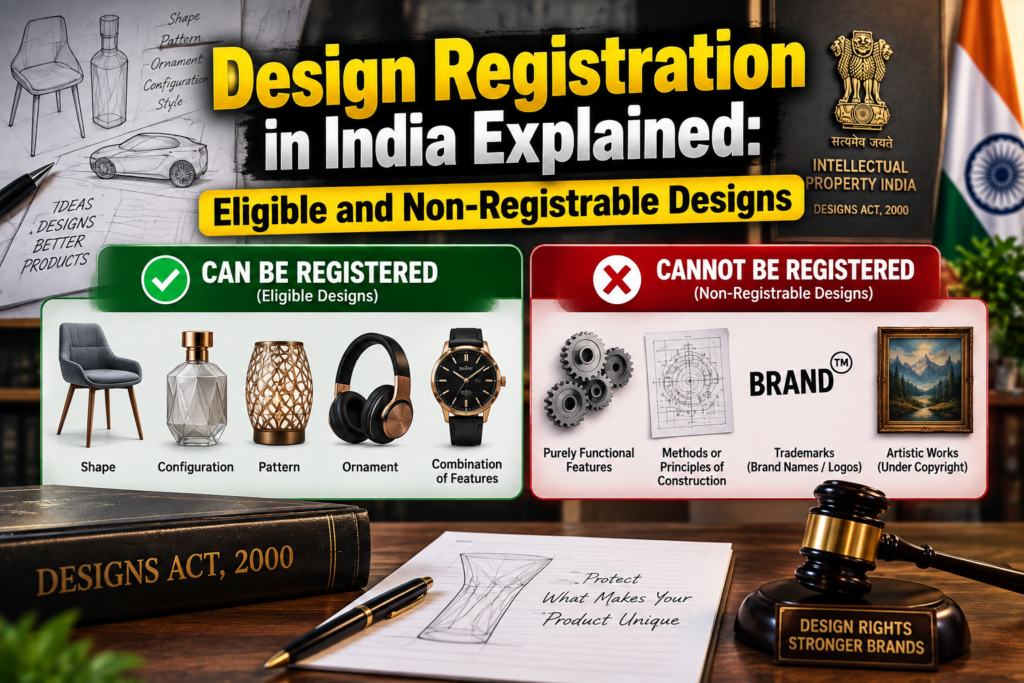
A unique product design can become an important business asset. However, not every attractive, innovative, or creative product can be protected through design registration in India.
The Designs Act, 2000 provides specific requirements for determining whether a design is eligible for registration. Understanding these requirements before filing a design registration application can help businesses avoid objections, unnecessary costs and loss of novelty.
So, what exactly can be registered as a design in India, and what cannot?
Let’s understand the design registration requirements in India.
What Is a Design Under Indian Law?
Under the Designs Act, 2000, a design primarily concerns the visual features of an article.
These features may include:
- Shape
- Configuration
- Pattern
- Ornament
- Composition of lines
- Composition of colours
- Combination of these features
The protection is focused on the appearance of the article, rather than the technical mechanism or functionality behind it.
For example, if a company develops a uniquely shaped cosmetic bottle, the distinctive external appearance of that bottle may potentially qualify for design registration, provided the statutory requirements are satisfied.
Similarly, the appearance of furniture, containers, packaging-related articles and certain consumer products may potentially be protected through design registration.
What Are the Requirements for Design Registration in India?
Before applying for registration, the design should be carefully evaluated against the statutory requirements.
One of the most important requirements is that the design should be new or original.
The applicant should also consider whether the design:
- Has already been published or disclosed;
- Has previously been used in the public domain;
- Produces a distinctive visual impression;
- Relates to the appearance of an article;
- Contains features that are capable of being protected under design law; and
- Falls within the scope of the Designs Act, 2000.
A prior public disclosure can create serious novelty issues.
Therefore, businesses should ideally consider design registration before publicly launching, displaying or commercially disclosing a new design.
What Does “Visual Appearance” Mean in Design Registration?
Design law primarily protects the visual appearance of an article.
Depending on the circumstances, examples may include:
- A distinctive bottle shape;
- A unique furniture configuration;
- A decorative surface pattern;
- A novel configuration of a consumer product;
- An ornamental appearance of an article; or
- A distinctive arrangement of lines or colours.
The important distinction is between how a product looks and how a product works.
If the feature exists primarily to perform a technical function, design protection may not be the appropriate form of IP protection.
What Cannot Generally Be Registered as a Design in India?
The Designs Act, 2000 excludes certain categories of subject matter from design protection.
1. Purely Functional or Mechanical Features
Design registration is not intended to provide a monopoly over technical functionality.
Where a feature exists solely because it is necessary for the product to perform a particular function, it may fall outside the scope of design protection.
For example, a technical mechanism inside a machine that improves its performance is generally a question of patent protection, rather than design protection.
The key question is:
Is the feature primarily concerned with the appearance of the article, or is it dictated by its technical function?
2. Methods or Principles of Construction
A method or principle of construction is different from the visual appearance of an article.
Design registration protects qualifying visual features and does not generally provide protection for the underlying method or principle by which a product is constructed or operates.
3. Trademarks, Brand Names and Source-Identifying Marks
A trademark performs a different legal function.
A trademark identifies the commercial source or origin of goods or services, while a design generally protects qualifying visual features of an article.
For example, a company may use:
Brand Name → Trademark Protection
Product Appearance → Design Protection
A business should therefore select the appropriate form of IP protection based on what exactly it wants to protect.
4. Certain Artistic Works
Certain original artistic works may fall primarily within the scope of copyright protection rather than design protection.
The appropriate IP regime depends on the nature of the creation, how it is applied to an article and the applicable statutory requirements.
Therefore, businesses should carefully assess whether a particular creation is better protected through:
- Copyright;
- Design registration;
- Trademark registration; or
- Patent protection.
5. Designs That Are Not New or Original
Novelty is a critical consideration in design registration.
If a design has already been published, disclosed or otherwise made available to the public in a manner relevant to the statutory requirements, it may face objections based on lack of novelty or originality.
This is one reason why conducting a design search before filing is important.
6. Scandalous or Obscene Designs
Designs containing matter that falls within the statutory prohibition relating to scandalous or obscene content may be refused registration.
Applicants should therefore consider the nature and presentation of the design before filing.
7. Designs Contrary to Public Order or Morality
Certain designs may also be refused where they fall within legally prohibited subject matter concerning public order or morality.
Accordingly, eligibility should be assessed not only on the basis of creativity or attractiveness but also against the statutory restrictions.
Design vs Function: An Easy Example
Consider a company that develops a new chair.
The chair has four legs because it needs stability.
The existence of four legs is primarily connected with the function of the chair.
However, suppose the same chair has:
- A distinctive ornamental shape;
- A unique decorative pattern;
- An unusual configuration; or
- A visually distinctive external appearance.
Those visual characteristics may potentially qualify for design protection, provided the statutory requirements are satisfied.
This illustrates the basic distinction:
Design law focuses on the appearance of the article, not merely on the technical way in which the article works.
Why Is a Design Search Important Before Filing?
A design search can help businesses identify potential issues before submitting a design registration application.
A preliminary search may help identify:
- Similar registered designs;
- Previously disclosed designs;
- Potential novelty concerns;
- Similar designs in the relevant class; and
- Existing designs that may create objections.
A search does not guarantee that a design will be registered.
However, it can help the applicant make a more informed decision about whether and how to file for design registration.
Practical Examples of Design Registration
Example 1: Cosmetic Bottle
A cosmetic company develops a bottle with a highly distinctive external shape.
If the design satisfies the requirements of the Designs Act, 2000, the visual appearance of the bottle may potentially qualify for design registration.
Example 2: Furniture
A furniture manufacturer develops a chair with an unusual ornamental configuration and distinctive external appearance.
The visual features may potentially be protected through design registration if the statutory requirements are met.
Example 3: Machine Mechanism
A company develops a new internal mechanism that makes a machine operate more efficiently.
This is primarily a technical innovation.
Depending on the facts, patent protection may be more appropriate if the invention satisfies the requirements of patent law.
Example 4: Brand Name
A company creates the brand name “ABC” for its products.
The name primarily raises a trademark protection issue rather than a design registration issue.
Design vs Patent vs Trademark vs Copyright
A single product can involve multiple forms of intellectual property.
For example:
| Intellectual Property | What It Primarily Protects |
|---|---|
| Patent | Technical invention or functionality |
| Design | Qualifying visual appearance of an article |
| Trademark | Brand identity and source indication |
| Copyright | Original literary, artistic and other protected works |
This distinction is extremely important for businesses developing new products.
A product may have a patented technical feature, a registered design protecting its appearance and a trademark protecting its brand name.
Why Choosing the Right IP Protection Matters
Choosing the correct form of intellectual property protection can help businesses build a stronger overall IP protection strategy.
Before filing, ask:
What exactly am I trying to protect?
If the answer is:
“How the product works” → Consider Patent Protection
“How the product looks” → Consider Design Protection
“What identifies my brand” → Consider Trademark Protection
“An original artistic/literary creation” → Consider Copyright Protection
The same commercial product can potentially involve several of these rights simultaneously.
Conclusion
Design registration in India is specifically concerned with the visual appearance of qualifying articles. However, not every attractive product, logo, artwork, technical innovation or functional feature can be protected as a registered design.
Before filing a design application, businesses should carefully evaluate:
- Novelty;
- Originality;
- Prior publication;
- Visual appearance;
- Functionality;
- The nature of the article; and
- The appropriate form of intellectual property protection.
A proper design search and IP assessment before filing can help identify potential problems and determine whether design, patent, trademark or copyright protection—or a combination of these—would be most appropriate.
For businesses launching a new product, protecting the design at the right stage can be an important part of a broader intellectual property protection strategy in India.