
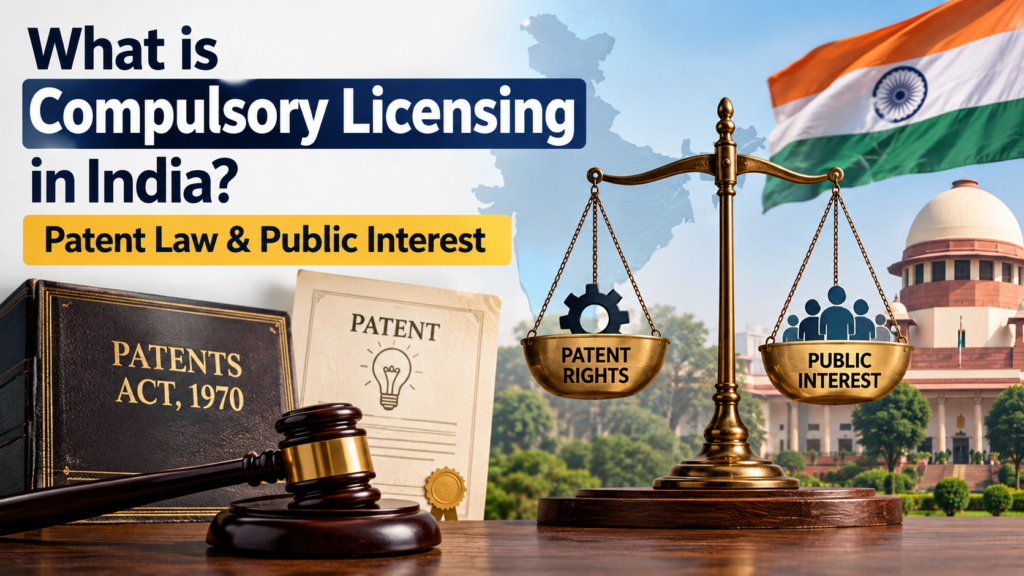
Compulsory Licensing in India is an important mechanism under Indian patent law that allows a third party to use a patented invention without the consent of the patent owner, subject to statutory conditions. It represents a balance between patent protection, innovation, public interest, affordability, and access to essential inventions.
Under the Patents Act, 1970, compulsory licensing is primarily governed by Sections 84 to 92. These provisions allow the government or eligible applicants to seek authorised use of a patented invention in specific circumstances, particularly where public requirements, affordability, or emergency needs are involved.
One of the most significant examples of compulsory licensing in India is the Natco Pharma–Bayer dispute involving the cancer drug Nexavar, which demonstrated how Indian patent law can address public access while retaining the broader framework of patent protection.
What is Compulsory Licensing in India?
A compulsory licence is an authorisation granted under patent law allowing a person or entity to manufacture, use, or sell a patented invention without obtaining the voluntary permission of the patent holder.
The licence is not an automatic cancellation of the patent. Instead, the patent continues to exist, while the authorised third party is permitted to use the patented invention subject to conditions imposed under the law.
In India, compulsory licensing is intended to address situations where the exclusive rights granted by a patent may not adequately serve public requirements.
Key objectives of compulsory licensing include:
- Ensuring that reasonable requirements of the public are satisfied;
- Making patented inventions available at a reasonably affordable price;
- Encouraging the working of patents in India;
- Addressing national emergencies and extreme urgency; and
- Supporting public non-commercial use where legally justified.
Compulsory Licensing Under the Indian Patents Act, 1970
The principal statutory provisions relating to compulsory licensing are found in Sections 84 to 92 of the Patents Act, 1970.
These provisions create different mechanisms depending on the circumstances in which a compulsory licence is sought.
Section 84: Ordinary Compulsory Licence
Section 84 of the Patents Act, 1970 provides the principal mechanism for an ordinary compulsory licence.
After three years from the date of grant of a patent, any person interested may apply to the Controller for a compulsory licence.
The applicant must establish one or more of the statutory grounds prescribed under Section 84.
Grounds for Grant of Compulsory Licence
A compulsory licence may be sought where:
- The reasonable requirements of the public have not been satisfied;
- The patented invention is not available to the public at a reasonably affordable price; or
- The patented invention has not been worked in the territory of India.
These requirements are important because compulsory licensing is not triggered merely because a patented product is expensive or unavailable in a particular situation.
The statutory grounds have to be established based on the facts and evidence of the particular case.
What Does “Reasonably Affordable Price” Mean?
One of the important considerations under Section 84 is whether the patented invention is available to the public at a reasonably affordable price.
The assessment is not necessarily based on price alone. The Controller may examine the circumstances surrounding access to the patented invention, including the needs of the public and the relevant economic factors.
Therefore, the question is not simply:
“Is the patented product expensive?”
Instead, the legal inquiry involves whether the invention is reasonably affordable in the circumstances contemplated by the Patents Act.
What Does “Working of a Patent in India” Mean?
Another important ground for compulsory licensing is the non-working of a patent in India.
Indian patent law recognises that patent rights are intended not merely to prevent others from using an invention but also to promote the practical availability and development of patented inventions.
The requirement concerning working may therefore become relevant where a patented invention is not being adequately made available in India.
However, whether a patent has been sufficiently worked is a fact-specific legal question and must be examined in accordance with the statutory framework and evidence available in the particular matter.
Natco Pharma v. Bayer: Landmark Compulsory Licensing Case in India
The Natco Pharma–Bayer dispute is one of the most important examples of compulsory licensing under Indian patent law.
The dispute concerned Bayer’s patented cancer medicine sorafenib tosylate, marketed under the brand name Nexavar.
In 2012, the Controller General of Patents granted Natco Pharma a compulsory licence under Section 84 of the Patents Act, 1970.
The decision was subsequently challenged before the Intellectual Property Appellate Board (IPAB), which upheld the grant of the compulsory licence, subject to modifications.
The proceedings examined several important issues, including:
- Whether the reasonable requirements of the public were satisfied;
- Whether the patented medicine was available at a reasonably affordable price;
- Whether the patent was being worked in India; and
- The conditions that should govern the compulsory licence.
The Natco–Bayer dispute consequently became a major reference point in discussions concerning patent rights versus public interest in India.
Section 92: Compulsory Licensing in Emergencies
Section 92 provides a separate mechanism for compulsory licensing in certain exceptional circumstances.
Where the Central Government notifies that a compulsory licence should be granted because of:
- National emergency;
- Extreme urgency; or
- Public non-commercial use,
the statutory framework provides for a more specialised route than the ordinary Section 84 process.
This provision recognises that certain circumstances may require faster intervention in the public interest.
Importantly, Section 92 should not be confused with the ordinary compulsory-licensing mechanism under Section 84. The statutory conditions and procedure differ.
Section 92A: Compulsory Licence for Export of Pharmaceutical Products
Another important provision is Section 92A of the Patents Act, 1970, which deals with compulsory licences for the manufacture and export of patented pharmaceutical products in certain circumstances.
This provision is particularly relevant to countries that have insufficient or no manufacturing capacity in the pharmaceutical sector and require access to medicines.
Section 92A reflects the interaction between Indian patent law and the international framework governing access to medicines.
Compulsory Licensing and the TRIPS Agreement
Indian compulsory licensing provisions must also be understood in the context of the TRIPS Agreement administered by the World Trade Organization.
Article 31 of TRIPS recognises circumstances in which a member country may permit the use of a patented invention without the authorisation of the patent owner, subject to specified conditions.
The international framework therefore recognises that patent rights are important, but they are not necessarily absolute in every circumstance.
India’s compulsory licensing framework operates within this broader international legal structure.
Patent Rights vs Public Interest: Finding the Balance
A central question surrounding compulsory licensing is how to balance patent protection with public interest.
Patents provide inventors and businesses with exclusive rights for a limited period. These rights can encourage investment in research, development, technology, and innovation.
At the same time, patent protection can create situations where a patented product is difficult to access because of price, availability, supply, or other factors.
Compulsory licensing provides a statutory mechanism for addressing certain such situations.
However, compulsory licensing does not mean that patent rights are automatically overridden whenever public interest is claimed.
The statutory requirements, procedural safeguards, evidence, and circumstances of each case remain important.
Does Compulsory Licensing Harm Innovation?
The relationship between compulsory licensing and innovation is more nuanced than simply saying that compulsory licensing either promotes or harms innovation.
Strong patent protection can encourage investment in research and development by providing inventors with a period of exclusivity.
On the other hand, the possibility of compulsory licensing can encourage patent holders to ensure that inventions are made available under appropriate conditions and that statutory requirements relating to the working and accessibility of patented inventions are addressed.
The Indian framework therefore attempts to maintain a balance between:
Innovation + Investment + Patent Rights + Public Access + Public Interest
The appropriate balance depends on the facts and statutory requirements applicable to each case.
Difference Between Section 84 and Section 92 Compulsory Licensing
| Feature | Section 84 | Section 92 |
|---|---|---|
| Nature | Ordinary compulsory licence | Special/emergency mechanism |
| Timing | Generally after 3 years from grant | Based on notified exceptional circumstances |
| Applicant | Any person interested | Operates following Central Government notification |
| Key considerations | Public requirements, affordability, working | National emergency, extreme urgency, public non-commercial use |
| Purpose | Address statutory grounds in ordinary circumstances | Address exceptional public-interest situations |
Key Points About Compulsory Licensing in India
Before considering compulsory licensing, it is important to understand the following:
1. A patent is not automatically cancelled
Granting a compulsory licence does not necessarily invalidate or cancel the underlying patent.
2. Statutory grounds must be established
A compulsory licence cannot ordinarily be granted merely because another business wants to manufacture or sell the patented product.
3. Public interest is an important consideration
The statutory framework specifically recognises circumstances involving public requirements, affordability, emergencies, and public non-commercial use.
4. Evidence matters
The Controller must consider the facts and evidence relevant to the statutory requirements.
5. International obligations also matter
Indian compulsory licensing provisions operate within the broader framework of the TRIPS Agreement.
Conclusion
Compulsory Licensing in India represents an important part of the country’s patent law framework. It recognises that while patent protection is essential for innovation and investment, exclusive rights may be subject to statutory intervention in specific circumstances involving public requirements, affordability, working of the invention, emergencies, or public non-commercial use.
Sections 84 to 92 of the Patents Act, 1970 provide the principal legal framework, while Section 92A addresses certain pharmaceutical exports.
The Natco Pharma–Bayer dispute remains a landmark example of how compulsory licensing has operated in India. At the same time, the statutory safeguards surrounding compulsory licensing demonstrate that public-interest intervention must be considered within the established legal framework rather than treated as an automatic limitation on patent rights.
Ultimately, India’s compulsory licensing regime seeks to maintain a legal balance between patent exclusivity, technological innovation, investment incentives, affordability, and public access.