
Why This Case Matters for Barcode and Product-Based Businesses
A recent decision by the Delhi High Court has reinforced an important lesson for businesses dealing with products, packaging, and brand identity—the business that uses a brand name first holds stronger legal rights than later entrants, even if the later business is significantly larger.
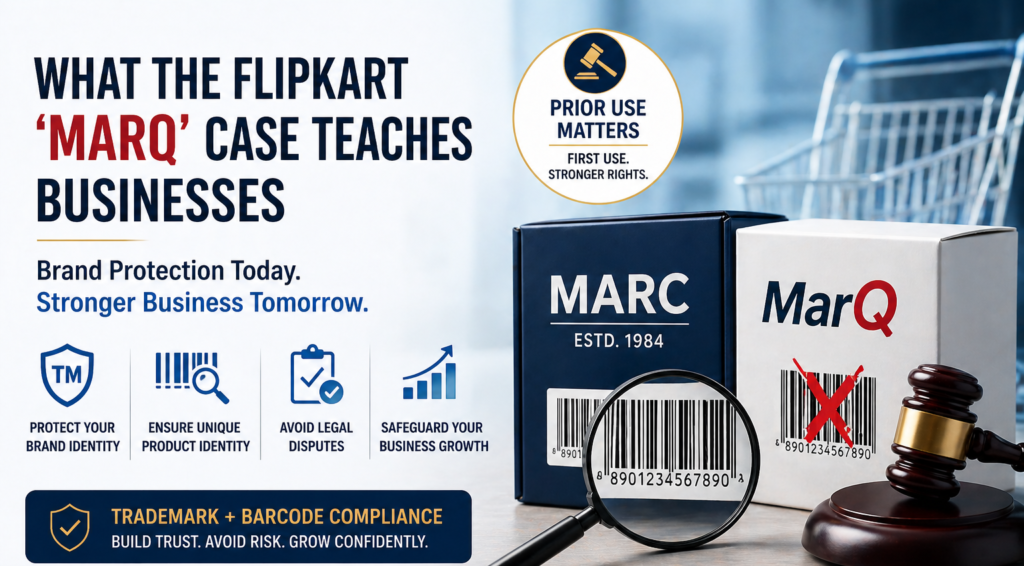
In the dispute between Flipkart and Marc Enterprises, the Court rejected Flipkart’s use of the mark “MarQ”, recognizing the earlier use of the trademark “MARC.” This ruling highlights a crucial takeaway for product-based businesses: brand identity, packaging labels, and barcode-linked product names must be legally secure before entering the market.
The Connection Between Trademark Rights and Barcode Identity
Every product sold in the market—whether in retail stores or online platforms—relies on barcodes and brand names to create a unique product identity.
In this case, the conflict arose because the mark “MarQ” was found to be confusingly similar to the long-standing trademark “MARC,” which had been used since 1984.
For businesses using barcodes, this highlights an important reality:
To know more about this, click the link below-
A barcode does not protect your brand name—your trademark does.
Without proper trademark protection, even barcode-registered products can face legal challenges.
Key Lesson #1: Product Identity Begins with Brand Ownership
The Court reinforced the importance of the prior user principle, which means the first business to use a brand name in commerce has stronger legal rights.
What This Means for Product Businesses:
- Early brand usage strengthens product ownership
- Proper trademark records support barcode registration
- Established brands gain stronger protection against imitators
- Brand identity must be secured before product scaling
For businesses planning large-scale retail or e-commerce distribution, this step is essential.
Key Lesson #2: Similar Brand Names Can Create Barcode Conflicts
A major factor in the ruling was the phonetic similarity between “MARC” and “MarQ.”
Although the spelling was slightly different, both names sounded identical when spoken—making them likely to confuse consumers.
What This Means for Barcode Users:
- Similar-sounding product names increase legal risk
- Barcode labeling with confusing names may trigger disputes
- Packaging similarity can affect customer trust
- Brand clarity improves product traceability
Even a single-letter difference may not be enough to avoid trademark conflicts.
Key Lesson #3: Rebranding Products Can Be Extremely Costly
As a result of the ruling, Flipkart was directed to stop using the disputed mark.
For product-based businesses, this can result in:
- Reprinting barcode labels
- Redesigning packaging
- Updating product listings
- Changing logistics and inventory systems
Such changes can cause major operational disruptions and financial losses, especially in high-volume businesses.
Why Trademark Checks Are Critical Before Barcode Registration
Many businesses assume that obtaining a barcode is enough to protect their product identity. However, this case demonstrates that barcode registration alone is not sufficient without proper trademark protection.
Before Launching a Product, Businesses Should:
✔ Conduct trademark availability searches
✔ Verify phonetic similarity with existing brands
✔ Secure trademark registration
✔ Apply barcode registration only after brand clearance
✔ Ensure packaging compliance with legal requirements
This structured approach reduces long-term legal risks.
How This Judgment Impacts Retail, Manufacturing, and E-Commerce Businesses
The lessons from this case are particularly relevant for:
- Manufacturers launching new products
- E-commerce private-label sellers
- FMCG and consumer goods brands
- Importers and exporters
- Businesses expanding product lines
As markets become more competitive, clear product identity supported by trademarks and barcodes becomes a business necessity.
Final Takeaway for Barcode-Based Businesses
The Flipkart–MARC case demonstrates that product success depends on strong brand ownership and legal clarity.
Businesses that integrate trademark protection with barcode compliance are better positioned to:
- Protect their product identity
- Avoid packaging and labeling disputes
- Maintain market credibility
- Scale products safely across markets
- Build long-term brand value
In today’s competitive retail environment, barcode compliance combined with trademark protection is not just regulatory—it is strategic.
Conclusion
The Flipkart–MARC trademark dispute highlights the importance of securing brand identity before launching products into the market. For barcode-driven businesses, the lesson is clear: a barcode supports product tracking, but a trademark protects product ownership.
Businesses that conduct proper trademark checks before barcode registration can prevent costly disputes, protect their packaging investments, and ensure smooth market expansion. Ultimately, combining trademark protection with barcode compliance creates a strong foundation for sustainable product growth and long-term brand success.