
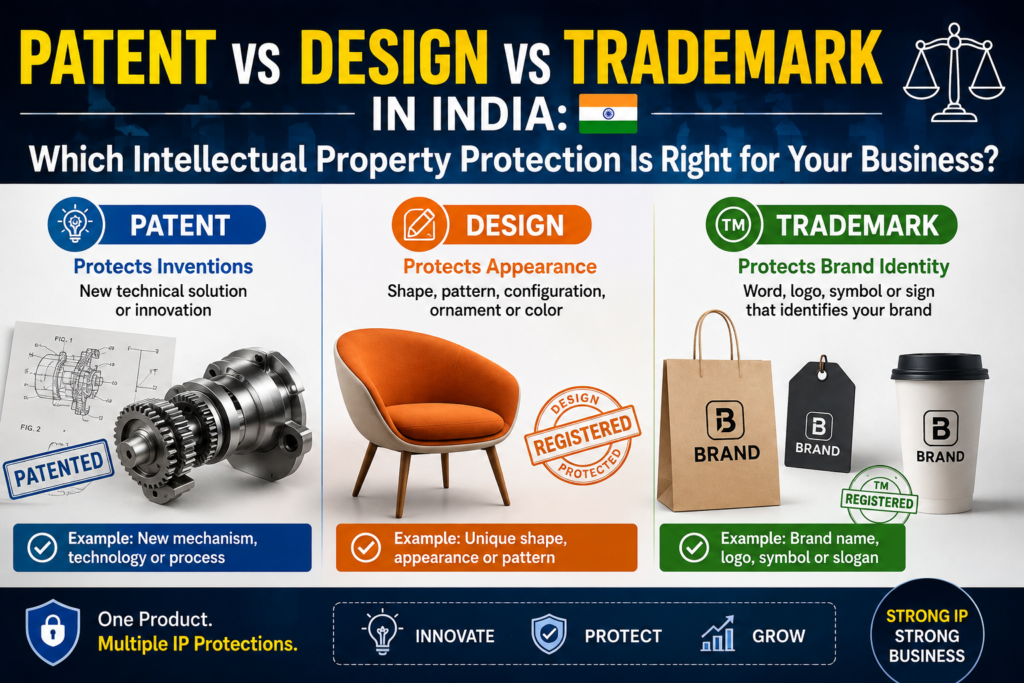
Businesses rarely create products that involve only one type of intellectual property (IP). A single product can contain patented technology, copyrighted software, a trademark, and a distinctive visual appearance that may qualify for design protection.
This raises an important question for startups, manufacturers, founders and established businesses:
Should you protect your product with a patent, design registration, trademark registration, or copyright?
The answer depends on what exactly you want to protect.
A patent generally protects a new technical invention. A design registration protects the visual appearance of an article. A trademark protects a distinctive sign that identifies the commercial source of goods or services. Copyright may protect original literary, artistic, musical and certain software-related works, subject to applicable law.
Understanding these differences is essential for building an effective IP protection strategy in India.
Patent vs Design vs Trademark: Quick Comparison
| Intellectual Property | What It Protects | Example | General Term of Protection in India |
|---|---|---|---|
| Patent | Technical invention | New mechanism or manufacturing technology | 20 years from filing, subject to law |
| Design Registration | Visual appearance of an article | Shape, configuration, pattern or ornamentation | 10 years + possible 5-year extension |
| Trademark | Brand/source identifier | Brand name, logo, distinctive mark | 10 years per registration, renewable indefinitely |
| Copyright | Original creative expression | Software, artwork, content | Depends on the type of work |
The important point is that one product can potentially receive more than one type of IP protection.
What Does a Patent Protect?
A patent protects an invention that satisfies the requirements prescribed under Indian patent law.
Under the Patents Act, 1970, an invention generally needs to satisfy requirements such as:
- Novelty
- Inventive step
- Industrial applicability
It must also fall within patentable subject matter and not be excluded by the Act.
Patent protection is therefore primarily concerned with technical innovation, rather than simply the appearance or branding of a product.
Example of Patent Protection
Suppose a company develops an electric kettle with a completely new heating mechanism that improves energy efficiency.
The technical mechanism may potentially be protected through a patent, provided it satisfies the applicable legal requirements.
The patent would focus on the technical invention, not merely on the colour or external shape of the kettle.
What Does Design Registration Protect?
Design protection is fundamentally different from patent protection.
A registered design protects the visual appearance of an article, rather than the underlying technical principle.
Section 2(d) of the Designs Act, 2000 broadly covers features such as:
- Shape
- Configuration
- Pattern
- Ornament
- Composition of lines
- Composition of colours
where the features are applied to an article and are judged solely by the eye.
Example of Design Protection
Imagine that the same electric kettle has an unusual and commercially attractive external shape.
If the value lies primarily in that distinctive visual appearance, design registration may be relevant, provided the statutory requirements are satisfied.
The design registration does not give the owner a patent over the kettle’s technical functioning.
This distinction is extremely important.
What Does a Trademark Protect?
A trademark identifies and distinguishes the goods or services of one business from those of another.
A trademark can potentially include:
- Brand names
- Logos
- Words
- Letters
- Numerals
- Product labels
- Taglines
- Certain shapes or packaging
- Other distinctive marks recognised under trademark law
For example, the electric kettle may be sold under a distinctive brand name and logo.
Those branding elements can potentially be protected through trademark registration if they satisfy the applicable requirements.
The Key Purpose of Trademark Protection
The fundamental purpose of a trademark is brand identification and consumer association.
When consumers see a particular trademark, they should be able to identify the commercial source of the product or service.
This is why trademark protection can become increasingly valuable as a business builds reputation and goodwill.
Patent vs Design vs Trademark: The Key Difference
The easiest way to understand the distinction is to ask:
What exactly are you trying to protect?
If You Want to Protect a Technical Invention → Patent
A patent may be relevant when your competitive advantage comes from a new technical solution or invention.
If You Want to Protect Product Appearance → Design
Design registration may be relevant when the commercial value lies primarily in the visual appearance of the product.
If You Want to Protect Your Brand → Trademark
Trademark registration may be relevant when you want to protect the name, logo or other distinctive identifier associated with your business or product.
If You Want to Protect Original Creative Expression → Copyright
Copyright may become relevant to original artistic, literary, musical and certain software-related works, subject to applicable law.
Can One Product Have Patent, Design and Trademark Protection?
Yes, potentially.
This is one of the most important concepts in intellectual property strategy.
Consider a smartphone.
A smartphone may contain:
- Patented technical technology
- Copyright-protected software
- A registered trademark for its brand name
- A distinctive external appearance that may potentially qualify for design protection
Each right protects a different element of the overall product.
Therefore, businesses should not always think in terms of choosing only one form of IP protection.
Instead, they should identify all commercially valuable IP assets associated with the product.
Example: Protecting an Electric Kettle
Let’s take a simple example.
A company develops an innovative electric kettle.
1. Technical Innovation
The company creates a new heating technology.
Potential protection: Patent
2. Product Appearance
The company develops a distinctive and aesthetically attractive kettle shape.
Potential protection: Design registration
3. Brand Name
The company launches the kettle under a unique brand name.
Potential protection: Trademark
4. Artwork and Software
The packaging contains original artwork, and the product includes original software or digital content where applicable.
Potential protection: Copyright, subject to the applicable legal framework
This creates a layered IP protection strategy.
Patent vs Design: What Is the Difference?
This is one of the most common questions asked by businesses.
The basic distinction is:
Patent = Technical Function/Innovation
Design = Visual Appearance
For example, if a company develops a new internal mechanism that makes a product operate more efficiently, patent protection may be relevant.
If the company creates a new external shape that makes the product visually distinctive, design protection may be relevant.
However, the exact legal position depends on the facts and the statutory requirements applicable to the particular subject matter.
Design vs Trademark: What Is the Difference?
Design and trademark protection can sometimes appear similar because both may involve the appearance of a product.
But their legal purposes are different.
A design registration primarily protects the visual features of an article covered by the Designs Act.
A trademark primarily protects a source-identifying sign that distinguishes the goods or services of one business from another.
For example, a unique product shape may initially be protected as a registered design. In appropriate circumstances, a shape may also potentially function as a trademark if it satisfies the requirements for trademark protection.
Therefore, businesses should carefully evaluate the legal basis and commercial purpose of each form of protection.
Trademark vs Patent: What Is the Difference?
A patent protects an invention.
A trademark protects a brand identifier.
For example:
New technology inside a product → Patent
Brand name on the product → Trademark
A patent is generally limited to a statutory term, while trademark registrations can generally be renewed repeatedly, allowing brand protection to continue indefinitely as long as the applicable requirements are satisfied.
How Long Does IP Protection Last in India?
The duration differs significantly depending on the type of IP.
Patent
A patent generally has a 20-year term from the filing date, subject to the provisions of the Patents Act and applicable requirements.
Registered Design
Under Section 11 of the Designs Act, 2000, registration initially provides protection for 10 years, with the possibility of extending it by a further 5 years, subject to the statutory requirements.
Trademark
A trademark registration is generally valid for 10 years and can be renewed repeatedly.
This means a properly maintained trademark can potentially provide brand protection indefinitely.
Copyright
Copyright duration varies depending on the type of work and applicable statutory provisions.
Why Should Businesses File IP Protection Before Launch?
Timing can be extremely important.
For patents and designs, public disclosure before filing can create serious issues regarding novelty and registrability, depending on the circumstances and applicable law.
Therefore, businesses should ideally evaluate their IP position before publicly launching a new product.
Before publishing product photographs, displaying prototypes at exhibitions, launching a website, sharing technical details with potential partners, or beginning commercial sales, businesses should consider whether relevant IP applications should be filed.
Why Startups Need an IP Strategy Before Product Launch
Startups often focus heavily on:
- Product development
- Funding
- Marketing
- Sales
- Customer acquisition
- Business expansion
IP protection may be considered later.
This can be a costly mistake.
If a startup develops a valuable invention or distinctive product design and publicly discloses it without considering the appropriate IP filing strategy, it may create avoidable legal problems.
An IP strategy should ideally be developed alongside product development, not after the product becomes successful.
Common Mistake: Assuming One Registration Protects Everything
One of the biggest misconceptions is:
“I have registered my trademark, so my entire product is protected.”
That is generally not how intellectual property rights work.
A trademark registration does not automatically protect the technical invention inside a product.
Similarly:
Patent ≠ Brand Protection
Design Registration ≠ Technical Invention Protection
Trademark ≠ Complete Product Protection
Each IP right has a specific legal purpose.
How to Build a Strong IP Protection Strategy
Businesses can follow a simple framework.
Step 1: Identify the Innovation
Ask:
What is technically new?
If there is a potentially patentable technical invention, evaluate patent protection.
Step 2: Identify the Visual Features
Ask:
What makes the product visually distinctive?
Consider whether design registration may be appropriate.
Step 3: Identify the Brand
Ask:
What will customers associate with our business?
Identify brand names, logos, taglines and other potential trademarks.
Step 4: Identify Creative Assets
Consider:
- Artwork
- Packaging artwork
- Website content
- Software
- Product manuals
- Marketing materials
- Photographs
- Videos
Copyright and other relevant rights may apply depending on the asset.
Step 5: Create an IP Filing Strategy
Instead of filing registrations randomly, businesses should develop a coordinated IP strategy covering the technology, appearance, branding and creative assets that create commercial value.
Why IP Strategy Matters for Business Growth
Intellectual property is not merely a legal formality.
A strong IP portfolio can contribute to:
- Competitive advantage
- Brand value
- Licensing opportunities
- Investor confidence
- Business valuation
- Market differentiation
- Commercialisation
- Enforcement against infringement
For startups seeking funding or planning future expansion, a well-organised IP portfolio can become an important business asset.
Conclusion: Protect the Right IP Asset
The question is not simply:
“Should I register a patent, trademark or design?”
The better question is:
“What exactly have I created, and which part of it has commercial value?”
If the value lies in technical innovation, patent protection may be appropriate.
If the value lies in visual appearance, design registration may be appropriate.
If the value lies in brand identity, trademark protection may be appropriate.
And where there are original creative works, copyright protection may also be relevant.
In many cases, the strongest approach is not choosing one IP right but developing a multi-layered intellectual property strategy that protects the different commercially valuable elements of the business.
Your product may be one asset—but your IP protection can have multiple layers.