
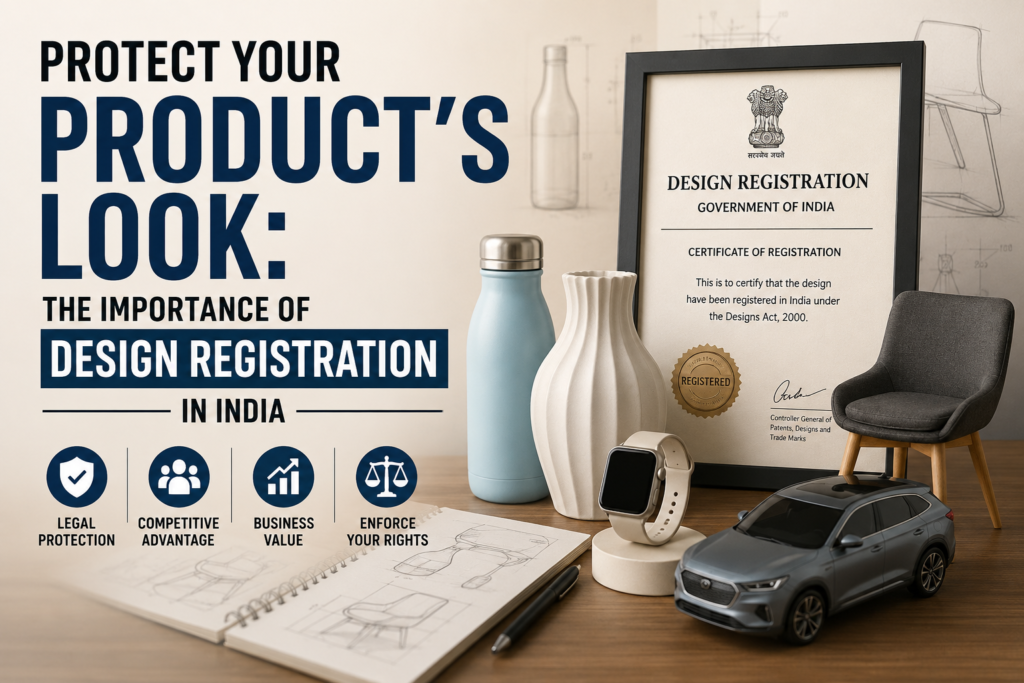
A product’s appearance can be one of its most valuable commercial assets. From a uniquely shaped chair or bottle to a distinctive smartphone accessory, automobile component, jewellery piece, or packaging design, visual appearance can play a major role in how consumers recognise and choose a product.
In a competitive marketplace, businesses often invest substantial time and money in developing distinctive product designs. However, without appropriate legal protection, competitors may attempt to reproduce or imitate those visual features.
In India, industrial designs are primarily protected through registration under the Designs Act, 2000. For businesses that rely heavily on product appearance, understanding design registration in India, its requirements, benefits, and limitations is therefore essential.
What Is Design Registration in India?
Design registration is a form of intellectual property protection that protects the visual appearance of an article.
Under Section 2(d) of the Designs Act, 2000, a “design” generally refers to features of shape, configuration, pattern, ornament, or composition of lines or colours applied to an article and judged solely by the eye.
In simple terms, design law focuses on how a product looks, rather than how it functions.
For example, suppose a company develops a table with an unusual geometric structure. The mechanical or technical mechanism used to manufacture or operate the table may potentially be relevant to patent protection. However, the distinctive visual configuration of the table may fall within the scope of design protection if the statutory requirements are satisfied.
This distinction is important because businesses may need to consider different forms of intellectual-property protection for different aspects of the same product.
Why Is Design Registration Important for Businesses?
A distinctive product appearance can become an important part of a company’s brand identity and commercial value.
Consumers may associate a particular visual design with a specific business even without seeing the company’s name or logo. This is especially relevant in industries where purchasing decisions are strongly influenced by aesthetics.
Design registration can help businesses:
- Protect the visual appearance of their products
- Deter competitors from copying or imitating registered designs
- Establish statutory rights over the registered design
- Take appropriate legal action against design piracy
- Strengthen their overall intellectual-property portfolio
- Support licensing and commercialisation opportunities
- Add value during investment, collaboration, or business transactions
For businesses that spend considerable resources on product development, protecting the appearance of the final product should therefore form part of the overall IP strategy.
What Can Be Protected Under Design Law?
The Designs Act primarily protects the visual features of an article.
These may include:
- Shape
- Configuration
- Pattern
- Ornamentation
- Composition of lines
- Composition of colours
- Combinations of these features
The design must be capable of being judged solely by the eye.
This means that design registration generally does not protect the underlying technical function or mechanism of a product.
For example, the external appearance of a newly designed consumer product may potentially qualify for design protection, while the innovative technology inside that product may require a different form of intellectual-property protection, such as a patent.
Businesses should therefore identify which aspects of their product require design protection and which may require other forms of IP protection.
Key Requirement: Novelty and Originality
One of the most important requirements for obtaining design registration in India is novelty or originality.
Section 4 of the Designs Act restricts registration of designs that do not meet the statutory requirements, including designs that have been previously disclosed or published in circumstances that affect their eligibility.
Before filing an application, businesses should therefore consider conducting appropriate searches to determine whether a substantially similar design already exists.
This is particularly important for companies operating in competitive industries where similar products may already be available in the market.
Why Businesses Should Not Publicly Reveal a New Design Too Early
One of the most common mistakes businesses can make is publicly disclosing a new product design before taking appropriate steps to protect it.
A company may launch a promotional campaign, publish photographs on Instagram or another social-media platform, display the product at a trade fair, or circulate product catalogues before filing a design application.
Such disclosure can potentially create issues relating to prior publication and novelty.
Therefore, if a business has developed a commercially valuable new product design, it should consider its design-protection strategy before publicly launching or displaying the design.
Confidentiality and timely filing can be critical components of an effective design-protection strategy.
What Is the Design Registration Process in India?
A business seeking design registration must prepare and file an appropriate application in accordance with the applicable legal and procedural requirements.
An important part of the process is identifying the relevant article and classification.
The applicant must also provide appropriate representations of the design.
Importance of Clear Design Representations
The visual representation submitted with a design application is extremely important because the scope of protection is closely connected to what has been represented and registered.
The representations should clearly communicate the features of the design for which protection is being sought.
Poorly prepared or unclear representations can create difficulties later, particularly if the proprietor needs to enforce the registered design against a competitor.
Businesses should therefore give careful attention to the preparation of drawings, photographs, or other representations forming part of the application.
How Long Does Design Registration Last in India?
Under Section 11 of the Designs Act, 2000, registration of a design provides protection for an initial period of 10 years.
The registration may be extended for an additional 5 years, subject to the applicable legal requirements.
Accordingly, the maximum period of protection can generally extend to 15 years.
The limited duration reflects the nature of design protection. Unlike perpetual rights, design protection provides businesses with a commercially meaningful period during which they can exploit and protect the visual appearance of their products.
What Is Design Piracy Under Section 22?
Once a design is registered, the proprietor obtains statutory rights in relation to the registered design.
Section 22 of the Designs Act, 2000 deals with piracy of registered designs.
Broadly, the provision addresses certain unauthorised acts involving the application of a registered design, or a fraudulent or obvious imitation of it, to articles for purposes such as sale or importation, subject to the statutory framework.
Consider a furniture company that spends two years developing a distinctive chair design.
After the chair becomes commercially successful, a competitor begins selling chairs with an identical or obviously imitative visual appearance.
If the original design has been properly registered, the proprietor may be able to rely upon the statutory remedies available under the Designs Act.
This demonstrates why design registration can be both a defensive legal tool and a commercial asset.
Can a Registered Design Be Cancelled?
Yes.
Design registration does not provide an absolute guarantee that the registration can never be challenged.
Under Section 19 of the Designs Act, a registered design may be cancelled on specified statutory grounds.
These can include circumstances relating to:
- Lack of novelty or originality
- Prior publication
- Other grounds recognised under the Designs Act
This is why businesses should not treat registration as a substitute for proper clearance and documentation.
A strong design-protection strategy should include appropriate searches and records showing how and when the design was independently developed.
Industries That Should Consider Design Registration
Design protection can be particularly valuable in industries where visual appearance influences consumer purchasing decisions.
Examples include:
1. Furniture
Chairs, tables, lighting products and other furniture may derive significant commercial value from their distinctive shape and configuration.
2. Consumer Electronics
Smartphone accessories, wearable devices, speakers and other consumer products often compete heavily on appearance and aesthetics.
3. Automotive Products
Automobile components and other products may incorporate distinctive visual features that can have substantial commercial value.
4. Fashion and Lifestyle Products
Jewellery, accessories, bags and other lifestyle products often depend heavily on their visual appeal.
5. Packaging
Distinctive packaging shapes and visual features can contribute significantly to product recognition.
6. Household and Consumer Products
Kitchenware, storage products, appliances and other everyday products may also benefit from appropriate design protection.
Design Registration vs. Copyright: What Is the Difference?
Design protection and copyright protection are different forms of intellectual-property protection and should not automatically be treated as interchangeable.
Copyright generally arises automatically when an eligible original work is created, whereas protection under the Designs Act is based on registration.
Design law specifically focuses on visual features of an article that fall within the statutory definition of a design.
Businesses should therefore assess the nature of the work and the applicable legal framework before deciding which form of protection is appropriate.
In some situations, multiple intellectual-property rights may need to be considered as part of a broader IP strategy.
Design Registration as a Business Asset
Design registration should not be viewed only as a legal formality.
A registered design can form part of a company’s broader intellectual-property portfolio and may have commercial significance during:
- Licensing negotiations
- Investment discussions
- Strategic partnerships
- Brand expansion
- Product commercialisation
- Mergers and acquisitions
Formal registration can demonstrate that a business has taken steps to protect the visual aspects of its products.
For companies whose competitive advantage depends on product appearance, this can be commercially significant.
Common Mistakes Businesses Should Avoid
Businesses developing new product designs should be careful to avoid the following mistakes:
Publicly Disclosing the Design Before Filing
Publishing the design online or displaying it publicly before filing may create issues concerning novelty and prior publication.
Failing to Conduct Searches
A design that appears new to a business may already have been published or registered elsewhere.
Submitting Poor-Quality Representations
Unclear or incomplete representations can create uncertainty regarding the scope of protection.
Ignoring Documentation
Businesses should maintain records concerning the creation and development of their designs.
Waiting Until Copying Occurs
Design protection should ideally be considered before competitors begin copying the product.
How Businesses Can Build an Effective Design Protection Strategy
A practical design-protection strategy should begin during the product-development stage.
Businesses should consider the following steps:
1. Identify protectable visual features
Determine which aspects of the product’s appearance may qualify for design protection.
2. Maintain confidentiality
Restrict public disclosure until the appropriate protection strategy has been implemented.
3. Conduct clearance searches
Search relevant databases and publicly available material for potentially conflicting designs.
4. Prepare accurate representations
Ensure that the application clearly represents the design for which protection is sought.
5. File the application at the appropriate stage
Timely filing can help reduce risks associated with prior disclosure.
6. Maintain development records
Keep documentation relating to the creation and development of the design.
7. Monitor the market
After registration, businesses should remain alert to potentially infringing or imitative products.
Key Takeaway
A product’s appearance can represent substantial commercial value. In industries where customers are influenced by aesthetics, a distinctive design can become an important competitive advantage.
However, that advantage can be weakened if competitors are able to reproduce or imitate the product’s appearance without effective legal protection.
In India, design registration under the Designs Act, 2000 provides a statutory framework for protecting qualifying product designs.
Businesses should therefore consider design protection early in the product-development process rather than waiting until imitation or infringement becomes a problem.
A well-planned strategy should combine confidentiality, prior-art and design searches, timely registration, accurate representations, proper documentation, and market monitoring.
Ultimately, design registration is not simply about protecting how a product looks. It can be an important part of protecting the commercial value, competitive advantage, and intellectual-property portfolio of a business.