
Introduction
Artificial intelligence is rapidly transforming the way audio and digital content is created. One of the most significant developments is AI voice cloning, a technology capable of reproducing a person’s voice, tone, cadence, accent and vocal characteristics with remarkable accuracy.
While AI voice cloning has legitimate applications in entertainment, accessibility, education and digital media, it also raises important legal questions. What happens when someone’s voice is cloned without permission? Can the unauthorized use of a person’s voice amount to copyright infringement? Or is it primarily a violation of personality rights, publicity rights or privacy rights?
In India, these questions are becoming increasingly important because the existing legal framework does not contain a specific, comprehensive statute dealing exclusively with AI-generated replicas of a person’s voice.
This article examines the relationship between AI voice cloning and copyright law in India, while also considering personality rights, privacy protections, judicial developments and possible legal reforms.
What Is AI Voice Cloning?
AI voice cloning is a technology that uses machine-learning models to analyze a person’s existing voice recordings and generate new speech that resembles the person’s voice.
Depending on the sophistication of the system, an AI-generated voice may reproduce characteristics such as:
- Vocal tone and timbre
- Pronunciation and accent
- Speech rhythm and cadence
- Emotional expression
- Pitch and speaking style
The technology creates a significant legal distinction between copying a particular recording and imitating the identity associated with a person’s voice.
This distinction is central to understanding whether copyright law alone is sufficient to protect individuals from unauthorized AI voice cloning.
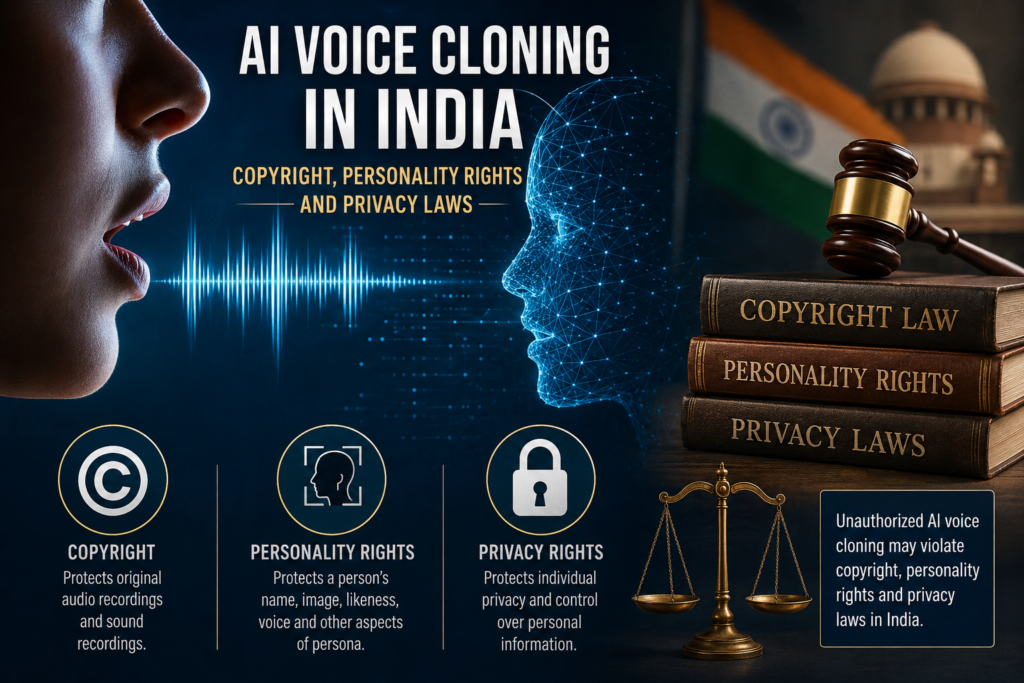
Copyright vs. Personality Rights: What Is the Difference?
Copyright and personality rights protect different legal interests.
Under the Copyright Act, 1957, copyright protects original works and subject matter such as literary, dramatic, musical and artistic works, as well as sound recordings. Copyright protection is generally concerned with the unauthorized reproduction, communication, adaptation or commercial exploitation of protected works.
Personality rights, on the other hand, concern the unauthorized commercial exploitation of aspects of an individual’s identity or persona, such as:
- Name
- Image
- Likeness
- Voice
- Signature
- Distinctive characteristics
Therefore, a person may potentially object to an unauthorized AI-generated voice even when the AI output does not reproduce a particular copyrighted recording.
For example, if an AI system creates a new advertisement using a synthetic voice that sounds like a well-known actor, the legal issue may not simply be whether an existing sound recording was copied. The larger question may be whether the individual’s identity or persona has been commercially appropriated without authorization.
Are Voice Clones Protected by Copyright?
A crucial question is whether an AI-generated voice itself can receive copyright protection.
Copyright law generally protects qualifying creative works rather than a person’s identity or natural characteristics. A person’s ordinary speaking voice, by itself, is not equivalent to a copyrighted literary or artistic work.
However, recorded performances and sound recordings may attract copyright protection depending on the circumstances.
The distinction can therefore be understood as follows:
Original voice recording:
A recording may constitute protected subject matter under copyright law.
AI-generated voice imitation:
A synthetic voice may raise separate questions concerning personality, publicity and privacy rights, particularly where it imitates an identifiable individual.
This distinction demonstrates why copyright law alone may not completely address unauthorized AI voice cloning.
Human Creativity and AI-Generated Content
Another important issue concerns AI authorship.
Section 2(d) of the Copyright Act, 1957 deals with the concept of an “author” in relation to different categories of works. Copyright protection traditionally assumes a connection between creative expression and human intellectual contribution.
In Eastern Book Company v. D.B. Modak, the Supreme Court emphasized the requirement of originality and a minimum level of creativity for copyright protection.
This becomes complicated when an AI system independently generates synthetic audio after processing data.
Where a human provides substantial creative direction, selection, arrangement or modification, the resulting work may require a different analysis from content generated with minimal human involvement.
Accordingly, the legal question is not simply whether AI was used, but how much human creativity and control contributed to the final work.
Personality Rights and AI Voice Cloning in India
Personality rights have become increasingly significant in Indian jurisprudence, particularly in cases involving celebrities.
Indian courts have recognized that unauthorized commercial exploitation of a person’s identity can give rise to legal remedies.
In Anil Kapoor v. Simply Life India & Ors., CS(COMM) 652/2023, the Delhi High Court dealt with unauthorized use of the actor’s name, image, likeness, voice and other aspects of his personality, including AI-related misuse and deepfake concerns.
Similarly, Amitabh Bachchan v. Rajat Nagi & Ors., CS(COMM) 819/2022, involved protection against unauthorized exploitation of distinctive personality attributes.
These cases demonstrate the growing judicial recognition of personality-related interests, although the precise scope and limits of such rights continue to develop through case law.
Can Unauthorized AI Voice Cloning Violate Publicity Rights?
Potentially, yes—particularly where the cloned voice is identifiably associated with a particular individual and used commercially without authorization.
Consider a hypothetical example:
A company uses AI to create an advertisement featuring a synthetic voice that closely resembles a famous singer. The singer never authorized the company to use their voice.
Even if the company did not copy one of the singer’s existing recordings, the use could raise a personality-rights or publicity-rights issue because the commercial value associated with the singer’s identity may have been appropriated.
The stronger the association between the synthetic voice and the individual, the greater the potential legal concern.
AI Voice Cloning and the Right to Privacy
Personality rights are also closely connected with the constitutional right to privacy.
The Supreme Court’s recognition of privacy as a constitutionally protected right under Article 21 has significantly influenced discussions surrounding control over personal identity and digital representations.
AI-generated replicas create a new dimension to this issue because individuals may lose control over how their identity is represented online.
For example, an unauthorized AI voice could be used to make a person appear to:
- Endorse a product
- Make a political or social statement
- Promote a service
- Sing a song
- Narrate an audiobook
- Make statements they never actually made
Such uses can create reputational, economic and privacy-related harms even where conventional copyright infringement cannot easily be established.
Fair Dealing and AI Voice Cloning Under Section 52
Section 52 of the Copyright Act, 1957 provides exceptions to certain acts that would otherwise constitute copyright infringement. These exceptions are commonly discussed under the broader concept of fair dealing.
In Civic Chandran v. Ammini Amma, the Kerala High Court considered factors relevant to determining fair dealing, including the purpose and extent of the use and its potential impact on the market.
The application of these principles to AI voice cloning will depend heavily on the facts.
Potentially defensible uses
AI voice imitation may raise different considerations when used for:
- Criticism
- Commentary
- Satire
- Parody
- Research
- Education
- News reporting
However, the mere labeling of an AI-generated voice as “parody” would not automatically make every use lawful.
Commercial voice cloning
The legal position becomes more problematic where a synthetic voice is used commercially to compete with or substitute for an existing work or performance.
For example, creating an AI-generated audiobook using a cloned version of an identifiable narrator’s voice without permission could raise substantial legal concerns, particularly if the synthetic product is marketed as an alternative to the narrator’s services.
Thus, purpose, extent, market impact, authorization and the nature of the underlying material may all be relevant.
Who Owns an AI-Generated Voice Clone?
There is currently no simple answer under Indian law.
Several different rights may potentially be involved:
| Legal Interest | Potentially Relevant Protection |
|---|---|
| Original sound recording | Copyright |
| Human performance | Performer’s rights |
| Name and likeness | Personality/publicity rights |
| Identifiable voice | Personality/publicity concerns |
| Personal information | Privacy/data protection considerations |
| AI-generated output | Copyright may depend on human creative contribution |
This overlap makes AI voice cloning a particularly complex area of intellectual property law.
Practical Legal Risks of Unauthorized Voice Cloning
Businesses and content creators using AI-generated voices should consider several potential risks.
1. Personality-rights claims
An identifiable person’s voice may have commercial value, particularly where the individual is a celebrity, performer or public figure.
2. Copyright infringement
Using copyrighted recordings as training material, source material or input may create copyright issues depending on the circumstances and applicable exceptions.
3. Performer’s rights
Where a protected performance is reproduced or commercially exploited, performers’ rights may also become relevant.
4. Misrepresentation and endorsement
An AI voice can create the false impression that an individual has endorsed a product, service or statement.
5. Reputation and defamation
If a cloned voice is used to make harmful or false statements, additional legal claims may potentially arise.
How Can Businesses Use AI Voice Technology More Safely?
Organizations using synthetic voices should adopt appropriate safeguards.
Before commercially deploying an AI voice, businesses should consider:
- Obtaining written authorization where an identifiable person’s voice is being replicated.
- Clearly documenting the scope of any voice-licensing agreement.
- Specifying permitted platforms, territories and commercial uses.
- Maintaining records of the source material used to create the voice model.
- Avoiding misleading representations that suggest a person endorsed content when they did not.
- Using disclosure mechanisms for AI-generated audio where appropriate.
- Conducting copyright and personality-rights assessments before commercial release.
A proper AI voice licensing agreement can be particularly useful when businesses intend to commercially exploit a person’s vocal identity.
Need for Legal Reform in India
The rapid development of generative AI demonstrates the need for clearer legal rules concerning digital identity.
Several reforms could strengthen India’s legal framework.
1. Statutory protection for digital persona
Indian legislation could expressly recognize rights over commercially valuable aspects of digital identity, including synthetic representations of a person’s voice.
2. Codified publicity rights
A specific statutory framework could clarify the rights of individuals to control commercial exploitation of their name, likeness and voice.
3. AI-generated content disclosure
Platforms and content creators could be required to identify synthetic audio through labels, metadata or other technical mechanisms in appropriate circumstances.
4. Clear rules for AI training
Future legislation should also address when copyrighted audio recordings can be used to train generative AI systems and what licensing or compensation mechanisms may be appropriate.
5. Stronger remedies
Individuals whose voices are cloned without authorization may require efficient mechanisms for injunctions, takedowns, damages and other remedies.
Conclusion
AI voice cloning represents a significant challenge for traditional intellectual property law because it sits at the intersection of copyright, personality rights, publicity rights, privacy and emerging AI regulation.
Copyright law can protect qualifying sound recordings and other creative works, but the unauthorized imitation of a person’s voice may involve a fundamentally different interest: the individual’s control over their identity and commercial persona.
Indian courts have increasingly addressed unauthorized exploitation of celebrity identity, while the rapid development of generative AI is creating new questions that existing legislation does not expressly answer.
As AI voice technology becomes more accessible, India may need a clearer statutory framework that balances innovation, freedom of expression, copyright protection and an individual’s right to control the commercial use of their identity.
For businesses, creators and technology developers, obtaining appropriate permissions and conducting legal due diligence before commercially deploying cloned voices can significantly reduce potential legal risks.